Euclid releases 900 million galaxies in first big data drop
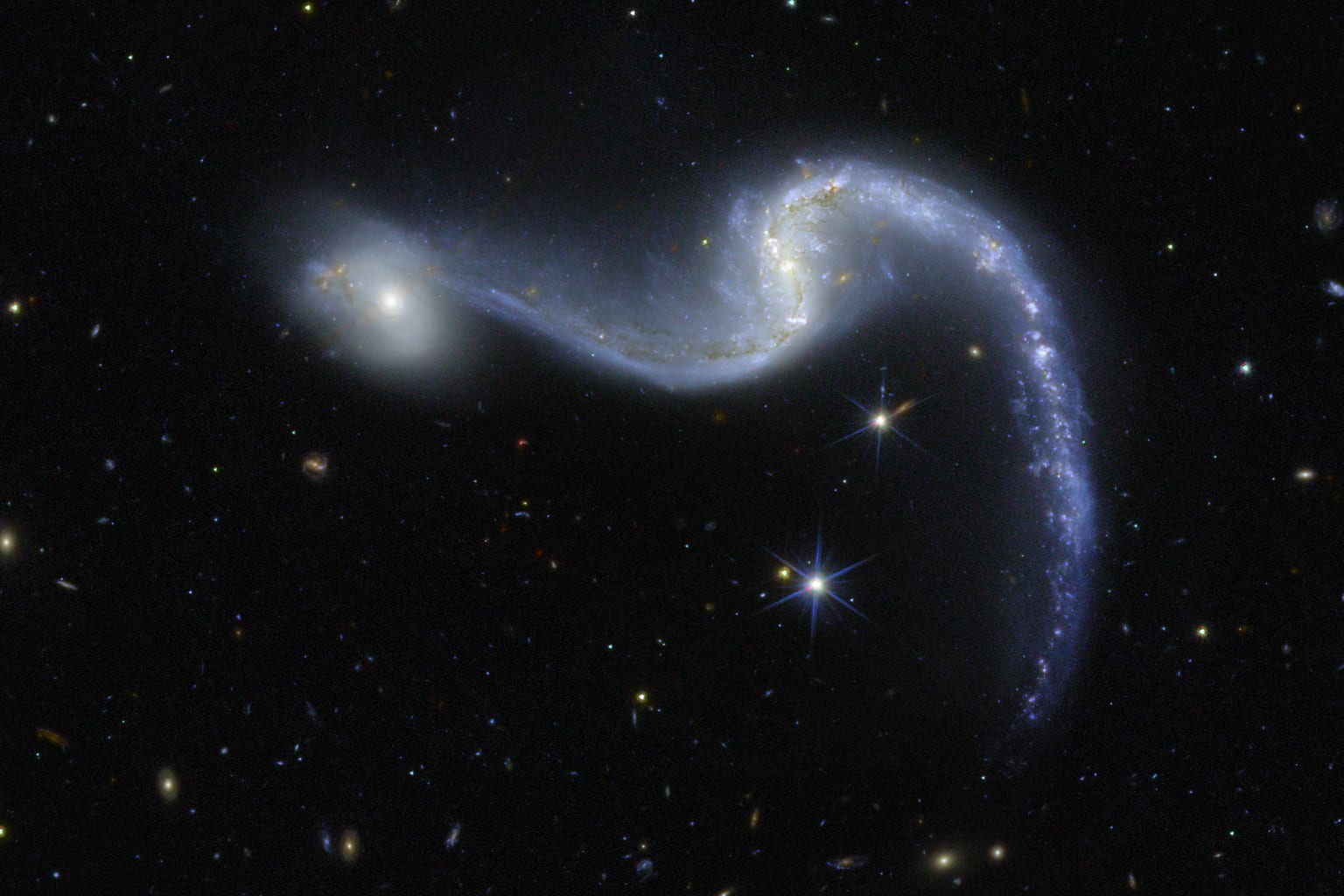
A space telescope launched in mid-2023 has just delivered its first big harvest. The European Space Agency’s Euclid has published a catalog of more than a billion cosmic objects, across a patch of sky as large as 9,500 full Moons. Inside are over 900 million galaxies, around 15,000 strong gravitational lensing candidates, and spectra from more than 160 million sources.
Until now, Euclid’s public releases were small. Earlier ones covered a few days of observations over about 60 square degrees, project scientist Valeria Pettorino said. This one holds more than a year of data over the Wide Survey’s 1,900 square degrees, or 1.7 million gigabytes. Above the blurring, dimming atmosphere, Euclid surveys deeply and widely in ways ground telescopes cannot, which pushes detection limits for rare, distant objects. Strong lenses form when a foreground galaxy bends the light of a more distant one. They are extremely rare, and this release contains the largest catalog of them ever, bigger than all earlier catalogs combined. Natalie Lines of the University of Portsmouth says the technique lets astronomers “weigh” individual galaxies, dark matter included, and study how the universe expands.
The 3D map itself rests on spectroscopy, which splits a galaxy’s light into a “rainbow” whose pattern reveals its distance. With distances in hand, astronomers can place galaxies within the cosmic web. Lens counts depend on the selection. The Q1 quick release catalog listed 497 lenses over 63 square degrees, and its authors estimate their search method would yield about 7,000 high-confidence ones across DR1. This release’s 15,000 figure counts candidates, not only high-confidence cases. Against the roughly 500 candidates reported in March 2025, the jump in scale is clear.
For cosmologists, the gain is raw material before conclusions. ESA says the complete DR1 follows in mid-2027, with weak-lensing measurements and calculations of how galaxies and clusters fit the cosmic web, though its timeline calls those dates tentative. TechTimes notes that no official cosmological results will come before that second stage. Meanwhile, Barbara Sartoris’s team at the JL Lagrange laboratory in Nice will study in the coming months how ancient galaxy clusters grew, samples of them previously out of reach. ESA’s director of science, Carole Mundell, called the release “far more than beautiful pictures.”
The release covers only about 14% of the sky Euclid will survey. The Q1 paper puts the full survey at approximately 14,000 square degrees and more than 1.5 billion galaxies. A Caltech page notes that the DR1 footprint overlaps with the High Latitude Survey of NASA’s Roman telescope. Pettorino says the dataset has enough statistics to uncover even rare objects, and that “so much discovery is yet to come.”
Sources — read the originals(Paris time)
Pages consulted while writing
Read next
Comments
Loading the thread…
Sign in to leave a comment. Sign in