Okinawa method builds 3D-printed Möbius bands from simple shapes
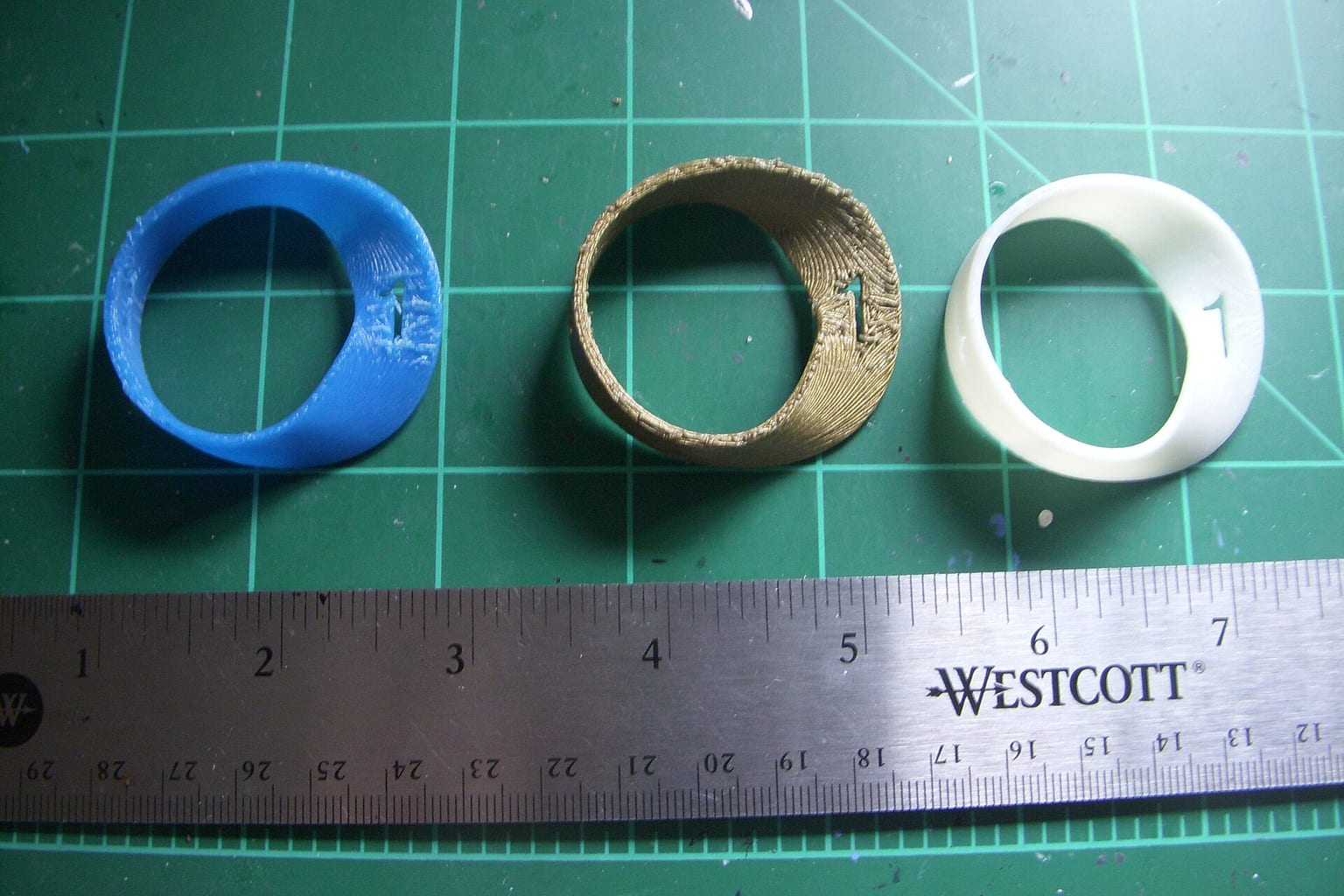
Bend a sheet of metal and you get a ship's hull or a concert hall roof. Describing the curves that result is another matter. Researchers at the Okinawa Institute of Science and Technology (OIST) have found a way to start from the opposite end: they take a simple, flat-sided 3D shape and let its corners generate the curve. The result is a new family of paths they call ortho-arc curves (OACs), which can be closed into looping bands, including twisted Möbius bands with one continuous surface.
Usually, designers work backward: they study the shape first, then choose mathematical descriptors that approximate it. The OIST team reverses this. A polyhedron sits inside a curved support surface, and the researchers join its corners with smooth curves made of circular arcs, placed at right angles to that surface. Not every polyhedron works. Some produce loops that do not close in a single plane, because the path rotates. Adjusting the dimensions of the starting shape changes the angle where the path meets itself, so that a flat, smoothly curving loop can join cleanly. One 3D-printed structure has a path that loops five times.
The team, led by first author Vishesh Bhat with design engineer Michael Grunwald and professor Eliot Fried, fabricated many shapes. They include a 5π-twisted Möbius band, a trefoil knot tube with a circular cross-section, and tables whose legs are wrapped by a Möbius band with three half-twists. The two tables are chiral, meaning they are mirror images that cannot be superimposed. Bhat also points to a Mario Kart racetrack as a popular example of a Möbius structure. The idea of building smooth freeform shapes from circular arcs has precedent: an earlier ACM paper by Pengbo Bo, Helmut Pottmann and colleagues proposed “circular arc structures” to realize freeform designs without losing a smooth look.
For designers and developers, the gain is a way to define such shapes mathematically, with controllable symmetry, chirality or topology. Bhat says these shapes were previously very difficult to visualize and program. Fried sees a longer reach. The three-dimensional structure of a molecule helps determine its properties and biological activity, so a framework for designing molecules with specified chirality and symmetry could help in developing medicines, agrochemicals and functional materials. The team gives no timeline for either use, and it reports no molecular result.
For now, the results are the team's own, and no independent test of the method has been reported. OIST's publications page still lists the paper as “in press,” while the journal citation carries a DOI. The next step is the presentation at SIGGRAPH ASIA 2026 in Kuala Lumpur, Malaysia, from December 1 to 4, a computer graphics conference frequented by major video game developers and animation studios.
Sources — read the originals(Paris time)
Pages consulted while writing
Read next
Comments
Loading the thread…
Sign in to leave a comment. Sign in