One gene fix restores neuron signaling in ALS
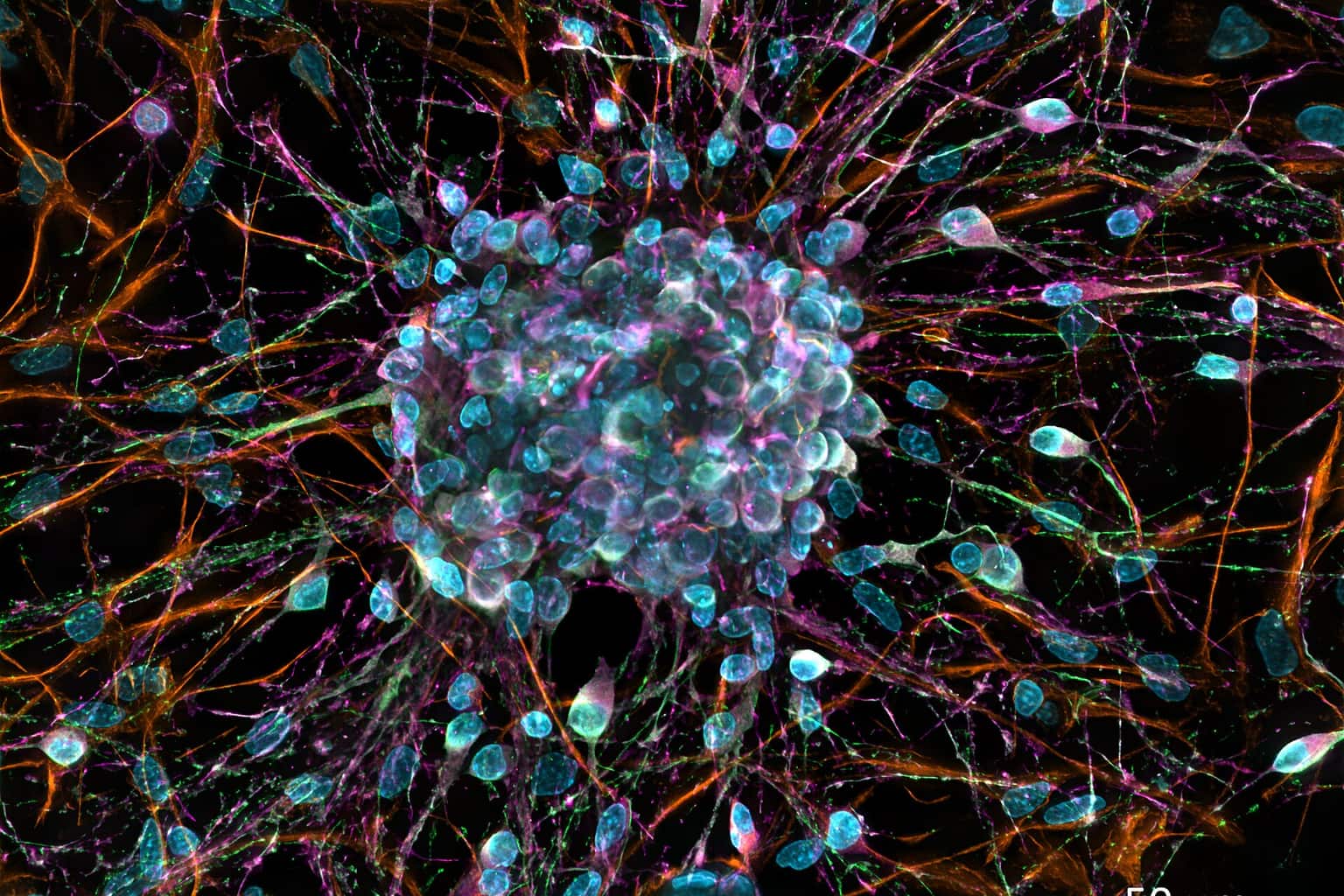
A single error in how one gene is read was enough to drastically reduce the signals between neurons. Fixing that error brought them back. In a study published in Nature, researchers from King's College London, University College London (UCL), the Francis Crick Institute, Leibniz-FMP and Trace Neuroscience used a drug to correct it in human neurons in the lab, and communication between the cells resumed.
Motor neuron disease, known as MND or ALS (amyotrophic lateral sclerosis), destroys motor neurons in the brain and spinal cord, and patients gradually lose the ability to move, speak, swallow and breathe. For the 97% of cases outside two rare genetic forms, no significant disease-modifying treatment exists. What these cases share is a protein called TDP-43, which normally acts as a proofreader for genetic material. When it fails, faulty proteins follow, and one of them is UNC13A, the protein neurons use to send signals. Common genetic variants in UNC13A are already among the strongest known risk factors for MND.
The team's answer was to target that production error directly, with an antisense oligonucleotide (ASO), a drug designed to act on a specific piece of genetic material. Once the error was corrected, functional UNC13A protein was restored and the neurons talked to each other again. “We were surprised to see that restoring just one genetic event, out of the hundreds disrupted, was enough to allow neurons to talk to each other again,” said Juan Burrone, professor at King's College London. Pietro Fratta, professor at UCL and group leader at the Francis Crick Institute, described UNC13A as “the main driver of synaptic release deficits” when TDP-43 fails.
The scope of the result needs to be stated plainly. The Nature paper reports that losing TDP-43 causes “a drastic loss of spontaneous and evoked synaptic transmission”, and that ASOs correct UNC13A splicing in human cortical and spinal motor neurons. An earlier preprint from 2024, with the same title, reported that one ASO, M21-4, restored UNC13A protein to ~30% of normal levels. Restoring the protein is not the same as restoring every signal, and the researchers acknowledged, according to a specialist news report, that correcting UNC13A did not reverse every abnormality tied to TDP-43 loss. A commentary in Nature also argues that combining such ASOs, including one that targets STMN2, makes sense.
For patients, the nearest step is clinical. TRCN-1023, a drug from Trace Neuroscience aimed at the same UNC13A mechanism, is in its Phase I/II FUNCTION ALS trial, with the first UK participants dosed. Nonclinical studies supporting the drug describe it as a potent, dose-dependent splice modulator that restores correctly spliced UNC13A and reduces cryptic-exon transcripts. For the 97% of people with MND who have no disease-modifying option, the approach could matter, because the faulty step it corrects is the one that the cases share. Whether the restoration seen in lab models holds in people is what that trial now tests, and it remains an early-stage study.
Sources — read the originals(Paris time)
Pages consulted while writing
Read next
Comments
Loading the thread…
Sign in to leave a comment. Sign in