Physicists measure record-low gravity between two tiny specks
Between two objects weighing a few milligrams, gravity becomes so faint that it is hard to pick out from the vibrations and stray forces of a laboratory. Every object with mass pulls on every other, but that pull falls away fast as objects shrink. A team of physicists led by Shan-Qing Yang at Sun Yat-sen University, in China, has now measured the pull between two silicon wafers of 7.6 milligrams each, and reported a force of 471 attonewtons, a record low for measurements of this kind.
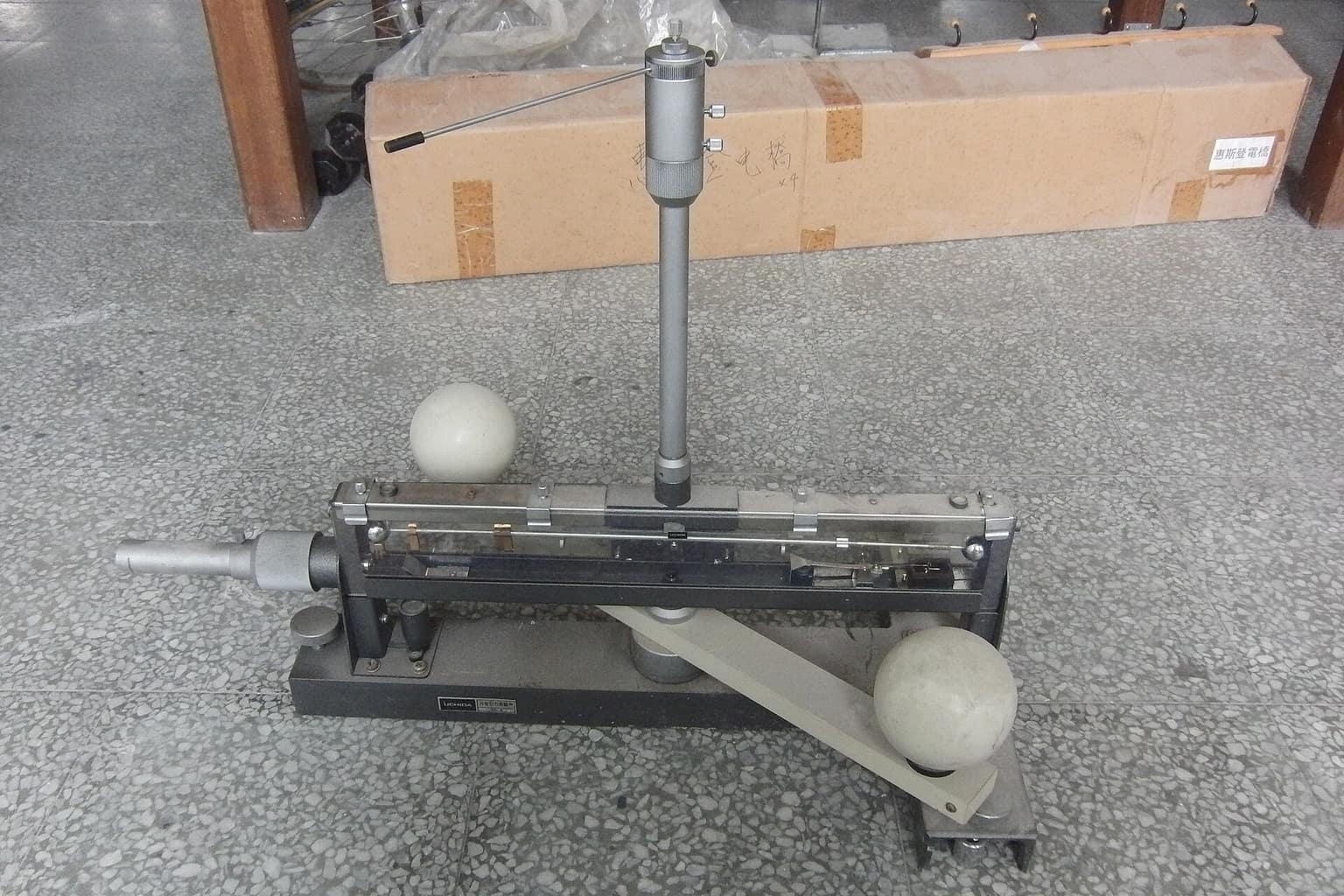
The method is an adaptation of an old one. In the classic Cavendish experiment, lead weights sit at the ends of a rod hung from a thin wire, and large lead balls placed nearby twist the rod; the amount of twist gives the force. In 2021, researchers used gold spheres of about 92 milligrams. Yang's team built a miniature version: a 7.6-milligram silicon wafer hangs from a rod balanced by a counterweight, while a rotating disc carrying 16 identical silicon wafers passes over it. That motion creates a repeating gravitational field, and because the disc turns only once every 10 minutes, the team could separate this signal from background noise. The apparatus sits in a vacuum chamber, a thin gold-coated silicon membrane reduces stray electrostatic effects, and electronic feedback holds the balance almost still while the force needed to counteract the pull is measured.
At the closest spacing, 0.654 mm, the force measured 471 attonewtons, or 0.000000000000000471 newtons. That is around 20 billion times less than the weight of a 1-milligram grain of sand on Earth. Measurements between 0.654 mm and 1.554 mm all matched Newtonian expectations, and the gravitational constant the team derived from them, 6.67 × 10⁻¹¹ m³ kg⁻¹ s⁻², lies within 5.3% of the accepted value. The paper appeared in Nature Communications on October 7, 2026. The margin of error on the force is given as ±23 attonewtons in the journal's abstract and as ±11 attonewtons in another version of the paper.
For now the gain is a check rather than a new discovery: Newton's description of gravity holds at masses of a few milligrams, and the result does not show that gravity is quantum. Physicists still lack a theory that unifies general relativity with quantum mechanics, and gravity between very light objects is one place where new effects might show up. The next step the team names is measuring gravity between objects in quantum states, which requires vibration, electrostatic and magnetic effects to stop dominating the signal. To get there, the researchers are exploring more sensitive torsion balances and optical or magnetic trapping of small objects. If those improvements work, the experiments could test whether gravity has quantum properties.
Sources — read the originals(Paris time)
Pages consulted while writing
Read next
Comments
Loading the thread…
Sign in to leave a comment. Sign in