In the lab, a sensor now catches single gas collisions
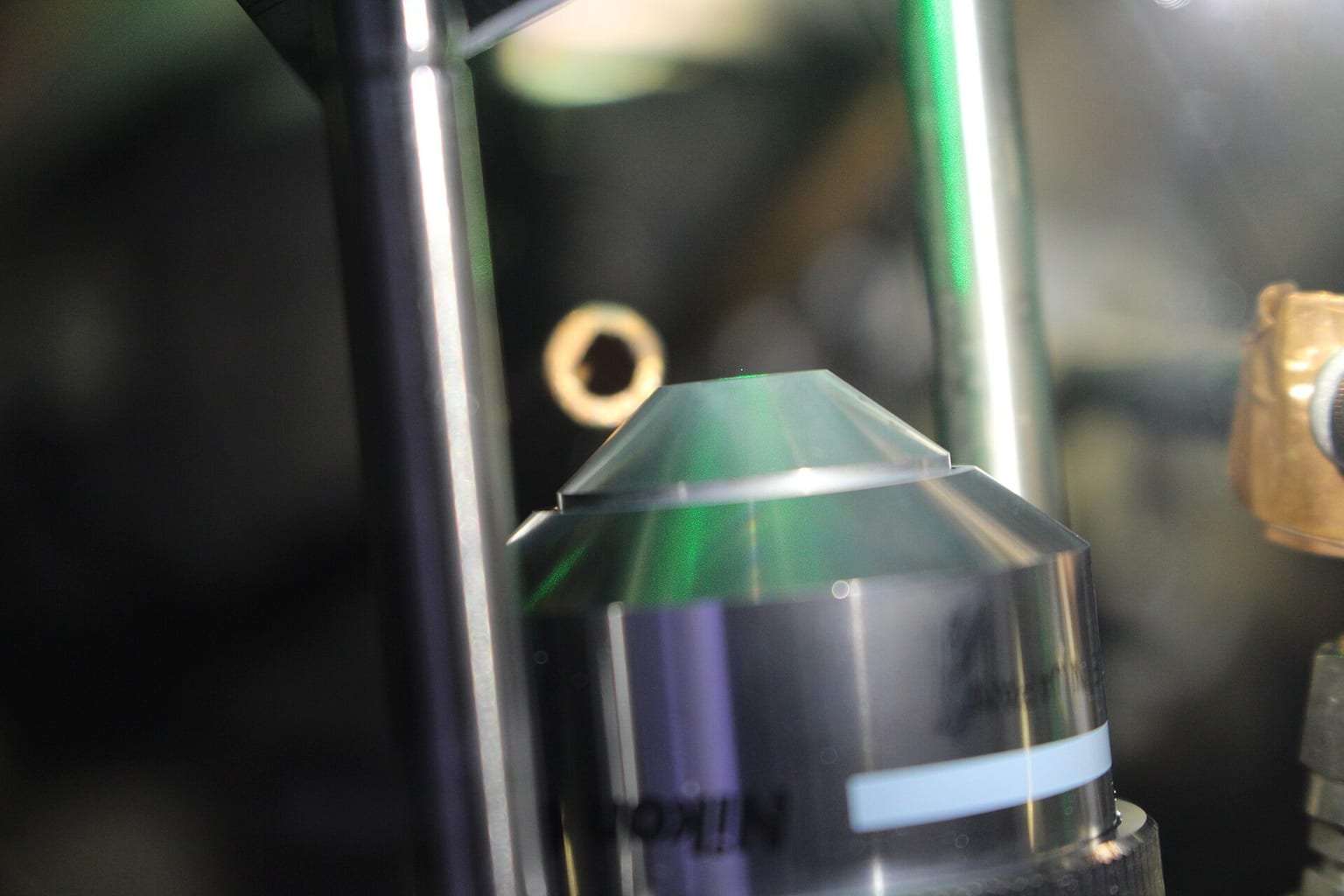
In a vacuum chamber, a sphere of silica no wider than a few hundred molecules hangs in a beam of laser light, and every gas molecule that touches it leaves a trace. That trace is what a team led by Yu-Han Tseng has now measured. Their study, published in Physical Review Letters in 2026, reports the momentum transfer of individual collisions between gas particles and a nanoparticle levitated by light, a measurement that until now was lost in the noise.
The idea has a long history. In 1827, Robert Brown saw pollen grains jiggle in water under a microscope, and Einstein later explained that this random motion came from countless impacts by fast-moving molecules in the fluid. Those impacts are normally too small and too frequent to tell apart. Researchers realised later that a particle held in laser light, with no supporting surface touching it, offered a cleaner way to listen to them. The team built on that approach, isolating a silica sphere about 100 nanometers in diameter and introducing three heavy gases one at a time: krypton, xenon and sulfur hexafluoride. They followed the sphere's motion through the light it scattered and checked the sensor against expected values, background recordings and theoretical predictions.
The result is that the kicks from krypton atoms, xenon atoms and sulfur hexafluoride molecules could be detected even though these gas particles are roughly 10 million times lighter than the silica. The measured spread of momentum transfers agreed well with gas theory. Pressures estimated from the collisions matched a conventional vacuum gauge within uncertainties, which the authors present as a proof of principle for pressure sensing. The experiment also suggested that the sphere's surface stayed near room temperature, although the researchers set upper limits on the temperature rather than a precise value.
The limits are real. Noise hid some of the smallest impacts, so lighter gases and weaker kicks were not resolved and not every collision was seen. The authors argue that better motion measurements could reveal them, along with lower pressures. For metrology laboratories, the practical promise is a pressure standard built from counting collisions rather than from a calibrated gauge, for exceptionally clean vacuum systems. For quantum experiments, the same sensitivity could help filter out environmental disturbances that destroy fragile quantum states, and the authors also mention dark-matter and other particle searches as possible uses. None of these applications has been built, and the article gives no timetable for any of them. The study is a laboratory demonstration, and its next step is a more sensitive sensor that can see the lighter gases it currently misses.
Comments
Loading the thread…
Sign in to leave a comment. Sign in