Quantum computing with light: one photon flips a switch
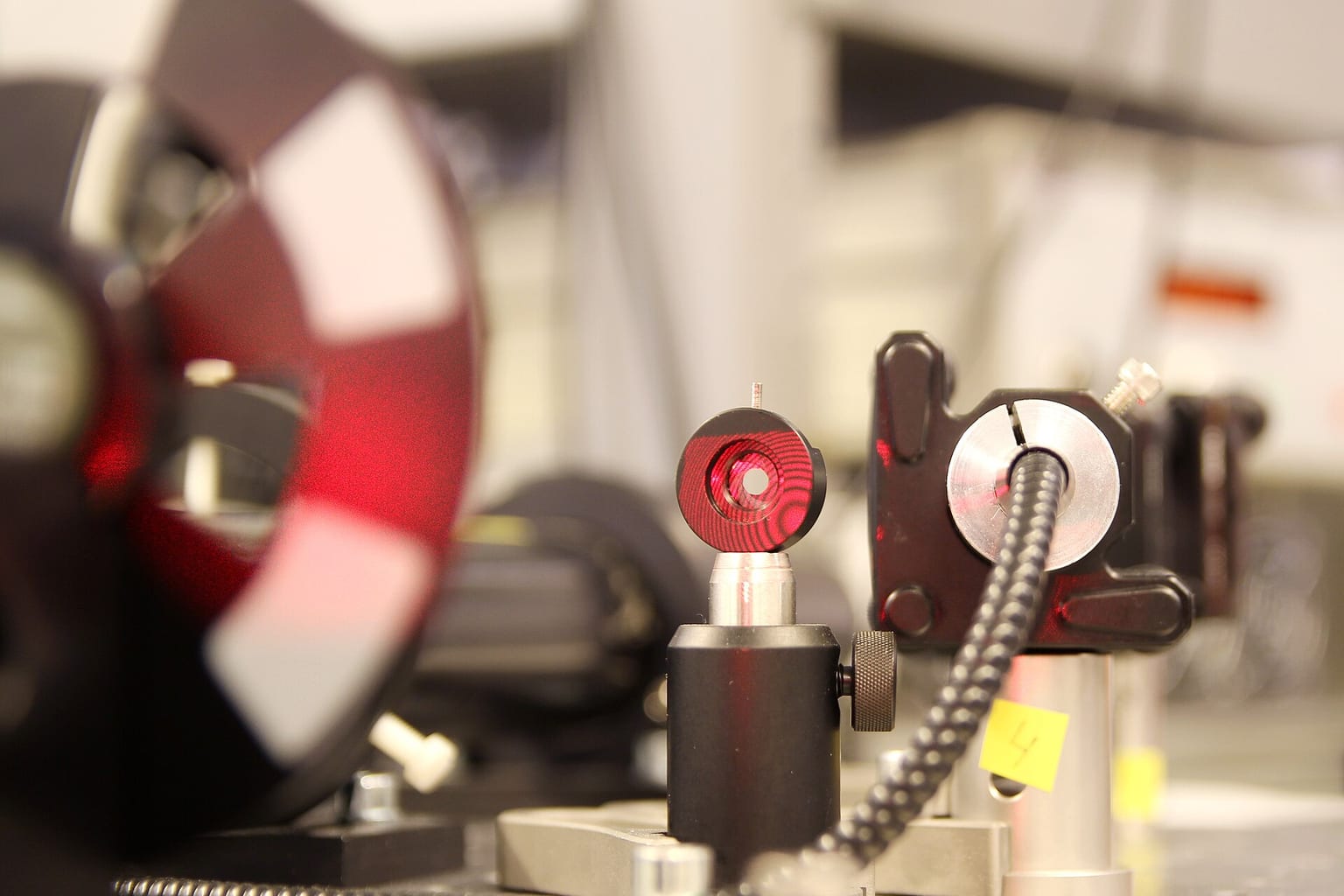
In a lab at Purdue University, the group led by Vladimir Shalaev and Alexandra Boltasseva has shown that a single photon, one particle of light, can switch a beam on and off on a chip. It is one of several steps they report toward quantum computers whose basic units would be photons.
The basic unit of a quantum computer is the qubit. Where an ordinary bit holds a zero or a one, a qubit can hold both at once through a phenomenon called superposition, which greatly expands the amount of information processed. Photons have two advantages over other candidates: they move through a circuit at the speed of light, and heat or changes in their surroundings barely disturb them, so they can keep qubits stable at room temperature. Other qubit types need supercold temperatures and consume more energy. The catch is scale. Useful calculations would require hundreds if not thousands of qubits, and these chips cannot yet reach that number.
The first obstacle is making photons one at a time. The process the industry has used, called spontaneous parametric down-conversion, generates single photons inconsistently and with low efficiency. In 2021, the team had shown a way to emit single photons from silicon nitride, the industry standard material for these platforms. Their new method emits exactly one photon at room temperature from dozens of locations on a silicon nitride platform each time a laser beam passes through it. The emitters are atomic defects, deliberate imperfections in the material's atomic structure. In a 2022 conference presentation, the researchers showed they can place these defects inside nanosized pillars, which would make the platform easier to manufacture uniformly.
The second obstacle is control. Single photons barely interact with each other, which makes them hard to steer with switches. In a paper in Nature Nanotechnology, the team reports a proof-of-concept switch that works at the level of a single photon. It borrows a mechanism the industry already uses in fiber-optic communications, where a strong light beam modulates a weaker one, but scaled down to one photon. A lone photon from the control beam hits silicon and frees an electron, which triggers an avalanche of electrons. The avalanche changes the silicon's refractive index, the property that governs how light propagates, so the probe beam passes only when a single photon starts the avalanche. The device works at room temperature and, according to the Quantum Insider, which calls it a photonic transistor, is compatible with CMOS, the process used to make most chips today.
What changes, and for whom? For now, the gains are for researchers: a more reliable source of photons and a switch that acts on light alone. Quantum computers built on photons could be faster and more energy-efficient than supercomputers, which is the premise behind the work. But these are laboratory demonstrations, and the announcement gives no timetable for chips at the scale of hundreds of qubits. The open problem is now scale: how many of these sources and switches can be built reliably on a single chip.
Sources — read the originals(Paris time)
Pages consulted while writing
Read next
Comments
Loading the thread…
Sign in to leave a comment. Sign in