Quantum data teleported across a chip in lab tests, even on weak links
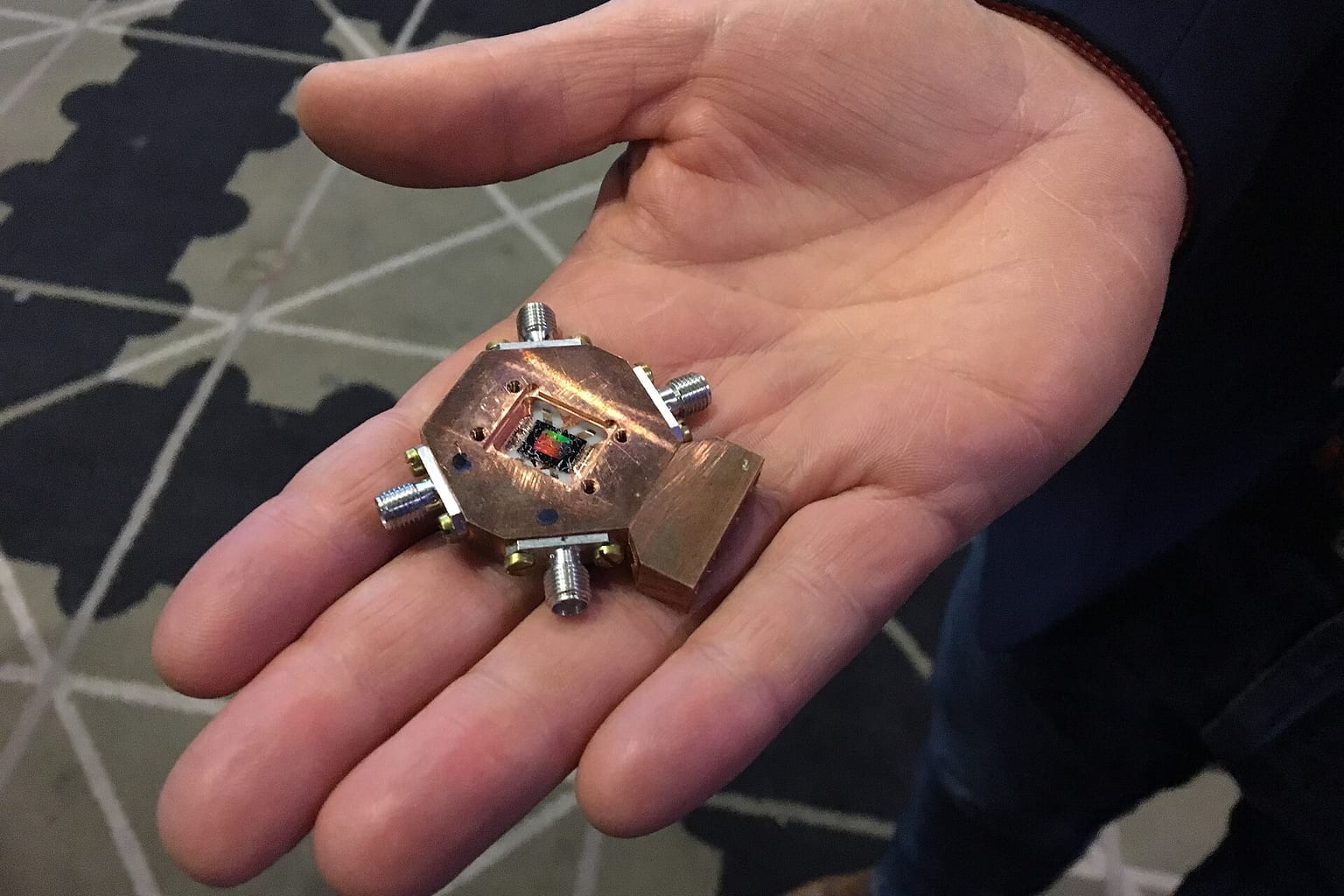
On a 125-qubit superconducting chip, the team set aside 98 qubits and split them into two groups of 49, called Alice and Bob. Alice was prepared in a logical zero, a protected encoded state. Bob started in a simple state with no link to anything else. The experiment asked whether Alice's encoded state could be transferred into Bob's group without being lost along the way.
Quantum teleportation, which transfers the state of one quantum system to another, has been demonstrated in a range of systems over several decades. What makes it harder here is the encoding. A logical qubit spreads its information across many physical qubits so that errors can be caught. The surface code used in this experiment is one such scheme: with a distance of seven, an undetected error that changes the encoded information must affect at least seven physical qubits. Moving that protected state, rather than a single qubit, risks losing the protection on the way.
The two groups were woven together, so that a qubit in one could interact with nearby qubits in the other. The researchers tuned the strength of these links, from nearly ideal to effectively broken, and read out every physical qubit. A decoding algorithm then identified the logical state that Bob's measurements most likely represented. At the strongest setting, the decoded logical error rate after transfer was about 2.5%. The team also moved other logical states, including an H-type magic state, the non-Clifford resource that universal quantum computation needs.
The most telling result is a transition. Above a critical link strength, larger codes protect the information better. Below it, increasing the code distance makes the transfer worse. The measured critical point matched the value predicted by theory, the Nishimori point. To test a way of raising that limit, the team changed the type of error they introduced, balancing bit-flip errors, which misread a 0 as a 1, with phase-flip errors. Rotating that balance raised the threshold from 0.122π to 0.175π, a measure of how weak a link the transfer can tolerate. The approach follows a 2024 theoretical prediction by Guo-Yi Zhu and his colleagues.
For quantum computer builders, the gain is a tolerance: encoded information can be transferred even when the entangling link is much weaker than the ideal. The demonstration stays on one chip, and the error rate is still a few percent at the strongest setting. What the work changes is the design margin for moving protected information inside a machine, a lab step that the team presents as a route to more tolerant quantum hardware.
Sources — read the originals(Paris time)
Read next
Comments
Loading the thread…
Sign in to leave a comment. Sign in