Radio waves drive a current in a fusion experiment
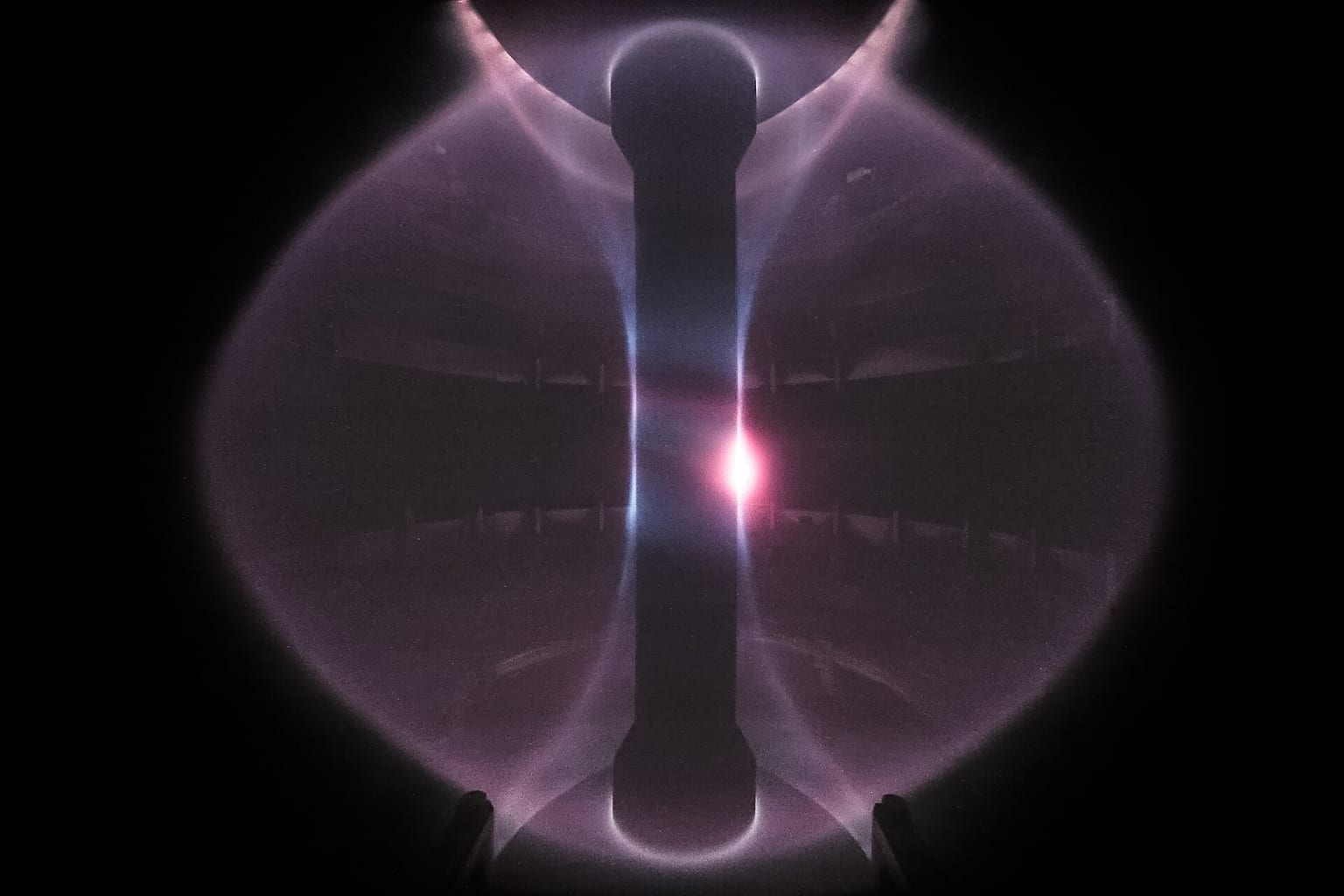
Inside a tokamak, the plasma keeps flowing only as long as the central solenoid can keep changing its magnetic field. Once that field has swept through its full range, the current stops, the plasma is shut down, and the solenoid is reset before the next pulse. At DIII-D, the research tokamak run by General Atomics in San Diego, pulses last about 10 seconds. The much larger ITER reactor, under construction in France, is expected to be limited to less than about 1,000 seconds in nominal operation.
A team led by Jeff Lestz at General Atomics has now shown a way to drive that current without relying on the solenoid. The method uses helicon waves, a type of radio wave that is absorbed less readily by electrons and can therefore penetrate deeper into a hot plasma. They are launched by a comb-line antenna, a row of radiating elements placed along the donut's circumference. Each element oscillates slightly later than its neighbour, which creates a rippling pattern that sends the waves preferentially in one direction around the torus. Electrons travelling at about the same speed as the waves can then ride along them, sustaining the current.
The experiment, published in Physical Review Letters, used a megawatt-level helicon system. The waves deposited their energy in the plasma's core, and the structure of the magnetic field changed noticeably faster than in comparable experiments where the helicons were replaced by a similar amount of microwave heating, a clear sign that extra current was being driven. Pinsker, who has studied tokamak fusion since the 1980s, calls it the first clear success in attempts dating back to the mid-1980s. The team also describes a first for the antenna itself: a very clear electron heating observed with the comb-line structure as the wave launcher.
For future reactors, the change would be practical. A plasma that does not depend on the solenoid for its current would not need to be shut down each time that solenoid runs out of flux swing, and the approach is meant for the larger, hotter plasmas where older radio-wave methods would be absorbed too close to the edge. The sources do not give the amount of current driven, nor a calendar for applying the method to a reactor, and the results come from a single research device. What they do establish is that the principle works where it was expected to work.
Pinsker expects the result to encourage other teams to use similar wave launchers, which is the next step the sources describe.
Sources — read the originals(Paris time)
Read next
Comments
Loading the thread…
Sign in to leave a comment. Sign in