Robots that sort and pack apples are being tested to run 20 hours a day, unmanned, in Andong
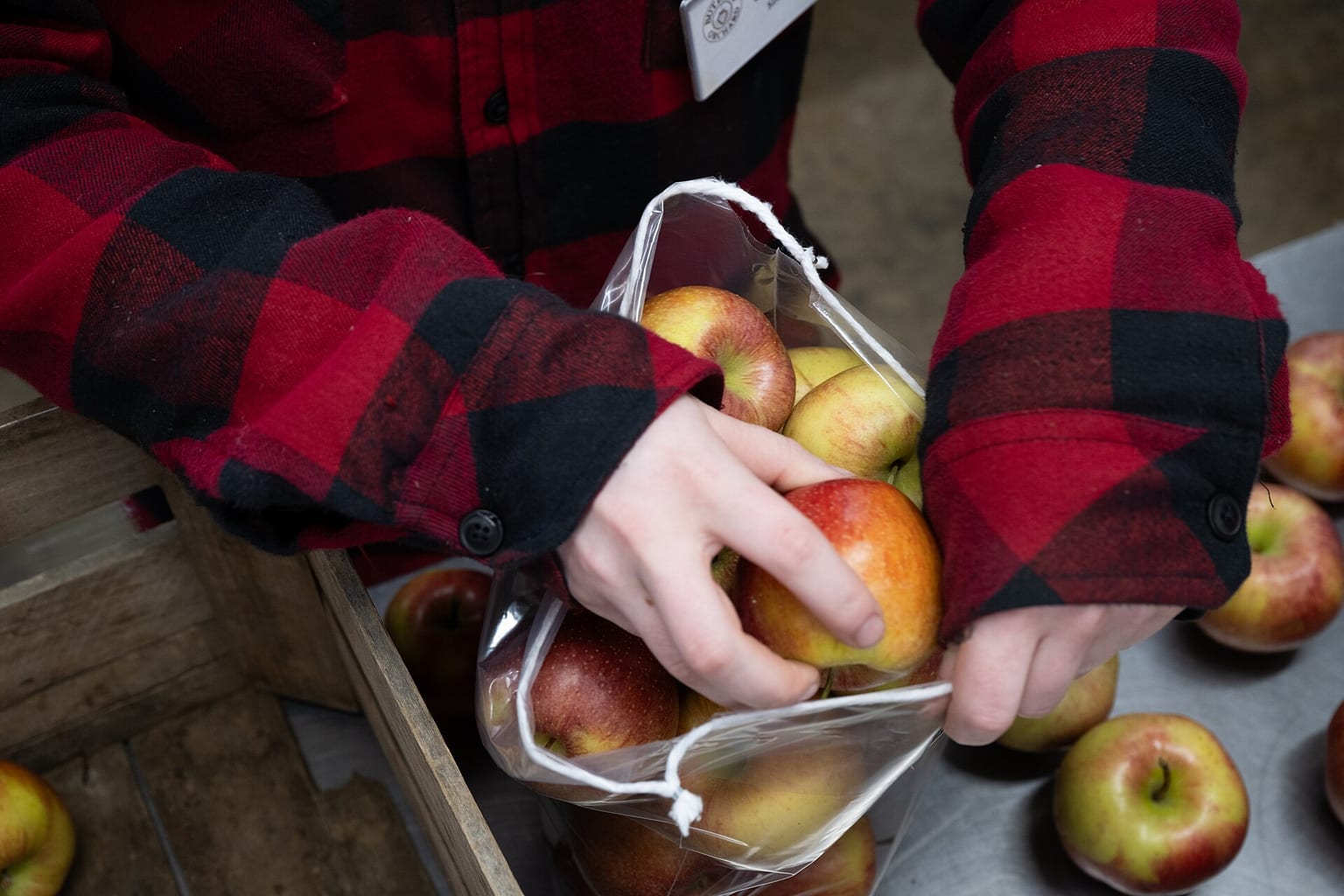
An apple spins on rollers. Two cameras take up to nine photos of each fruit while artificial intelligence (AI) reads its color, shape and any bruises, then diverts each apple to a different line according to its quality grade. This is the sorting line at the Agricultural Product Distribution Demonstration Center of the Korea Institute of Robot and Convergence in Andong, North Gyeongsang Province, visited on the 13th. It is an experiment in which machines take over tasks that were once done by hand.
Agricultural produce distribution centers (APCs), facilities that sort and pack harvested farm produce for shipment, generally handle one crop. After harvest season ends, equipment costing 1 billion to 2 billion won can sit idle. The center has designed its sorters and robots to be shared by several crops. It handles four products (apples, pears, peaches and oriental melons), and although the initial intake process differs, the main sorting and packing equipment is shared. On the packing line, the robotic gripper uses cameras to locate empty space in a box, and AI calculates where each item should go, changing the sequence to match the state of the box instead of repeating fixed motions. Unmanned forklifts that enter the cold storage reduce driving error to less than 5 cm using position-estimation technology.
The numbers must be read with their limits. The apple-sorting AI is 94.69% accurate. The recognition model can read up to 32 apple images per second, but the actual sorting equipment processes only about three apples per second. The researchers are demonstrating unmanned operation in which the line runs 20 hours a day, with the remaining 4 hours used for maintenance. Compared with existing APCs that operate 4 to 8 hours a day, this would greatly expand operating hours, the researchers calculate. The center also has a circulation system that collects used pallets and plastic crates and feeds them back into the line.
The effects are the researchers' estimates. An existing apple-sorting line needs at least 12 workers (seven for sorting, four for packing and one for management), but the researchers calculate that automation would allow it to run with one manager. Based on this, labor demand is estimated to fall by 91%, operating costs by 59.2% and distribution transaction costs by 21.3%. Daily apple throughput is calculated at 50 to 70 tons. Commercialization is designed as a modular system that adds only the equipment needed to existing APCs, and some participating companies have already begun selling equipment.
The project's timeline and budget are also worth noting. The research, launched in 2022 by the Ministry of Agriculture, Food and Rural Affairs (MAFRA) and set to end at the end of this year, received 22.8 billion won in government funding, for a total of about 33.3 billion won, the Electronic Times reported. MAFRA is considering linking the results to its smart APC support program. Seo Gap-ho, vice president of the Korea Institute of Robot and Convergence, said, “We took on the challenge of building a system capable of 24-hour unmanned operation, beyond the scope required in the original project.”
The next step is quality control. MAFRA plans a follow-up study that would convert produce quality into digital data, predicting how quality changes during distribution and when to ship.
Sources — read the originals(Paris time)
Pages consulted while writing
Read next
- X Square Robot's dual-arm gripper robot sorts 1,816 packages in a one-hour livestream; public information says costs cut 70%
- ASUS humanoid robot packs motherboard parts in a factory test
- Xiaomi humanoid robot works 8-hour shift on car factory line
- Hyundai Mobis showcases around 40 smart manufacturing technologies
Comments
Loading the thread…
Sign in to leave a comment. Sign in