Rocks blasted off Mars could stay on Phobos, lab tests show
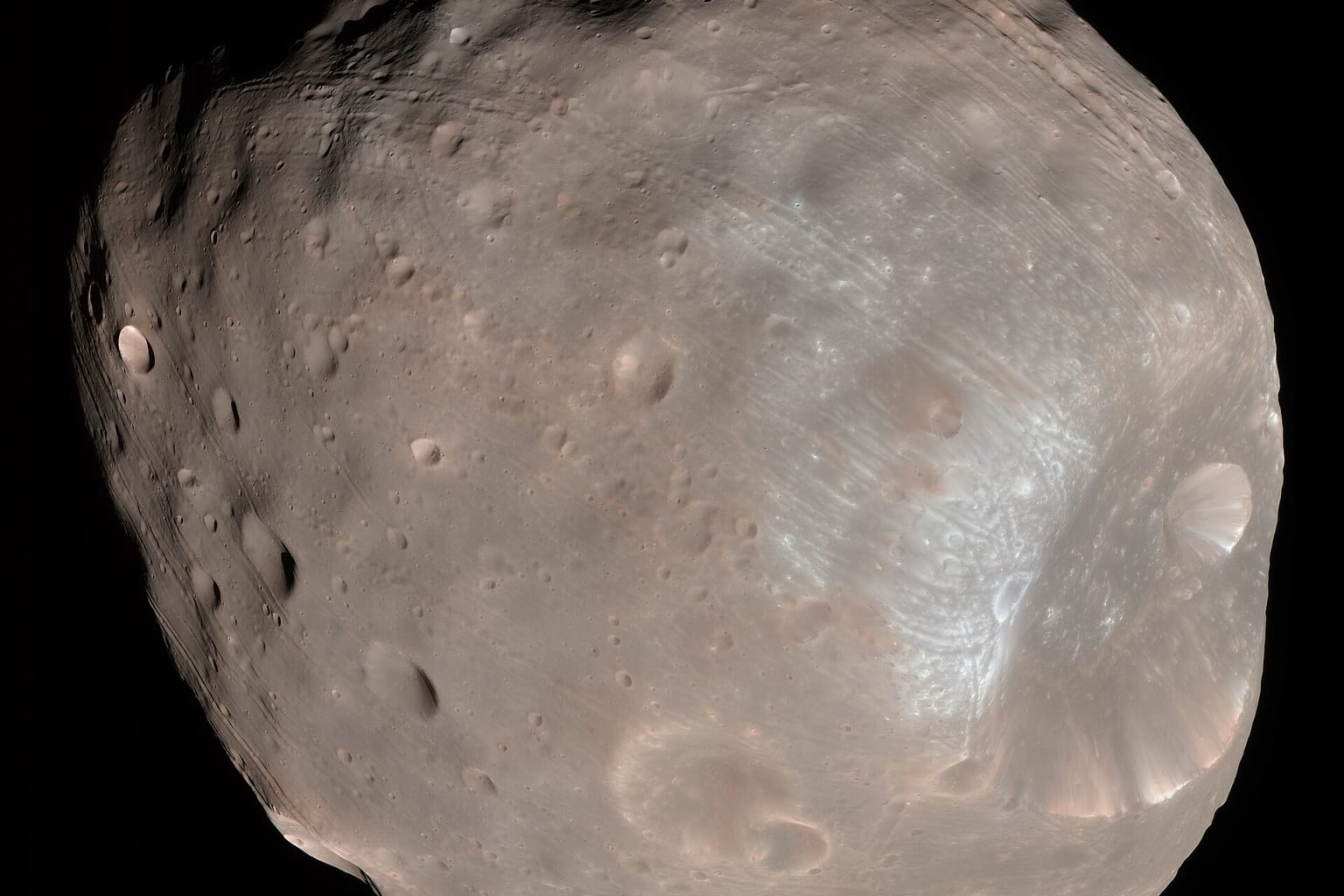
Two small moons circle Mars, and nobody has settled where they came from. Japan's Martian Moons Exploration mission, MMX, lifted off on Oct. 19 atop an H3 rocket from the Tanegashima Space Center in southern Japan, bound for Phobos, the larger of the two. Its aim is to collect soil from the moon and return it to Earth. The first signal confirming that the spacecraft was communicating normally has since reached ground controllers.
The soil matters because of an old puzzle. Either Mars captured two separate asteroids, or the moons formed from debris thrown into orbit when a large object struck the planet. Capturing two asteroids would be hard to explain, and the impact idea leaves open whether the moons' composition matches what such an impact would produce. Observations from the Soviet Union's Phobos 2 spacecraft in 1989, and from NASA's Infrared Telescope Facility in the 2010s, showed that Phobos reflects light like dark, primitive asteroids called D-types, which are thought to have formed in the outer solar system.
Chrysa Avdellidou, a researcher selected as a participating scientist in MMX in 2023, tackled the question in the lab. At the University of Kent, a light-gas gun fired projectiles at material designed to simulate Phobos's surface. The team fired six shots at speeds of 650 m/s to 1600 m/s and studied how crater formation depends on impact speed and object size. Rock ejected from Mars was retained in the simulated soil under the tested conditions, which the team says shows the process is feasible. The results match the natural process only under the conditions the experiment could reproduce, and the work has been submitted to the Monthly Notices of the Royal Astronomical Society (MNRAS).
A companion study, also submitted to MNRAS and still under revision, asks a harder question: could MMX's own instruments spot grains of Martian material in Phobos's surface layer before the probe collects anything? An analysis of MEGANE, one of MMX's instruments, estimates about 250 parts per million (ppm) of Martian material in the top 0.4 metres of the moon's surface, and finds that the amount MEGANE could measure is much smaller than the errors in its own calculation. The remote measurement is the weaker link.
If foreign material can be identified remotely, scientists can choose better soil samples and read them against a clearer record of Phobos's impact history. For the origin question, the two answers would leave different fingerprints: a captured asteroid would mean a primitive object from the outer solar system, while a giant impact could leave fragments of Mars and of the object that hit it. The samples MMX brings back would be the test. Before the probe touches down on Phobos to collect them, the next step is the companion check on whether its instruments can detect Martian grains.
Sources — read the originals(Paris time)
Pages consulted while writing
Read next
Comments
Loading the thread…
Sign in to leave a comment. Sign in