Japan's MMX probe launches to bring back samples from Phobos
Last August, from the edge of an ancient river delta on Mars, NASA’s Perseverance rover caught a small dark shape crossing the Sun. It was Phobos, one of the planet’s two moons, and it passed in front of the solar disk in less than a minute. On 20 October, Japan’s Martian Moons eXploration mission, MMX, lifted off from Tanegashima spaceport on the H3 rocket, after more than 10 years of work.
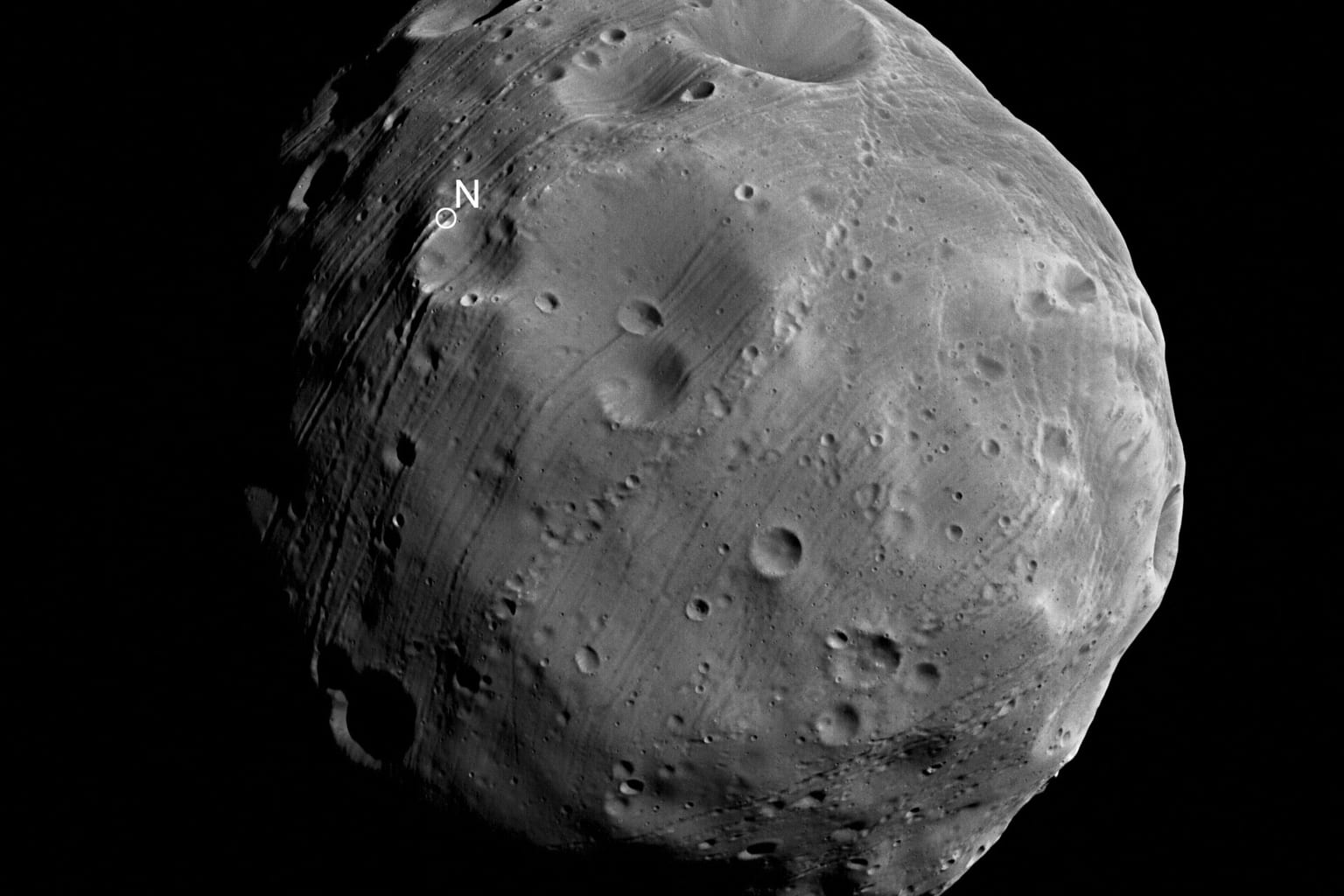
Phobos is a rubble pile: a loose mass of rock and dust shaped like a lumpy potato, about 27 kilometres long. Its gravity is only 1/1,800th of Earth’s, so a typical adult would weigh about as much as a tennis ball does here. Its origin is still open. One theory says it is an asteroid captured from the belt between Mars and Jupiter; another says a large body struck Mars and threw debris into orbit. The best orbital images so far resolve only a few metres per pixel, and closing that gap is what MMX has to do.
The mission is built from three modules. A propulsion module drives the spacecraft to Mars and brakes it into orbit. An exploration module carries the rover, the sampling gear and the instruments. A return module holds the capsule that will re-enter Earth’s atmosphere at high speed. Because Phobos is too small to orbit in the usual way, the spacecraft will follow an egg-shaped path that slings it ahead of and behind the moon. “When you’re closer to Mars, you’re accelerating with respect to Phobos, and when you’re farther from Mars, you’re decelerating,” says Nicola Baresi, an astrodynamicist who co-wrote a paper on these orbits.
The landing is the hardest part. “I often say that landing on Phobos is like trying to land a balloon,” says Yasuhiro Kawakatsu, MMX project manager at the Japan Aerospace Exploration Agency (JAXA). The rover, Idefix, is about the size of a microwave oven. It was developed by the French and German space agencies, CNES and DLR, in collaboration with JAXA. Mars periodically blocks communications with Earth, and the spacecraft must navigate complex orbits before touching down. Patrick Michel, research director at the French National Center for Scientific Research (CNRS) and co-principal investigator on Idefix, calls it “the most complex mission I have ever seen.”
The next milestone is the arrival at Mars in 2027, when the propulsion module will be jettisoned and the exploration and return modules will settle into orbit. The scientific payoff comes later: MMX is designed to deliver a 10-gram sample to Earth in the second half of 2031. The mission carries instruments from several space agencies, NASA among them, to study a moon whose makeup and history could tell us much about Mars and the wider solar system.
Sources — read the originals(Paris time)
Read next
Comments
Loading the thread…
Sign in to leave a comment. Sign in