Two probes just entered orbit around Mercury, after eight years
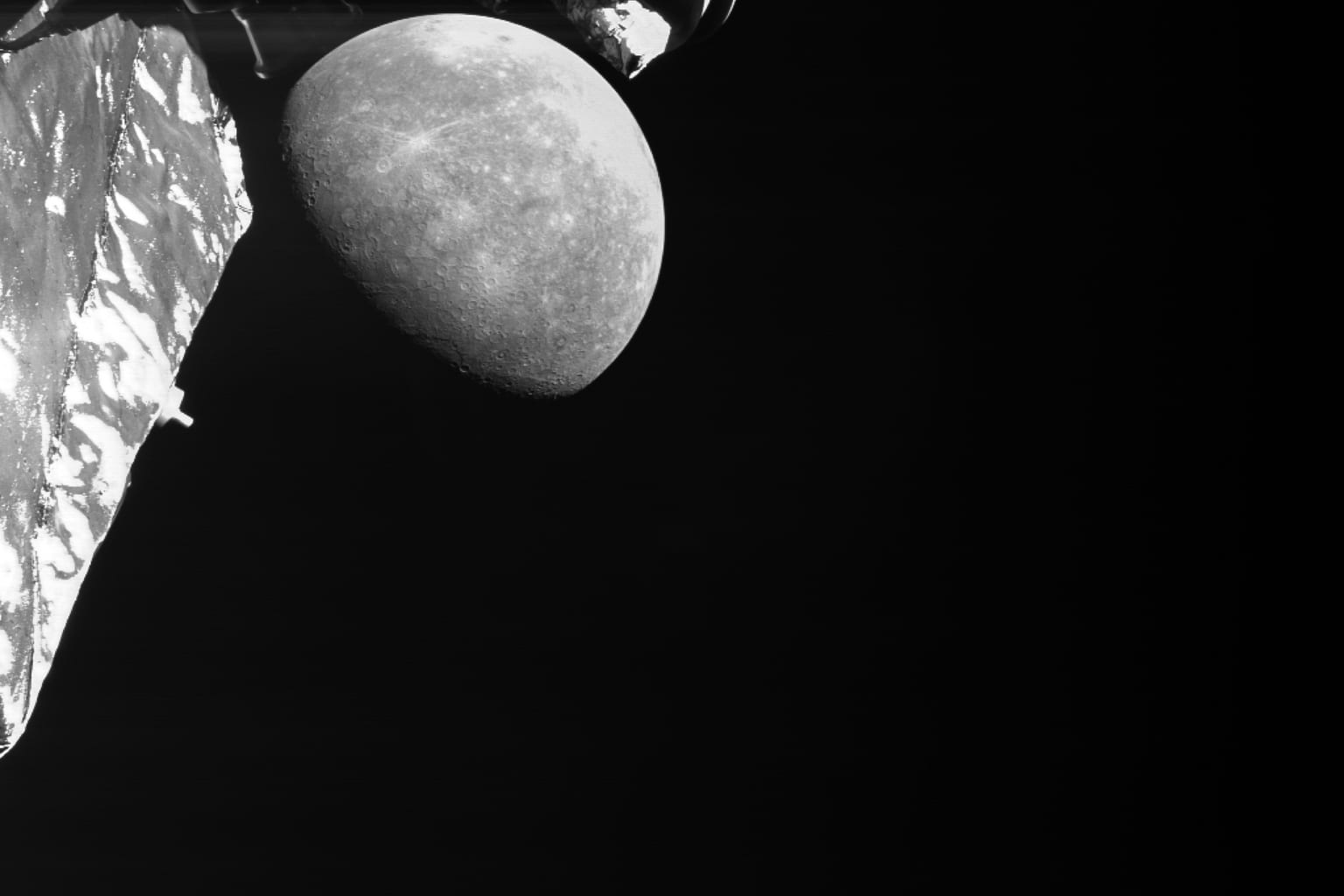
For eight years, BepiColombo was a trajectory on a flight plan, a long loop through the inner solar system. On Saturday 21 November, its two joined spacecraft fired thrusters that slowed them enough for Mercury's weak gravity to take hold. Then came the wait. Flight controllers in Germany, 152 million kilometres away, needed several anxious hours before they could confirm that the pair had reached orbit. The mission is a joint effort of the European Space Agency (ESA) and the Japan Aerospace Exploration Agency (JAXA). After eight years of travel, it is now the third spacecraft ever to visit Mercury, and the first in more than a decade.
The mission carries the name of Giuseppe "Bepi" Colombo, the late Italian mathematician whose work on the route let NASA's Mariner 10 fly past Mercury three times in the mid-1970s. Its aim is to do what no mission has done: study the planet from two altitudes at once. The ESA orbiter, called MPO, will fly between about 480 and 1,500 kilometres above the surface, circling every 2.3 hours with 11 instruments. The Japanese craft, Mio, is smaller. Its orbit swings out to about 11,640 kilometres and back down to about 590, with a lap every 9.3 hours and five instrument packages.
The two orbiters split the questions between them. MPO will study the surface and the planet's internal composition, while Mio will study the magnetosphere, the region of space around Mercury. The Planetary Society highlights two targets: water ice at the poles and an abnormally large core. The surface is pocked with impact craters, volcanic plains and ridges, and some peaks reach about 4.5 kilometres. Mercury is barely bigger than our Moon, yet it is one of the least explored planets in the solar system. Only Uranus and Neptune have had fewer visitors, and each of those got a single one, Voyager 2 in the 1980s.
Why so few? "Reaching Mercury is actually harder than reaching Pluto," ESA's Azul Pinochet-Barros has said. The Sun's enormous gravity makes it hard to place a spacecraft in a stable orbit around Mercury. Two spacecraft of this mass could not be sent there directly on a conventional launcher. BepiColombo lifted off from Kourou, in French Guiana, on 20 October 2018 aboard an Ariane 5 rocket, and the team solved the problem with a longer route.
That route used planets as brakes and slingshots. A gravity assist, or flyby, bends a probe's path as it passes a planet and changes its speed. BepiColombo flew once past Earth in April 2020, twice past Venus and six times past Mercury, adding up to about 10 billion kilometres on the odometer. Its first Mercury flyby came on 1 October 2021. The electric engines that drove the cruise were switched off on 15 June 2026, and the transfer module that had carried the stack was released on 3 September.
The capture was the riskiest part. Radio signals take minutes to cross the distance, so engineers on the ground could not steer the burn in real time. According to Space.com, the capture opens a sequence of about 16 manoeuvres spread over roughly six months. MESSENGER, the only earlier orbiter, needed a single braking burn of about 0.9 kilometres per second. The encyclopedia entry on BepiColombo gives 18:24 UTC and a 37-minute firing of four thrusters, but ESA's pages, checked on 19 November, gave no clock time for the capture. ESA has also not published a burn-by-burn plan.
The arrival was not on schedule. It was originally planned for December 2025, but a power fault on the transfer module in April 2024 reduced the thrust of the electric engine. The earlier orbiter, NASA's MESSENGER, operated at Mercury from 2011 to 2015.
The heat is the next problem. Mercury's surface can reach 427 degrees Celsius, and that stresses electronics. "The spacecraft and its instruments need to be kept as cool as possible, which is a huge technical challenge in itself," lead project scientist Geraint Jones said in an email. The nominal mission lasts one year, with an extension planned through 2029. Space agency officials want it to run at least one Earth year, the equivalent of four Mercury years. The mission cost about 1.7 billion euros.
What changes for researchers is the comparison. Jones says the team is eager to see "unprecedented measurements taken by two spacecraft at the planet at the same time." Jim Raines of the University of Michigan says the two orbiters will help separate Mercury's own magnetic field from the short-lived fluctuations caused by the Sun. That distinction matters for understanding how planets form, including those around other stars.
The next steps are dated. Mio separates from the European orbiter on 9 and 10 December 2026, and its sunshield is due to be released on 16 December. The European orbiter should reach its final science orbit on 10 March 2027, and the main science phase is set to begin on 6 April 2027. ESA says these dates can change. The new data are expected to start streaming back in the spring.
Sources — read the originals(Paris time)
Pages consulted while writing
Read next
Comments
Loading the thread…
Sign in to leave a comment. Sign in