After eight years in space, a Mercury telescope takes first images
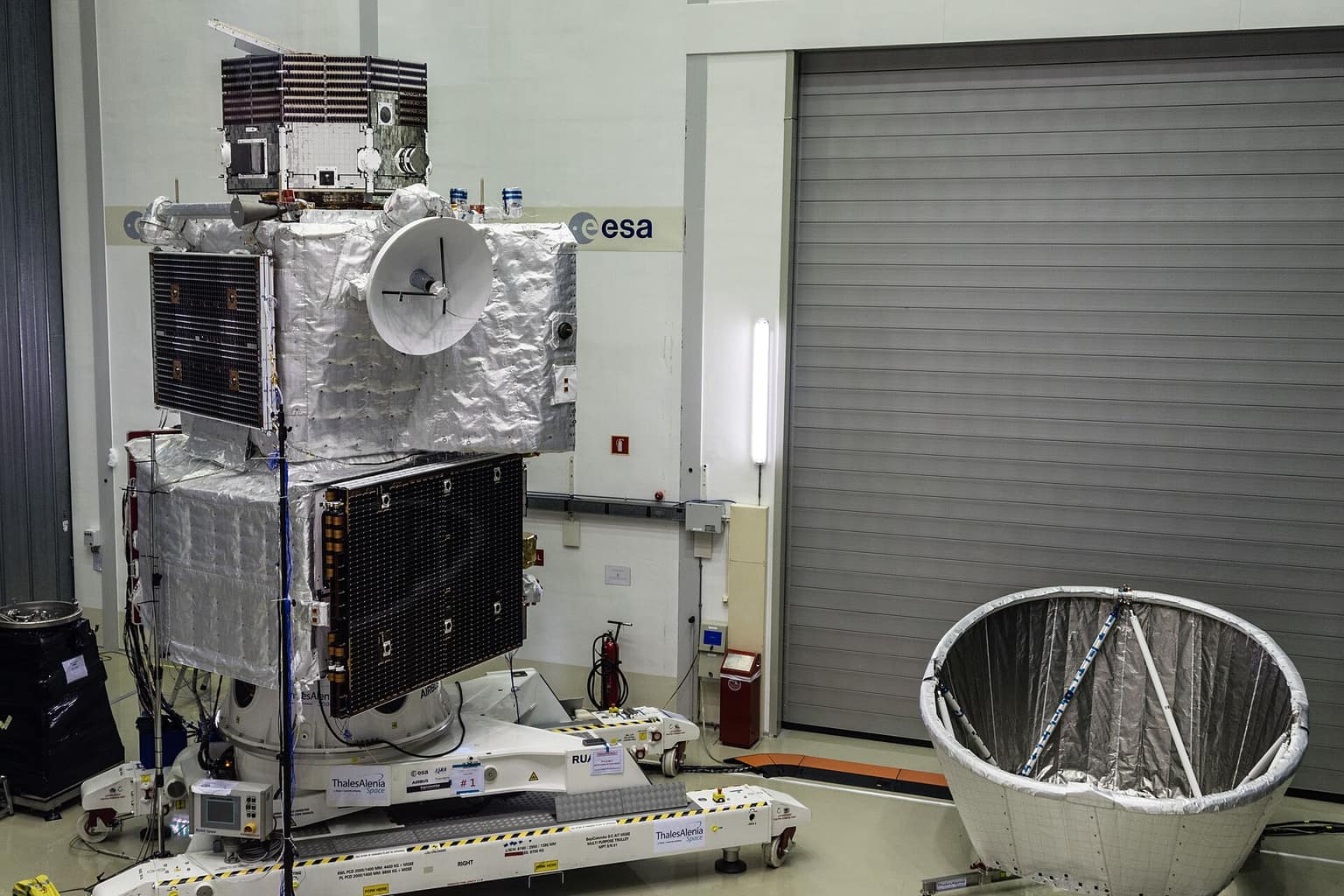
"The last time we could see through this telescope, it was in the basement under the School of Physics and Astronomy in Leicester." Dr. Adrian Martindale, instrument scientist for MIXS, was describing the first data sent back from the instrument. Since then it had survived a rocket launch, eight years in space and 10 billion kilometers of travel, and, in his words, it "looks just the same."
The first real view of the sky came in September. Only after the Mercury Transfer Module separated from the two science orbiters could MIXS, the Mercury Imaging X-ray Spectrometer, look into space at all. Over 11 and 12 September, the team turned the spacecraft 55 times and collected 39 hours of observations of the Crab Nebula, one of the brightest X-ray sources in the sky, 6,500 light-years away.
The goal is Mercury, the smallest and least explored terrestrial planet in the Solar System. BepiColombo, a mission of the European and Japanese space agencies, ESA and JAXA, carries MIXS on its Mercury Planetary Orbiter. The method rests on a simple effect: the Sun’s high-energy X-rays strike the surface rocks, which then emit their own fluorescent X-rays. Reading those X-rays reveals what the rocks are made of. A second instrument, SIXS, measures the incoming solar X-rays that trigger the process. On the night side, MIXS will pick up X-rays produced by charged particles trapped in Mercury’s magnetic environment, linking the surface to its surroundings.
Reaching that point has taken more than two decades. Martindale joined the project in 2003 as an undergraduate student. The instrument’s novel optic, the piece that focuses the X-rays, was designed under the original principal investigator, the late professor George Fraser. Emma Bunce, the current principal investigator, says about 80% of the technology on MIXS is new. The mission also faces a physical hurdle: the Sun’s enormous gravity makes it hard to place a spacecraft in a stable orbit around Mercury, according to ESA.
Calibration means checking an instrument against a known reference. Here the reference is the Crab Nebula, whose X-ray output is well documented, and the 2015 laboratory measurements of MIXS itself. The team reports that its angular resolution, meaning how sharply it separates fine details, is slightly better than in the lab. No stray light, the unwanted optical light that can creep into an image, shows up. Cosmic rays leave traces that the team understands and can filter out. Some self-fluorescence appears when sunlight hits the optic, but Bunce’s team says it should not affect observations of Mercury’s dayside. The detector shows no radiation damage after eight years in space.
The work is not finished. The team is still studying some effects in the instrument and plans optimization procedures during the commissioning phase, the fine-tuning stage before science begins. The spacecraft itself is reported healthy: the mission team said it is "healthy and operating as expected," according to CNN.
For planetary scientists, the change is concrete. MIXS would be the first imaging X-ray telescope to operate on a planetary science mission, and, according to the University of Leicester, it will help produce a global map of Mercury’s surface composition in unprecedented detail. Once orbit insertion, which begins on 21 November, is complete, the orbits are expected to take about three months to fine-tune, after which the main science mission starts. The instrument is to be commissioned for science operations in the spring.
Sources — read the originals(Paris time)
Pages consulted while writing
Read next
Comments
Loading the thread…
Sign in to leave a comment. Sign in