After eight years, the second probe is circling Mercury
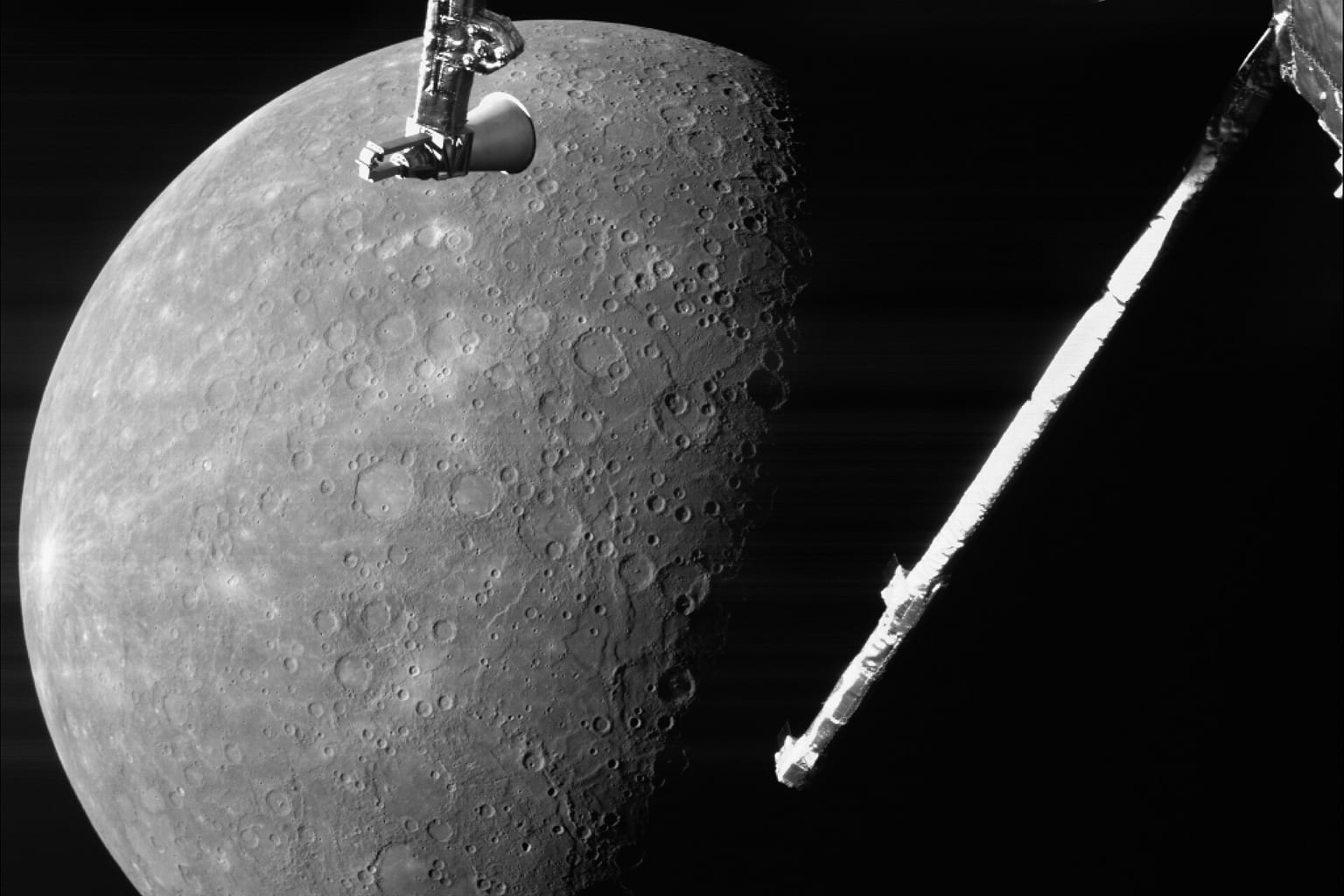
For thirty-seven minutes on Saturday, the engines of the BepiColombo spacecraft fired. In that time, a space probe on its way to Mercury became a satellite orbiting the planet. The mission of the European Space Agency (ESA) and Japan's space agency JAXA is now the second probe ever to study the innermost planet of the Solar System from orbit. Before it, only NASA's MESSENGER had held that position, from March 2011 onward.
The long wait is down to physics. Mercury is the least explored rocky planet in the Solar System, and getting a probe there requires more energy than a trip to the far more distant Pluto. The closer BepiColombo came to the Sun, the more strongly the star accelerated it. At that speed, the spacecraft would have been hard to capture with the gravity of the small planet. BepiColombo had launched in October 2018.
The solution was flybys. Nine times the probe flew past planets, and with each flyby the planet's gravity slowed it somewhat. Over a journey of roughly 9.9 billion kilometers through the inner Solar System, it shed the speed needed for the final capture. The engines alone would not have been enough.
The route was not without setbacks. As early as 2024, the solar panels of the transfer module no longer produced enough power for the propulsion. The ion engine, which accelerates the spacecraft slowly, later returned to 90 percent of its capacity, but that was not enough for the originally planned route. Arrival was postponed by one year and began in early September.
The actual braking maneuver on Saturday was carried out by four engines of the ESA's Mercury orbiter MPO. They were meant to slow the combined spacecraft enough for Mercury's gravity to hold it. However, the engine fired for less time than planned because of a software problem, the ESA said. The spacecraft is unharmed, and the mission control center ESOC in Darmstadt is now investigating exactly what happened.
The spacecraft consists of two parts: the ESA's MPO and JAXA's Mercury Magnetospheric Orbiter Mio. Both are due to separate on December 9 or 10 and move into different orbits. The MPO is to reach its final orbit on March 10, 2027. From April 2027, both probes are to begin their scientific work and study the surface and magnetic field of the planet closest to the Sun.
For research, this means that from spring 2027, two probes will simultaneously deliver measurements from a planet that, until now, only a single probe has studied from orbit. Scientists hope this will help them better understand the origins of the Solar System. The next milestone is the separation of the two parts in December.
Sources — read the originals(Paris time)
Pages consulted while writing
Read next
Comments
Loading the thread…
Sign in to leave a comment. Sign in