Soft-robot artificial muscles now hold steady positions
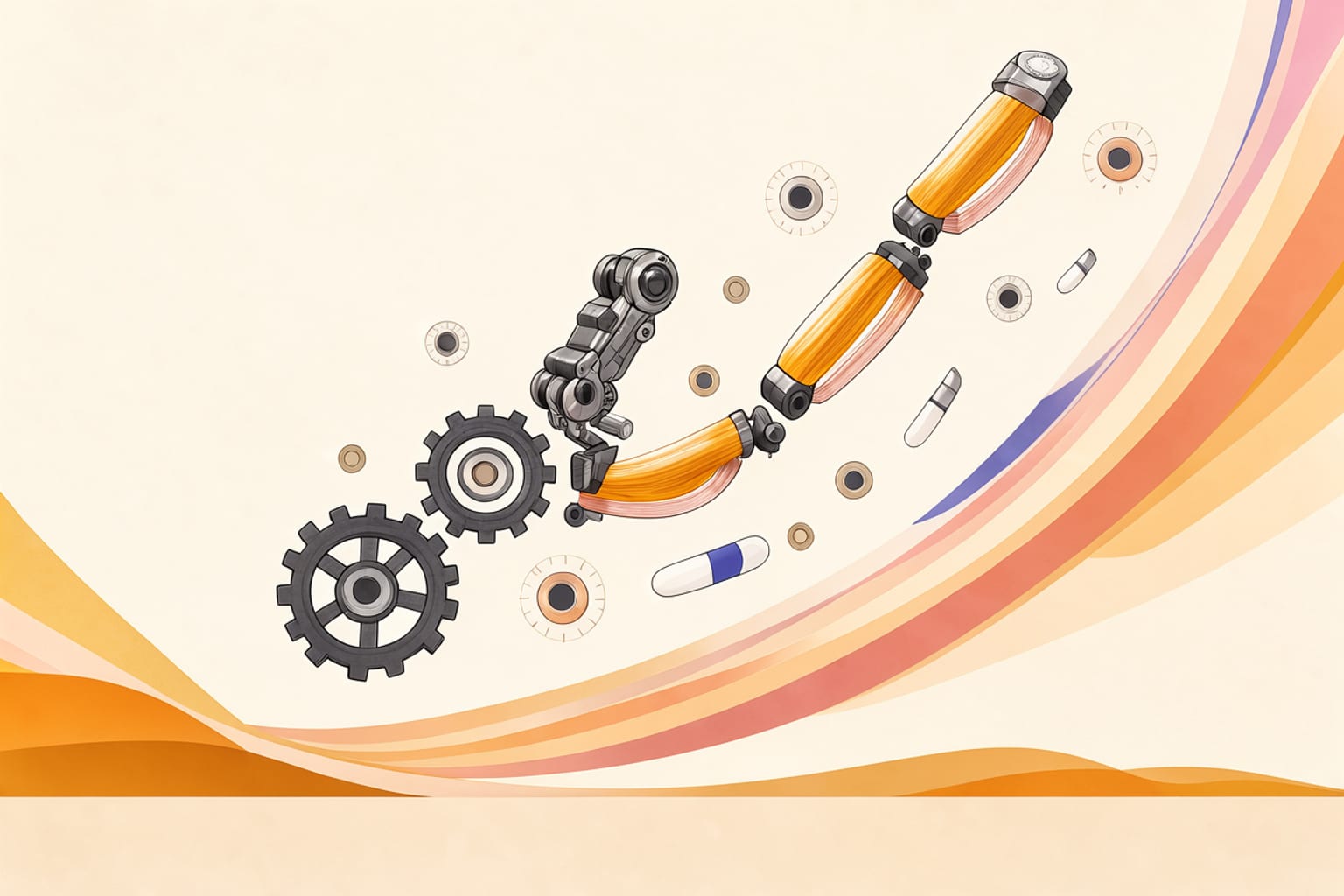
A robot hand presses piano keys one at a time, pauses, then moves to the next note. Nearby, a pair of robotic eyes shifts its gaze and holds it there. Both are driven by artificial muscles built by a team at the University of Pennsylvania.
Soft robots struggle with fine movement. Traditional robotic motors are precise, but they need bulky components and complex mechanical arrangements, far from the flexibility and compactness of biological muscle. Liquid crystal elastomers, or LCEs, are soft materials that change shape when heated and offer a possible alternative. Their problem is control: as they heat they contract, and as they cool they drift back toward their original shape, so holding a position in between normally requires continuous monitoring and adjustment.
The team's answer, called CoilLCE, makes the muscle sense its own state. It combines LCEs with graphene and embeds an ultrathin copper coil in the fibers. The coil does two jobs: it generates heat to activate the muscle, and it measures changes in its own electrical resistance as the material moves. The control system reads that resistance and adjusts heating power in real time, keeping it near a target value. The muscle can then hold intermediate positions for extended periods, and no separate position sensor is needed. “This is the first time that feedback control has been demonstrated on an LCE actuator,” said Cynthia Sung, associate professor in mechanical engineering at Penn Engineering, calling it “a necessary step” for future robotic uses.
Graphene makes the fibers softer and tougher, so they can stretch while withstanding the forces created when opposing muscles pull against each other. In pairs arranged like the muscles that move a finger or an eye, one muscle contracts while its counterpart stretches; the robotic eyes used four pairs of opposing actuators.
What changes for robots is the prospect of expressive faces and fine-motor hands built from fewer parts. Humanoid robot faces that reproduce natural expressions rely on many small actuators working together, and that is where the researchers see potential applications. Making larger numbers of these muscles work together in coordinated systems remains a challenge. The next step, according to the team, is combining more of them, with AI and computer vision to manage more complex movements. The researchers give no timeline for that work.
Sources — read the originals(Paris time)
Pages consulted while writing
Read next
Comments
Loading the thread…
Sign in to leave a comment. Sign in