Squeezing altermagnet crystals changes their magnetism
A pair of tiny crystals went between two titanium plates, and the team squeezed them. What changed was their magnetism. Scientists at the Department of Energy's Oak Ridge National Laboratory (ORNL), in Tennessee, found that even a small mechanical squeeze was enough to change the populations of magnetic domains of both materials.
The work focused on altermagnets, an emerging class of magnets that the team describes as a third fundamental class of magnetic materials. They combine two traits: like antiferromagnets, they show zero net magnetization, and like ferromagnets, they show strong momentum-dependent spin polarization and band splitting. The researchers studied two of them, manganese telluride (MnTe) and iron sulfide (FeS), and reported the results in two separate studies.
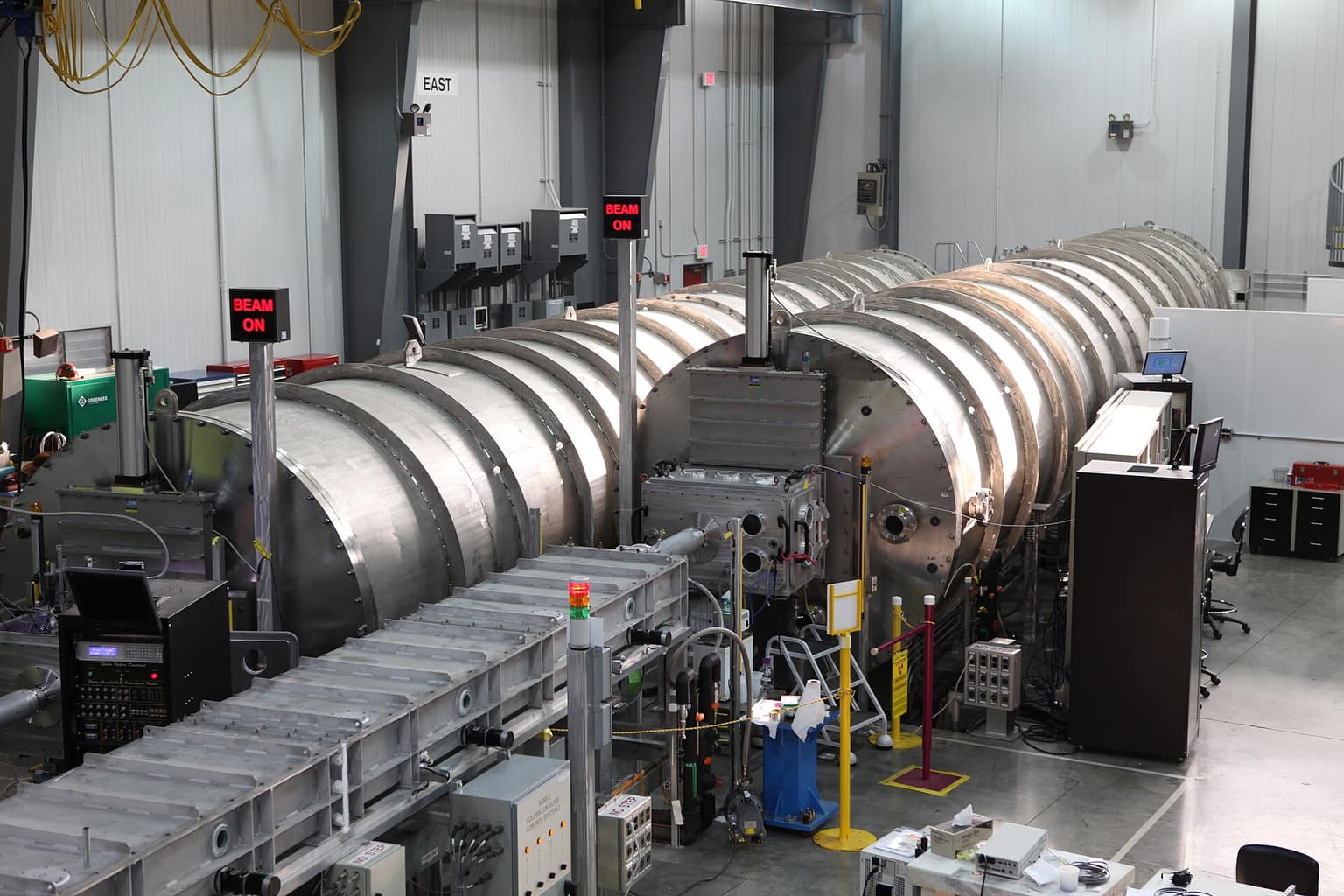
To see what happened inside the crystals, the team used neutron diffraction at ORNL's Spallation Neutron Source (SNS). The facility uses an accelerator to fire short proton pulses at a liquid mercury target, which releases neutrons that scientists use to study materials. The neutrons showed how pressure affected the magnetic structure of the crystals. The researchers also saw changes in the anomalous Hall effect (AHE), a voltage that appears across a magnetic material when an electric current flows through it. Unlike the ordinary Hall effect, it is driven by the material's internal magnetic properties rather than by an external magnetic field, so pressure acts on both the magnetic order and the flow of electrons.
For spintronics, the field that uses the spin of electrons rather than only their charge to store and process information, this matters. Pengcheng Dai, a researcher at Rice University and former ORNL neutron scientist, said that "by controlling the magnetic domains, we can directly influence the transport behavior, and that opens the door to exploring these materials for spintronic technologies." The team says the approach could lead to faster and more energy-efficient devices, such as advanced memory and computing systems.
The experiments were lab tests on crystals of two materials, so the effect has not been shown in working electronics. What the two studies suggest is a simple lever: a mechanical squeeze can reshape the magnetism of altermagnets and the electrical signal that comes with it. The next question for the field is whether that lever still works when the materials are built into devices.
Sources — read the originals(Paris time)
Read next
Comments
Loading the thread…
Sign in to leave a comment. Sign in