Tin flow battery unlocks its full charge in a 20-cell prototype
For years, acidic tin batteries have left half of tin's potential charge untapped. Their usual chemistry uses only two of the four electrons that tin can exchange, so a large share of the stored energy never comes out. A team in China has now shown that changing the liquid around the tin can unlock the rest.
In a flow battery, liquid electrolytes circulate through cells where chemical reactions store and release electricity, so the amount of usable charge in those liquids sets how much storage fits in a given volume. Tin's four-electron process has two steps: dissolved tin ions first gain two electrons, then gain two more and become metal deposited on an electrode. Discharging runs the sequence in reverse. The second half was the stubborn part in acid.
The team traced the problem to the chloride ions that bind tightly around dissolved tin. For electrons to pass, that arrangement has to reorganize, which costs energy and slows the reaction. Iodide makes the rearrangement easier because it forms weaker bonds, but an iodide-only solution barely dissolves the tin compound, and a liquid with little active material stores little charge. Combining the two ions solved the trade-off: chloride kept plenty of tin in solution, while iodide eased electron transfer. Too much iodide caused material to precipitate, so the proportions had to be right.
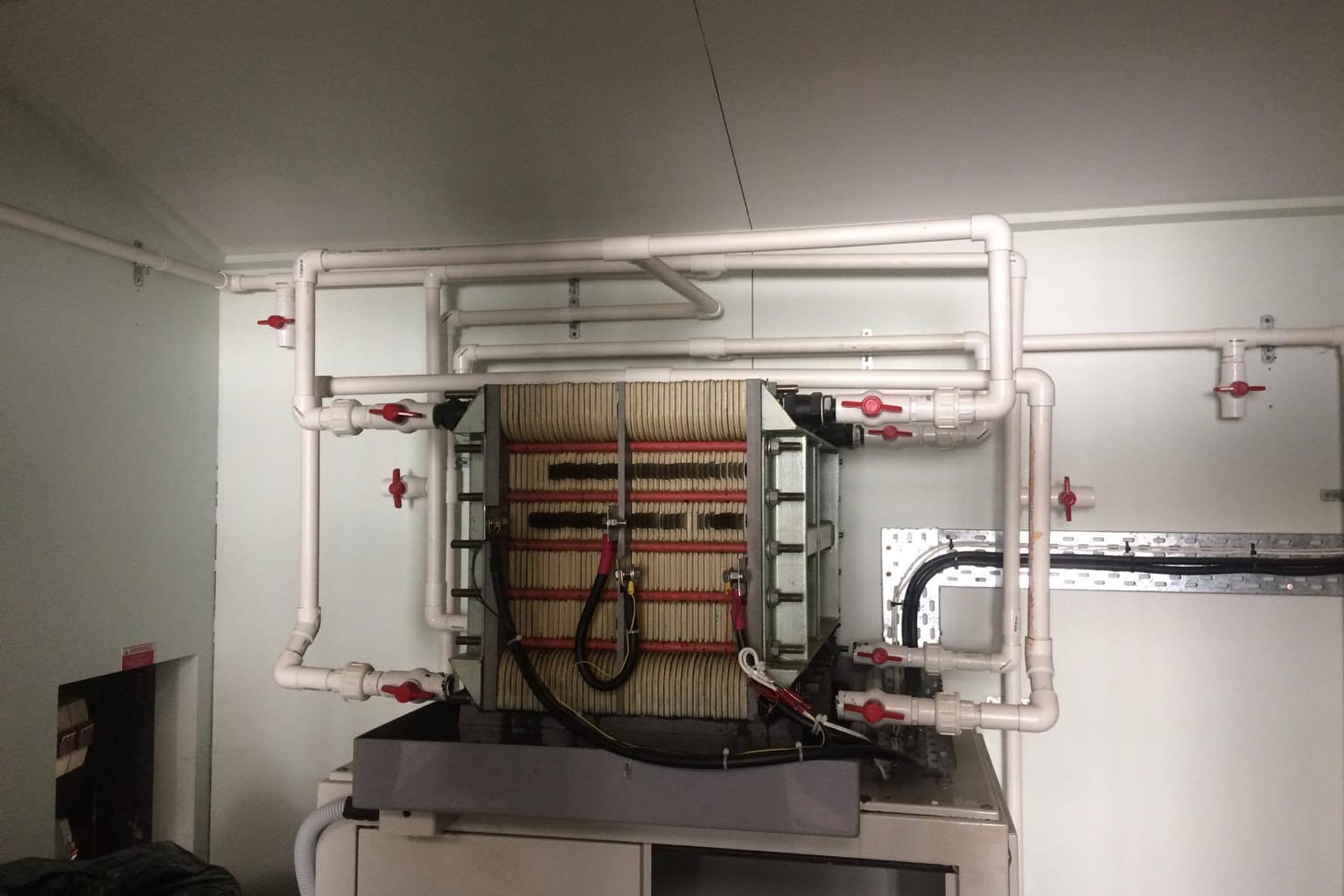
Paired with bromine on the other side, the modified electrolyte returned about 89% of the electrical energy supplied during charging, against 53% for the chloride-only comparison battery at the same tested current density. A more concentrated formulation reached 205 watt-hours per liter of tin-side electrolyte. Twenty cells stacked together delivered approximately 800 watts and completed more than 260 charge-discharge cycles over 1,000 hours. Tin deposits showed no obvious sharp, branching growths during extended testing.
The prototype did not run flawlessly. Iodide and tin ions gradually crossed the membrane between the two sides, and as iodide disappeared from the tin electrolyte, the reaction became less reversible and efficiency fell. Some tests also showed declining capacity. The gain therefore depends on keeping the liquid's composition stable, cycle after cycle, and the researchers say that longer operating times will need to be studied to address this loss. The study, published in Nature Chemistry, does not give a commercial timeline or cost.
Sources — read the originals(Paris time)
Read next
Comments
Loading the thread…
Sign in to leave a comment. Sign in