Voyager 1 nears one light day from Earth after nearly 50 years
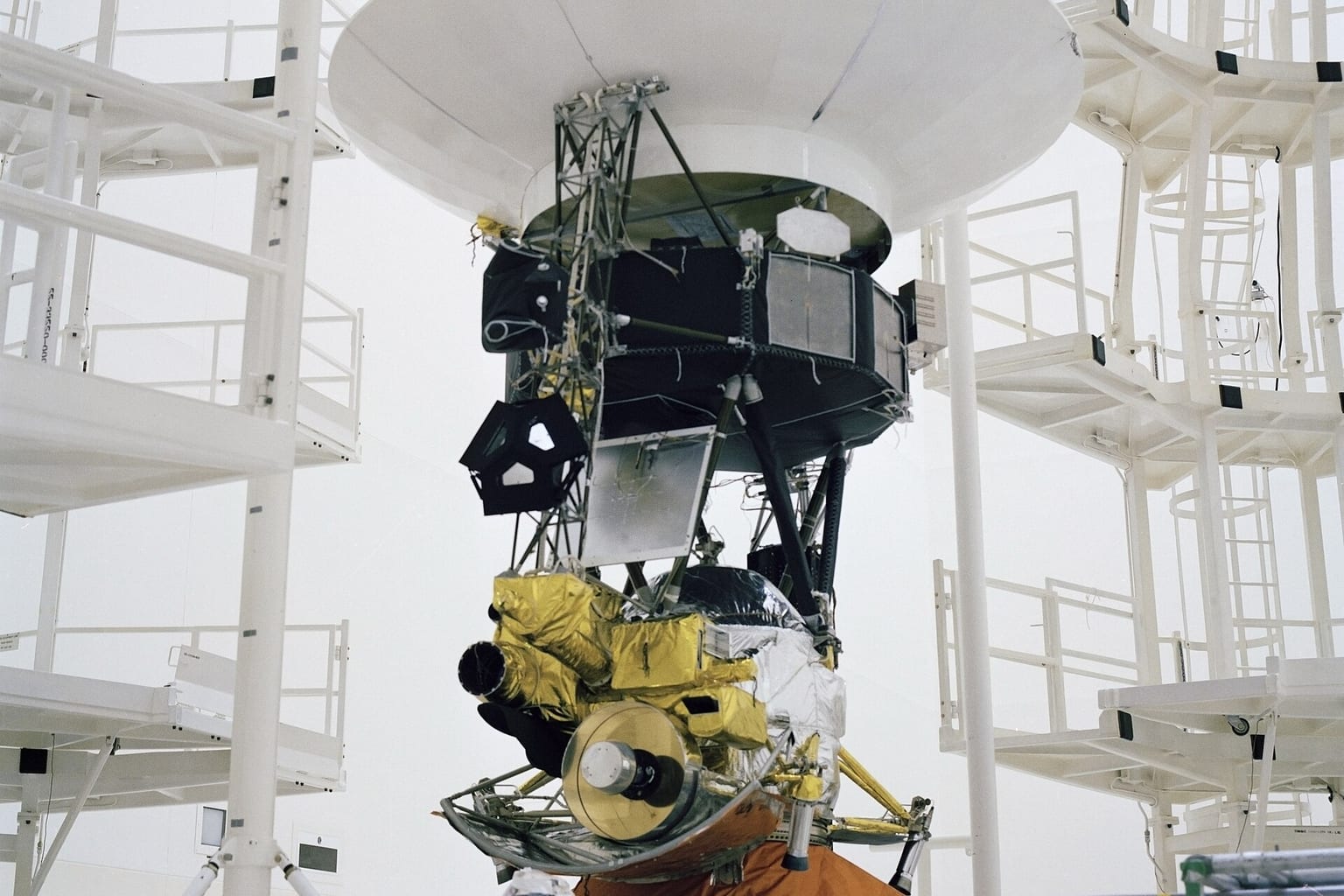
Launched in 1977 to study Saturn and Jupiter, Voyager 1 was designed for a mission of thirty months. Nearly 50 years later, it is due to reach one light day from Earth. At that distance, a radio signal or a beam of light needs 24 hours to cross the gap. The probe is still answering NASA, and every message it sends now comes from far beyond the planets.
Its early years were a string of discoveries. On March 5, 1979, as it approached Jupiter, it found the planet's ring and two moons never seen before, Metis and Thebe, and photographed its clouds and four of its main moons. Its closest approach to Saturn, on November 12, 1980, revealed five new moons and a new ring, the G-ring, which holds many small moons that help keep the rings in orbit. On February 26, 1998, it became the farthest human-made object, passing Pioneer 10. In August 2012 it crossed the heliosphere, the outer bubble of the solar wind that surrounds our solar system, to study the interstellar medium.
Near Saturn's moon Titan, researchers analysed the atmosphere and found it made up largely of nitrogen, about 90%, with some hydrocarbons and methane. That composition could help start pre-biotic chemistry, the set of reactions that comes before life.
Power has been the limit for years. Three radioisotope thermoelectric generators, or RTGs, turn the heat released by the decay of plutonium-238 into electricity. With less power left, NASA has been switching off equipment, and the latest shutdown was made so that data can keep flowing back to Earth. Only four scientific instruments remain: the magnetometer, the plasma wave instrument, the cosmic ray telescope and the low energy charged particle instrument.
The probe also carries the Golden Record, a 30-centimetre gold-plated copper disc with 115 pictures of life on Earth, 90 minutes of music, greetings in 55 languages and sounds from Earth, along with messages from former UN Secretary-General Kurt Waldheim and former American President Jimmy Carter. For researchers, what matters is the information the probe still sends back about the space beyond our solar system. The next chapter is set by power: each instrument switched off narrows what Voyager 1 can still report.
Sources — read the originals(Paris time)
Read next
Comments
Loading the thread…
Sign in to leave a comment. Sign in