96 Robots Learning From Each Other Reach 97.5% Success Rate
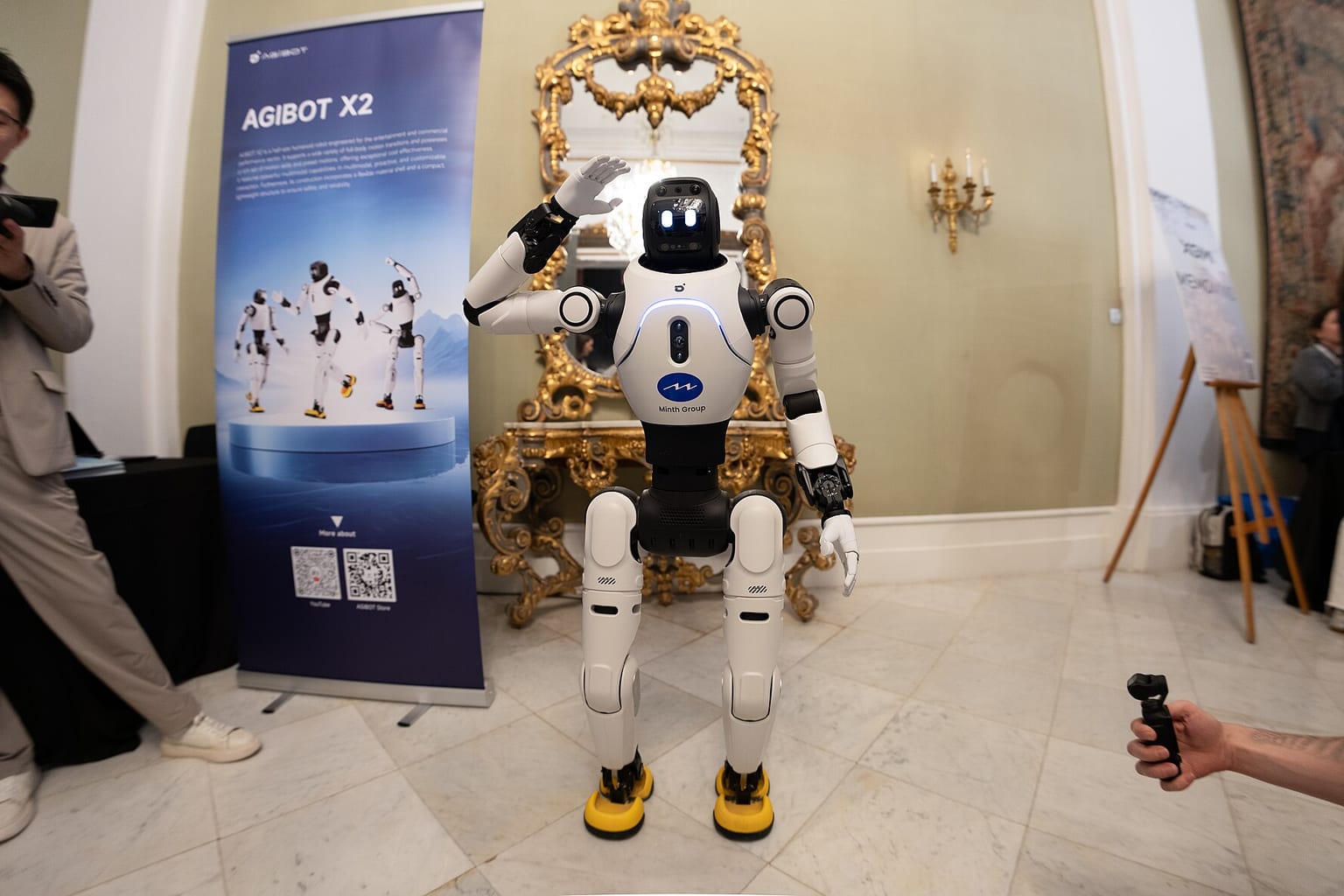
A robot that struggles with a task can now look up how its peers handled a similar situation. That is the core of a new training method tested on 96 real robots by researchers from Tsinghua University, Infinigence AI and AgiBot. They call it Collective Experience Learning, or CEL: the successful experience of one robot is stored and shared, so the fleet learns from its own wins rather than mainly from human demonstrations.
The starting point is a staffing problem. Robots improve by gathering real-world experience, and today that usually means a person demonstrating a motion again and again, or stepping in to correct mistakes. Robots can be deployed by the hundreds, but experienced operators cannot be scaled at the same rate. CEL moves the bulk of the learning from the operator's hands to the robots' own track record.
The researchers tested five tasks: arranging flowers, folding clothes, charging a phone, assembling a stool and packaging a phone. Two robots that had not taken part in training ran 600 trials and failed 15 times, an overall success rate of 97.5%. Success was higher on all five tasks than the average of six human operators. On phone packaging, a multi-step industrial task, success rose from 79.2% to 98.3% after collective learning, with two failures in 120 consecutive runs.
Two components make the system work. The first is a fault-tolerant asynchronous training system, called FATS, built on the open-source reinforcement learning framework RLinf. Robots upload their experience as soon as they finish a task, without waiting for the others, and the cluster keeps running when devices drop offline. In the 96-robot test, the cluster collected 9,834 episodes. Twenty-two robots had 30 faults in total, yet lost robot time came to only 1.3% of total operating time. The second is an algorithm called failure-guided experience retrieval fine-tuning, or FERT. A single manipulation can last minutes and involve thousands of action steps, while the only feedback is often a final success or failure. When a robot runs into trouble, FERT retrieves successful experience from similar situations and focuses learning on those examples.
The team also reports a scaling effect: with the same amount of real training time, raising the number of participating robots from 16 to 96 lifted success from 86.7% to 98.3%. These figures come from the researchers themselves and have not been independently replicated, and the test covered five tasks on one cluster. For fleet operators, the change is in the arithmetic: each additional robot in operation can add to the shared experience instead of adding another operator's workload. The paper gives no timeline for use beyond the research setting.
Sources — read the originals(Paris time)
Read next
Comments
Loading the thread…
Sign in to leave a comment. Sign in