A diamond amplifier boosts quantum signals 1,000-fold
Reading a quantum computer is a bit like following one voice in a crowded room through a single microphone that hisses. The answers come back as microwave signals so faint that the amplifier meant to lift them adds its own noise on the way.
Researchers at the Okinawa Institute of Science and Technology (OIST), in Japan, have built an amplifier that boosts such signals more than 1,000-fold while adding noise close to the minimum physics allows. The device works on a principle that is more than seventy years old, and it runs on diamond.
Superconducting quantum computers operate near absolute zero, and their amplifiers are cooled for the same reason. Even so, the amplifiers add a hiss of their own. That noise makes it harder to tell from a single measurement whether a qubit, the basic unit of quantum information, is in one state or the other, and the result is errors. Current standard amplifiers saturate when many qubits are read at once. The alternatives handle stronger signals but need more power and more wiring, which weighs on cost as machines grow. Spin qubits, built on semiconductors, need magnetic fields that overwhelm superconducting amplifiers altogether.
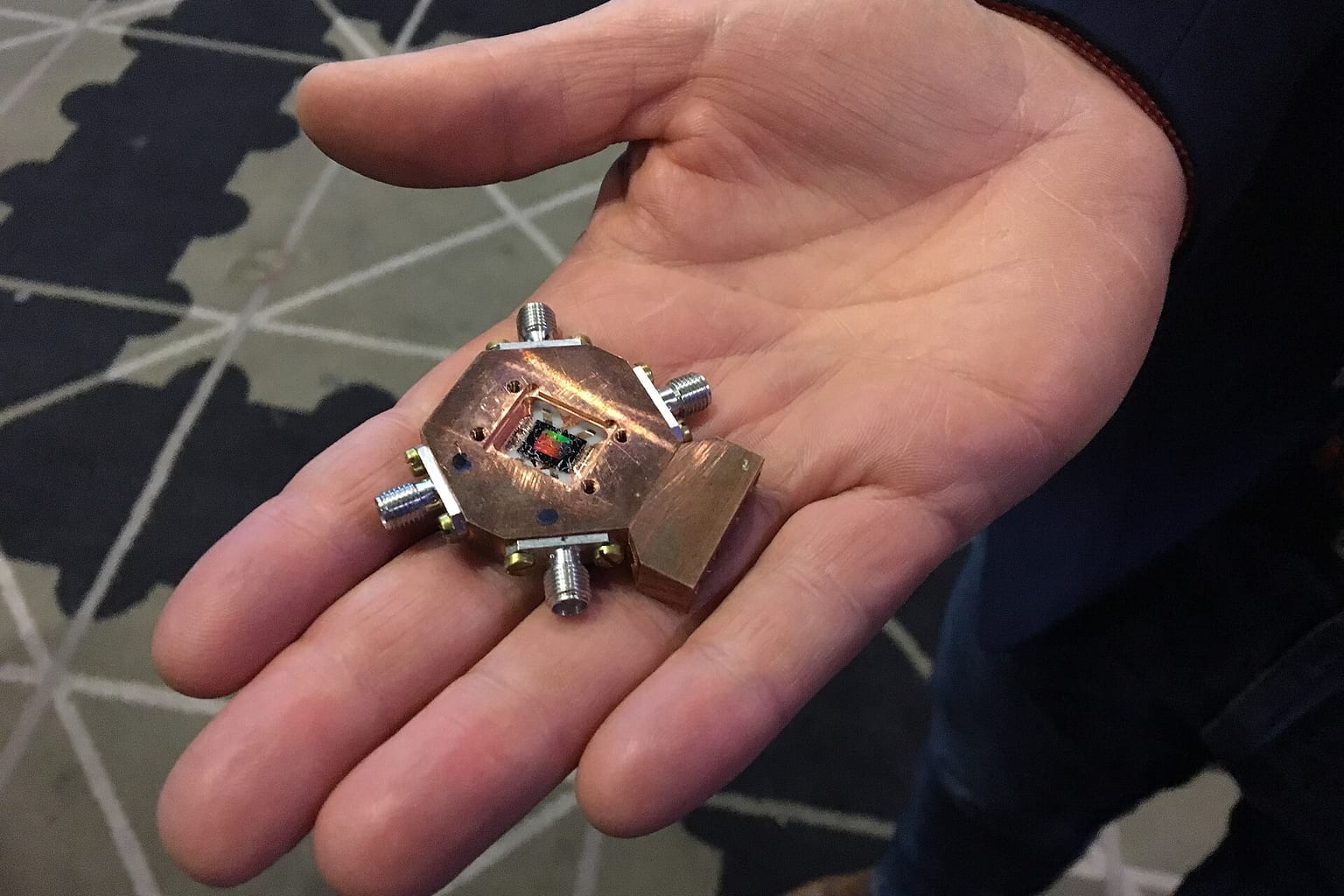
The maser dates from 1954, six years before the laser, and it works on the same principle, stimulated emission: a passing photon, a particle of light or microwaves, triggers an excited electron to drop and release an identical photon. In the OIST device, the electrons are spins, the tiny magnetic orientation of electrons, held in nitrogen impurities inside a diamond at the heart of the amplifier. A weak microwave field pushes most of those spins into a higher-energy state. When a signal arrives, the spins give up their energy at the same frequency, and the signal grows. “We were surprised by how much amplification we could achieve using such a small amount of microwave power,” says Yuimaru Kubo, head of the hybrid quantum device team at OIST.
Masers were long left behind because they needed cryogenic cooling to work. Kubo argues that quantum computers now run near absolute zero, which gives the old technology new life. The diamond maser also works in a magnetic field, so it suits spin-qubit machines, and it handles much stronger input than the standard amplifiers.
For anyone building quantum machines, the practical gain is in reading many qubits at once without the amplifier saturating. According to the researchers, the same device could also serve spectroscopy, the technology behind MRI scanners, and searches for dark matter, where low-noise amplification of microwaves matters.
The device is still a lab result. It operates at millikelvin temperatures, the same cold that kept masers out of practical use until very recently. The work is described in the journal Nature Communications, and the device is now in further development toward commercialization. The reporting gives no date for that step.
Sources — read the originals(Paris time)
Pages consulted while writing
Read next
Comments
Loading the thread…
Sign in to leave a comment. Sign in