A quantum chip stores data in tiny vibrations
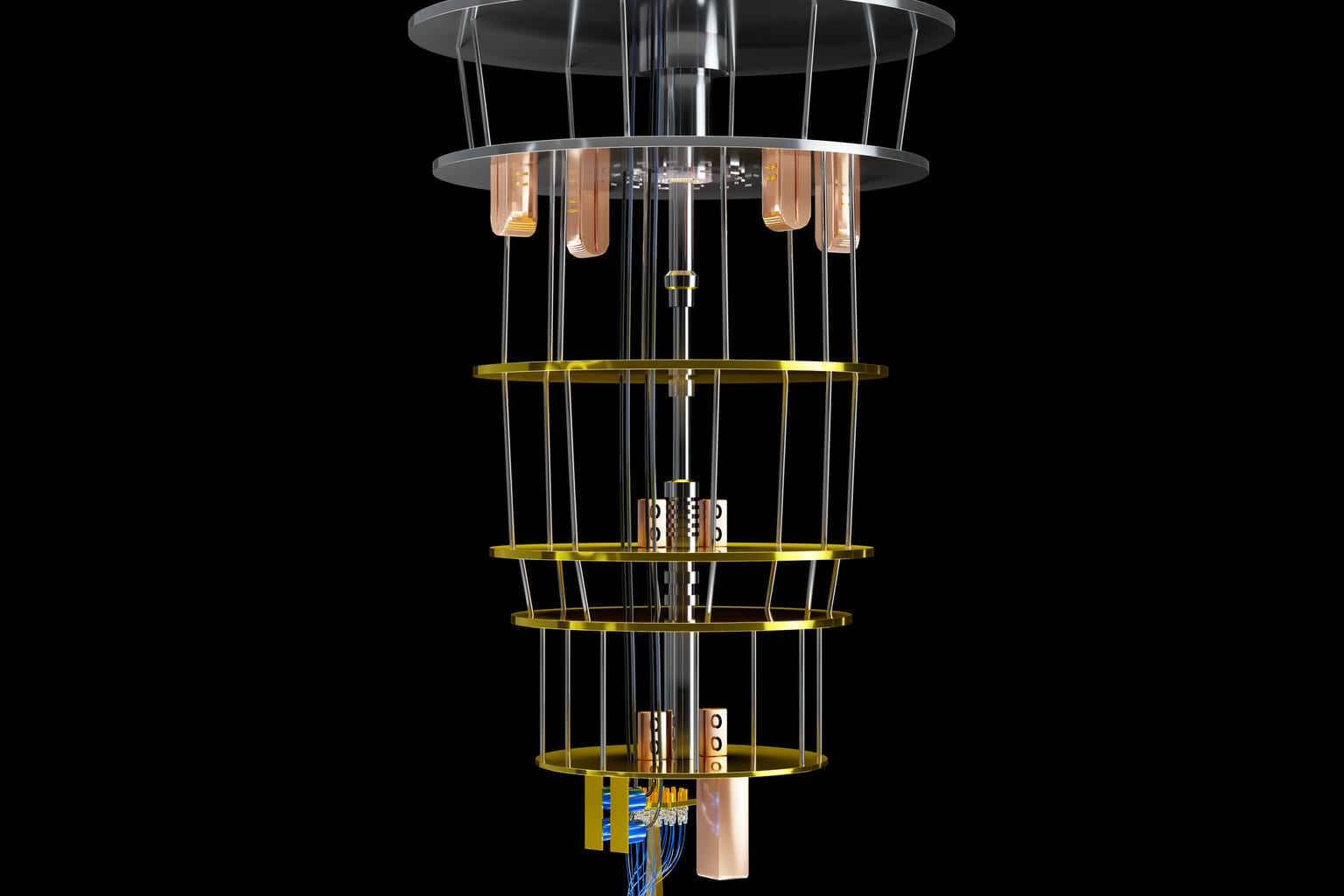
On a chip 7.5 mm long, researchers at ETH Zurich have built a quantum memory out of vibrations and shown that it works alongside a quantum processor. The team, led by Yiwen Chu, reports the results in Science. Many quantum computers store information in electromagnetic modes. Here, the memory keeps it in the mechanical vibrations of a tiny acoustic device instead.
Quantum computers need two roles, as ordinary ones do: a processor that runs the calculations, and a memory that holds the data they need. In this chip, the processor is a superconducting qubit, a quantum bit built from superconducting circuits. The memory is a high-overtone bulk acoustic-wave resonator, whose vibrations come in many distinct modes called phonons. These vibrate at frequencies far above human hearing, and each mode is a separate way to hold quantum information. Electromagnetic designs take up space, which limits how small a device can get. Packing many highly coherent vibration modes into a small package is the alternative the team puts forward.
The processor did more than hold data. The team ran a full set of quantum gates, the basic operations that quantum algorithms are built from, including single-qubit gates and controlled arbitrary phase gates. It also performed the quantum Fourier transform and period finding, which show how a quantum machine can detect repeating patterns in mathematical problems. “The Fourier Transform is necessary for many quantum algorithms and period finding shows how it can be applied,” said Igor Kladarić, a doctoral researcher in Chu’s group and co-author of the study.
For now, the gain is a proof of principle, not a machine. The team sees a path to quantum random-access memories built on this principle, which could store information in less space than electromagnetic designs. ETH’s own summary says that path is open. No date is given for a usable machine, and the work has not yet been scaled up.
The limits are clear. The number of phonon modes that can interact with the qubit caps how large the processor can be. Measurements on the device put the qubit’s coherence time at about 23 microseconds. The researchers are now working to increase that coherence, to test other designs, and to speed up the qubit’s readout, which they describe as vital to scaling the design.
Sources — read the originals(Paris time)
Pages consulted while writing
Read next
Comments
Loading the thread…
Sign in to leave a comment. Sign in