A simulation reproduces Mars' 1,000-mile cloud for the first time
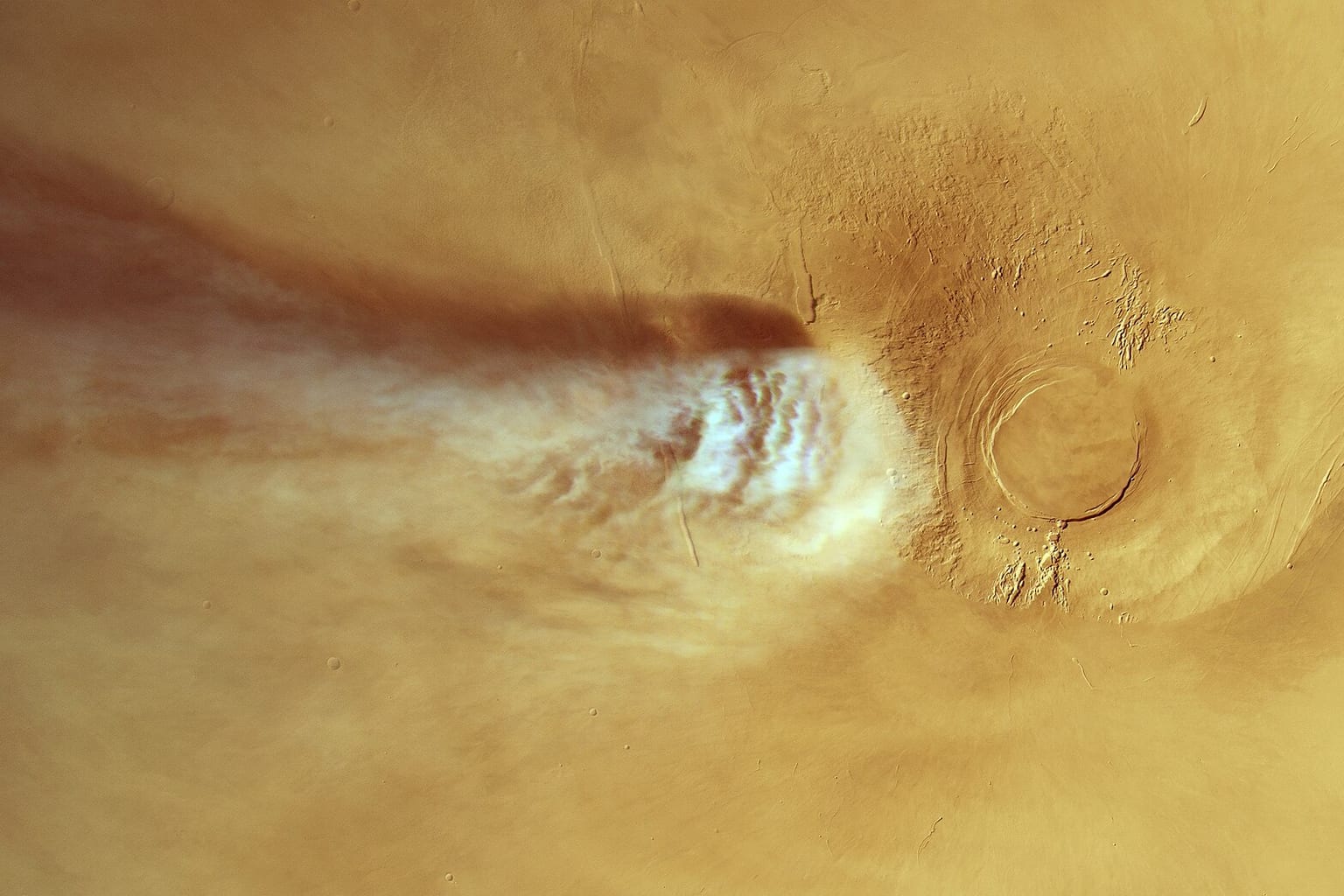
Every morning during the Martian spring and summer, a thin, extremely long cloud emerges near the volcano Arsia Mons, then disappears again. It stretches over 1,000 miles, about the distance from New York to Kansas City as the crow flies, before dissipating. The cycle repeats for several months. Scientists call it the Arsia Mons Elongated Cloud, or AMEC.
A probe recorded it in 2018, and since then researchers had found no plausible explanation for its existence. The difficulty was that the cloud's extreme length did not fit any mechanism they could reproduce.
This time, a team led by Jorge Hernández-Bernal, a planetary scientist at Sorbonne Université in Paris, managed to model the cloud's formation for the first time. Their key was physics that appears in textbooks but is treated as theoretical and usually thought not to happen in nature. "We found that we needed to include some exotic physics," Hernández-Bernal said in a press release. "It certainly hasn't been seen in action before." Once that process was added to the simulations, the cloud emerged "just as we hoped". The results suggest that the AMEC may be driven by a process never directly observed in any planet's atmosphere. The model reproduces the cloud, but the process has not been measured in the Martian sky.
For planetary scientists, a formation that resisted explanation since 2018 now has a candidate mechanism. If the process is confirmed, it would move from textbook theory to a phenomenon seen in a planet's atmosphere for the first time. No follow-up observation is announced, so the model remains the main evidence for now.
Sources — read the originals(Paris time)
Read next
Comments
Loading the thread…
Sign in to leave a comment. Sign in