Mars' giant canyon still has active faults, marsquake data show
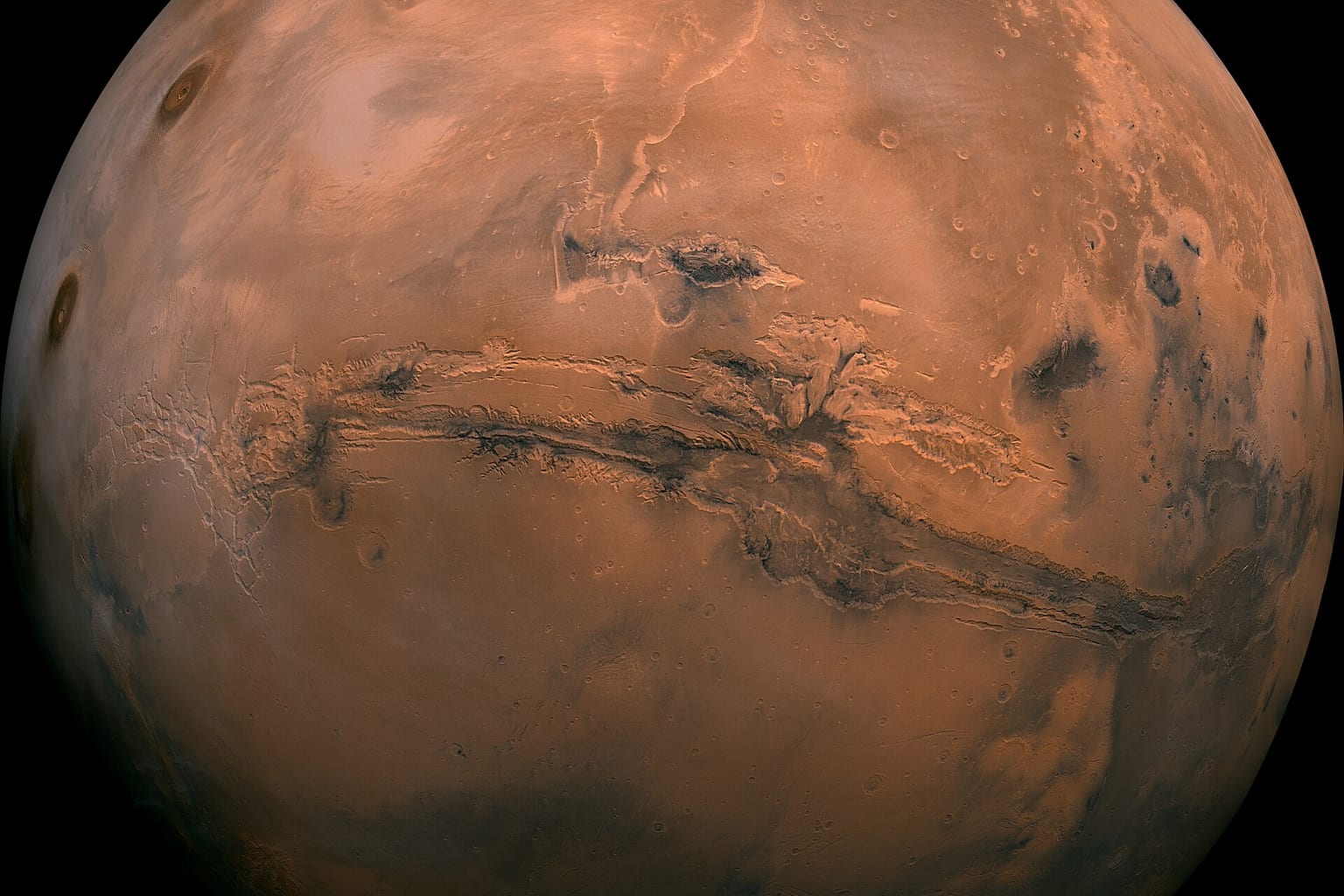
On Aug. 25, 2021, NASA's InSight lander felt a tremor that came from the wrong side of Mars. The event, called S0976a, was the only marsquake of the mission that could be located in the planet's western hemisphere, and for years its cause stayed uncertain. A team from Columbia University and Imperial College London now reports that the tremor originated beneath Valles Marineris, and that it was caused by rock slipping along a fault deep in the crust.
Valles Marineris is a scale that is hard to picture. The canyon system stretches nearly 3,900 kilometers across Mars, reaches up to 600 kilometers wide and is more than 9 kilometers deep. At their maximum dimensions, that makes it nearly nine times longer, more than 20 times wider and about five times deeper than the Grand Canyon. Mars has no system of moving tectonic plates that continually reshapes its crust. Its outer shell behaves more like a single, slowly cooling lid, so scientists had long assumed that the canyon's faults had gone quiet with the processes that formed them. On Mars, a seismic signal also does not automatically mean a fault has broken: impacts, landslides and other processes can send vibrations through the planet too.
To tell these causes apart, the researchers reconstructed the motion at the source from the amplitudes and directions of the seismic waves that reached InSight. The best fit is a strike-slip marsquake, in which blocks of crust move horizontally past one another along a steep, deeply rooted fault, roughly 20 to 40 kilometers below the surface of western Valles Marineris. The team tested meteoroid impacts, landslides and other kinds of mass movement, and none of those models reproduced the observed waves. Satellite images of the likely source region, taken after the event, showed no fresh impact crater and no large new landslide. Lead author Jung-Hun Song of Imperial's Department of Earth Science and Engineering says that several independent lines of evidence point the same way: the waves show sideways sliding deep underground, and the orbital geology shows a region crossed by long-lived fault systems.
The orientation of the faulting matches what would be expected if ancient structures were slipping again under stresses from the planet's long-term cooling, the nearby Tharsis volcanic region and effects specific to the canyon itself. Valles Marineris now joins Cerberus Fossae and the southern Elysium Planitia plain, two other places where InSight data have revealed active faulting, and the three regions show different styles of faulting. The researchers conclude that stresses in the Martian crust vary considerably from place to place. Co-author Folarin Kolawole of the Lamont-Doherty Earth Observatory at Columbia notes that structures created billions of years ago can still control where the crust breaks today. Doyeon Kim of Imperial adds that the same event's waves passed through the core, so one marsquake also informs what is known about the planet's deepest interior.
For planetary geologists, the immediate gain is a method and a body of data. The InSight recordings remain useful even though the mission ended in 2022, and the authors argue that similar analysis could reveal ongoing seismic activity on other planetary bodies that might otherwise be considered geologically inactive. The study rests on one event, and the team does not give a rate for such quakes or a timeline for further work. What the result changes now is the picture of Mars itself: a planet without plate tectonics, whose oldest faults still slip beneath the largest canyon in the solar system.
Sources — read the originals(Paris time)
Read next
Comments
Loading the thread…
Sign in to leave a comment. Sign in