A single early dose protects mice from an autism-linked brain defect
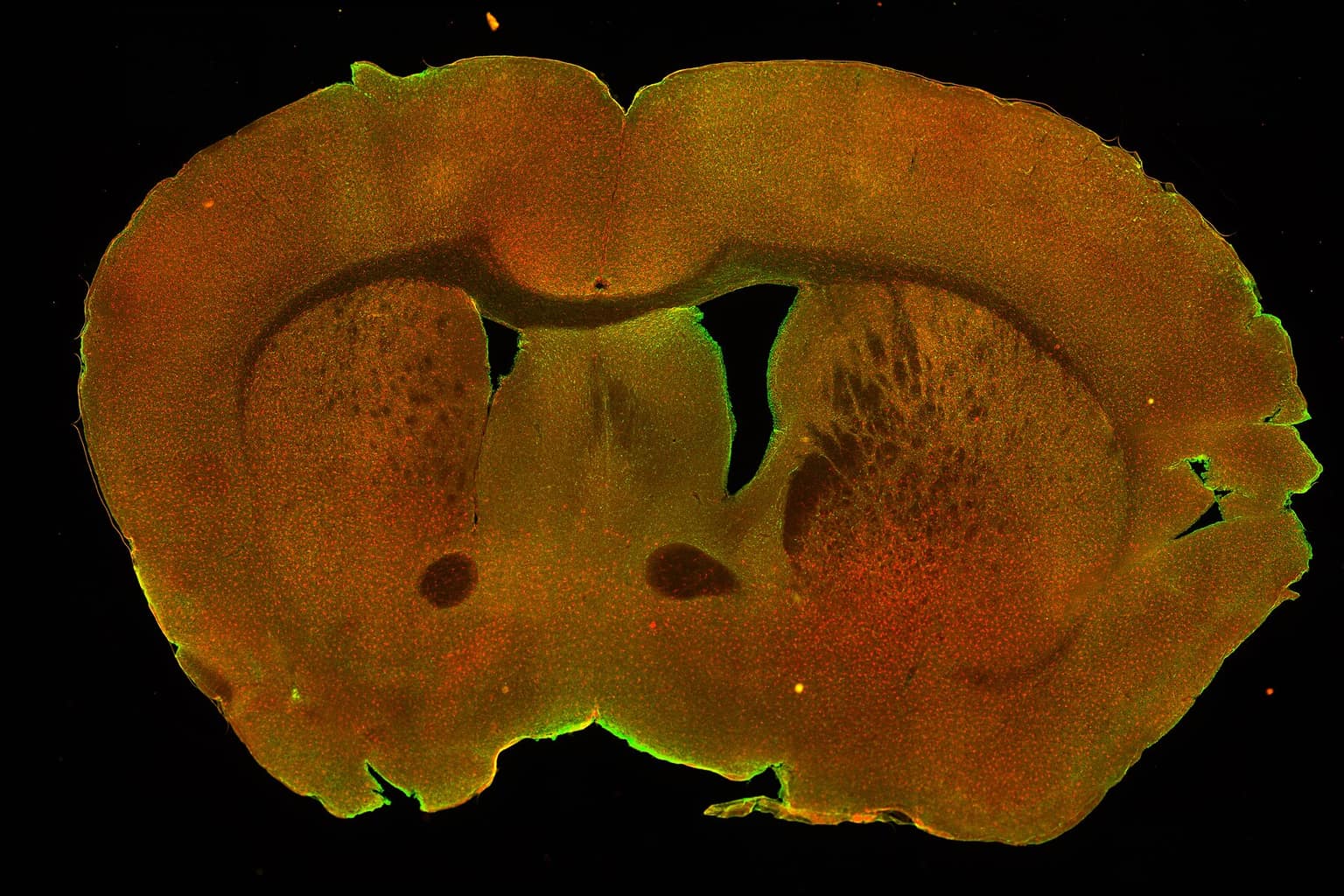
Newborn mice carrying a single altered gene copy began losing neurons in the hippocampus, the brain region that handles learning and memory. The mutation, called A636T, sits in GRIA1, a gene that codes for part of the AMPA receptors, the proteins that let neurons talk to each other. It has been found in people with autism spectrum disorder and intellectual disability. Richard L. Huganir, a neuroscientist at Johns Hopkins University School of Medicine and co-corresponding author of the study, and his colleagues at Academia Sinica in Taiwan have now shown that a short RNA-based drug, given once shortly after birth, prevents many of the harmful effects of the mutation in mice. The work is published in the journal Neuron.
Normally, as the brain matures, AMPA receptors change so that less calcium enters neurons. Calcium is needed for communication between cells, but too much of it kills them. The A636T mutation blocks this protective change, so calcium floods in. The mutant mice developed neuronal degeneration and inflammation, along with impaired learning, memory and social behavior, and more anxiety-like and repetitive behaviors, features that resemble some seen in human neurodevelopmental disorders.
The treatment is an antisense oligonucleotide, a short synthetic molecule designed to recognize and silence one specific RNA message. Unlike drugs that broadly suppress AMPA receptor activity, it reduces production of the abnormal receptor from the mutant gene copy and keeps the normal copy working. In the mice, a single administration of the optimized molecule shortly after birth prevented hippocampal neuronal damage, restored more normal synaptic function, reduced neuroinflammation and improved learning, memory and social behavior.
This is a proof of principle, not a treatment. The authors write that further studies using humanized mice or human stem cells derived from patients will be essential to validate the strategy. Huganir says the work offers hope that precision RNA therapies could eventually benefit patients with these disorders, a group the study describes as rare. The researchers give no timeline for clinical use.
For now, the change is mostly one of understanding. The study traces a developmental disorder to one receptor and shows that silencing the faulty copy can protect the circuits forming in the young brain. ASO-based therapies have already been developed for spinal muscular atrophy and some forms of Batten disease, and similar approaches are being investigated for ALS (amyotrophic lateral sclerosis), Huntington's disease and rare genetic epilepsies.
The team plans to keep studying the mechanisms behind these disorders in mice and in human stem cell models, while optimizing the RNA therapy for potential clinical applications.
Sources — read the originals(Paris time)
Pages consulted while writing
Read next
Comments
Loading the thread…
Sign in to leave a comment. Sign in