AI model reasons about 3D space 3.6 times faster
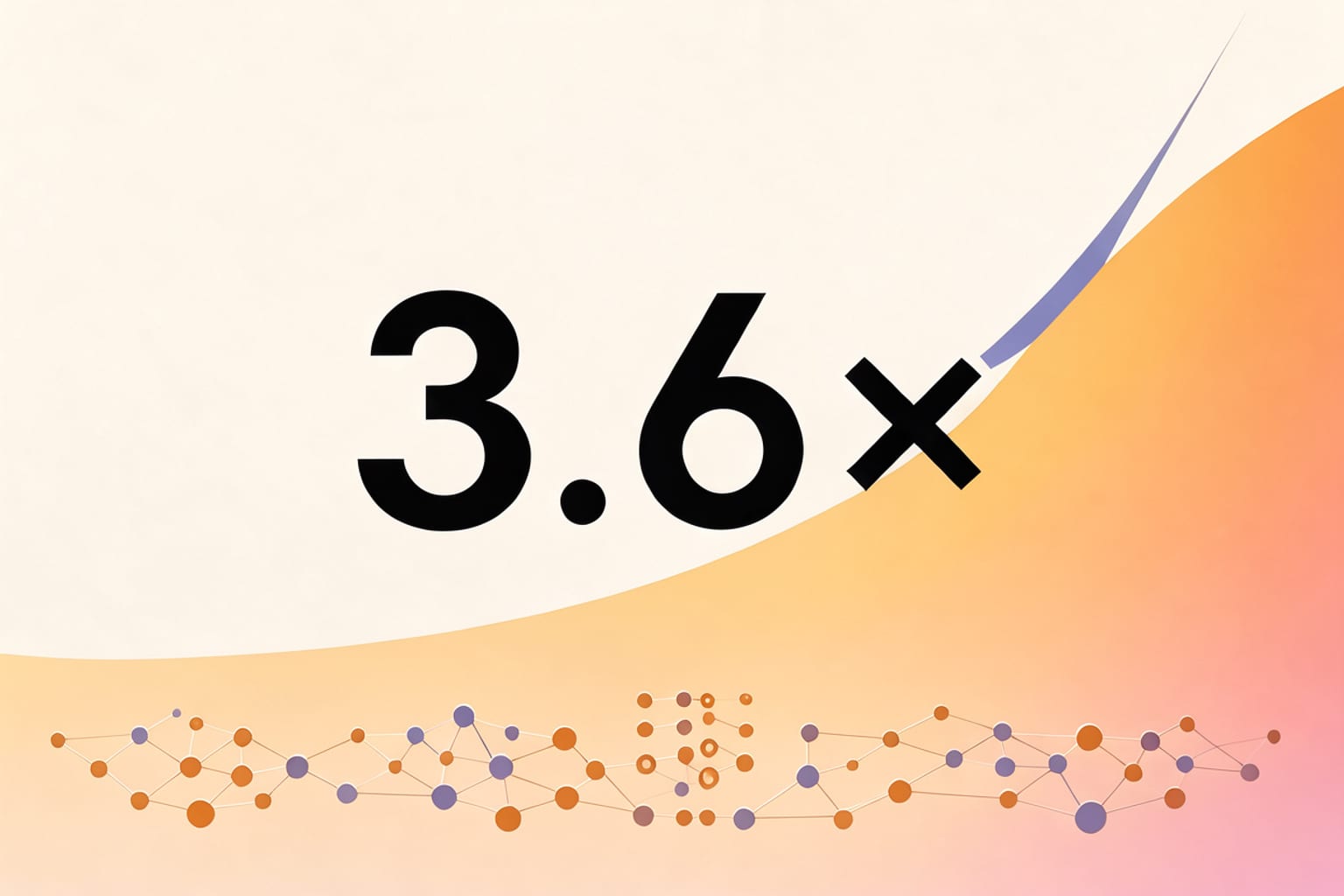
For a car or a robot, a question such as where an object sits and what lies next to it has to be answered in a fraction of a second. A team led by Professor Liang Xiaodan at Sun Yat-sen University, with researchers from XPeng, Nanyang Technological University and Mohamed bin Zayed University of Artificial Intelligence, has built a vision-language model that answers these questions from video alone. In the team's tests, the answer time dropped from 1.45 seconds to 0.40 seconds, about 3.6 times faster.
Judging where objects are and how they relate matters for autonomous driving and robotics. The common approach feeds a vision-language model features from a 3D geometry encoder such as VGGT, which extracts depth and point-cloud cues from several views. The first GeoThinker, accepted at ICML 2026, learned to pick only the geometry cues relevant to each question and scored 72.6 on VSI-Bench, a spatial-reasoning benchmark. But it still ran VGGT on every query, and that second model was the cost the new work sets out to remove.
GeoThinker-F splits the work into two stages. In the first, the vision-language model is kept frozen while two lightweight prediction heads learn from its middle layers to predict VGGT's geometry features for the current frame and semantic features for the next one. In the second, VGGT is removed. The backbone, the prediction heads and a temporal fusion module are fine-tuned together on spatial reasoning data. The authors say the heads help only after the first stage, which they read as evidence that the gains come from what the heads learn, not from extra parameters.
On Qwen2.5-VL-7B, trained on the same data, the new model scores 50.7 on VSI-Bench against 50.5 for the earlier GeoThinker. On Qwen3-VL-8B, the six-benchmark averages are nearly identical, 62.21 and 62.23, while the VSI-Bench score is slightly lower, 70.9 against 72.6. With more data and frames, the team reports a six-benchmark average of 69.29. The speed figure is measured on Qwen3-VL-8B with spatial token compression added. The results are not independently reproduced yet, so they remain a research preprint. What changes is the arithmetic of a single question: a system that reasons about space from video frames alone no longer needs a second 3D model running alongside it each time, which is what makes it a candidate for vehicles and robots that must answer quickly.
Sources — read the originals(Paris time)
Pages consulted while writing
Read next
Comments
Loading the thread…
Sign in to leave a comment. Sign in