AI model traces cell signaling history in mouse embryos
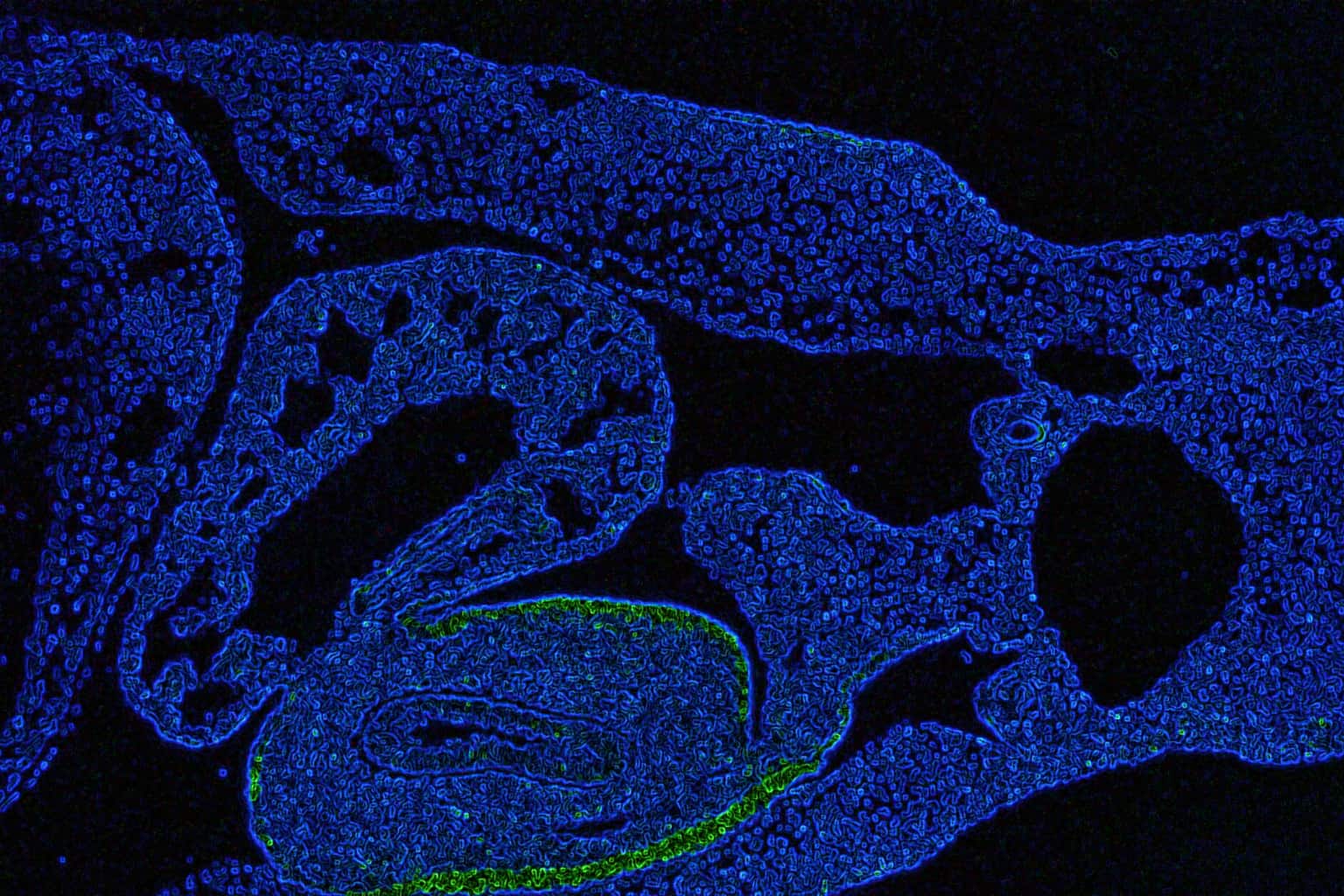
An embryo begins as a small cluster of stem cells. Those cells, once blank, take on specialized roles: brain, liver or muscle. Which role they take depends on which genes are switched on or off, and that choice is not made alone. Cells constantly send and receive chemical signals from their neighbors, telling each other where they are and what they should become.
These messages travel through multi-step sequences called signaling pathways, which turn outside signals into changes in gene activity. For researchers, retracing the instructions a cell has received would be a powerful way to understand how tissues form and how that process goes wrong in disease. It has been hard to do, because scientists long assumed that a pathway acts very differently in each cell type. Mapping each pathway in each cell type was, in the words of the study's own framing, an arduous and painstaking process.
Li and Hutchins found that each pathway leaves a consistent fingerprint in gene activity, and that this fingerprint holds across cell types. The team built IRIS, a neural network, a kind of AI that learns to recognize patterns in complex data, and trained it on thousands of human embryonic stem cells exposed to dozens of combinations of six major signaling pathways at several stages of development. The result is a map of how signal combinations shape cell behavior. Li compares it to voice recognition trained mainly in English that then recognizes other languages: this transfer learning is why IRIS works on cell types it has never encountered.
In mouse embryos during gastrulation, the stage when cells rapidly branch into different fates, IRIS accurately predicted when and where specific pathways switched on in cells destined to form heart, gut, muscle and spinal cord tissue. When the team used it to find the signals needed to create a lung cell type, the model predicted that activating one specific pathway would encourage lung development, and experiments in mouse embryos confirmed the prediction. The study does not report tests on human embryos; the team presents mapping them as a possibility.
For stem cell engineers and organoid makers, the gain is practical: once the pattern of signals that drives a stem cell toward a given type is known, it can be recreated in a lab to steer cell fate, and organoids, miniature 3D models of organs, can be built more reliably. The team says such models would let researchers study asthma, lung cancer and pulmonary fibrosis, a condition in which lung tissue becomes scarred, often without a known cause, and test therapies on them. The researchers' end goal is regenerative treatments that repair damaged tissue, but the study gives no date for that, and no treatment is reported yet.
Sources — read the originals(Paris time)
Read next
Comments
Loading the thread…
Sign in to leave a comment. Sign in