Anthropic's team maps first 3D bacterial vault
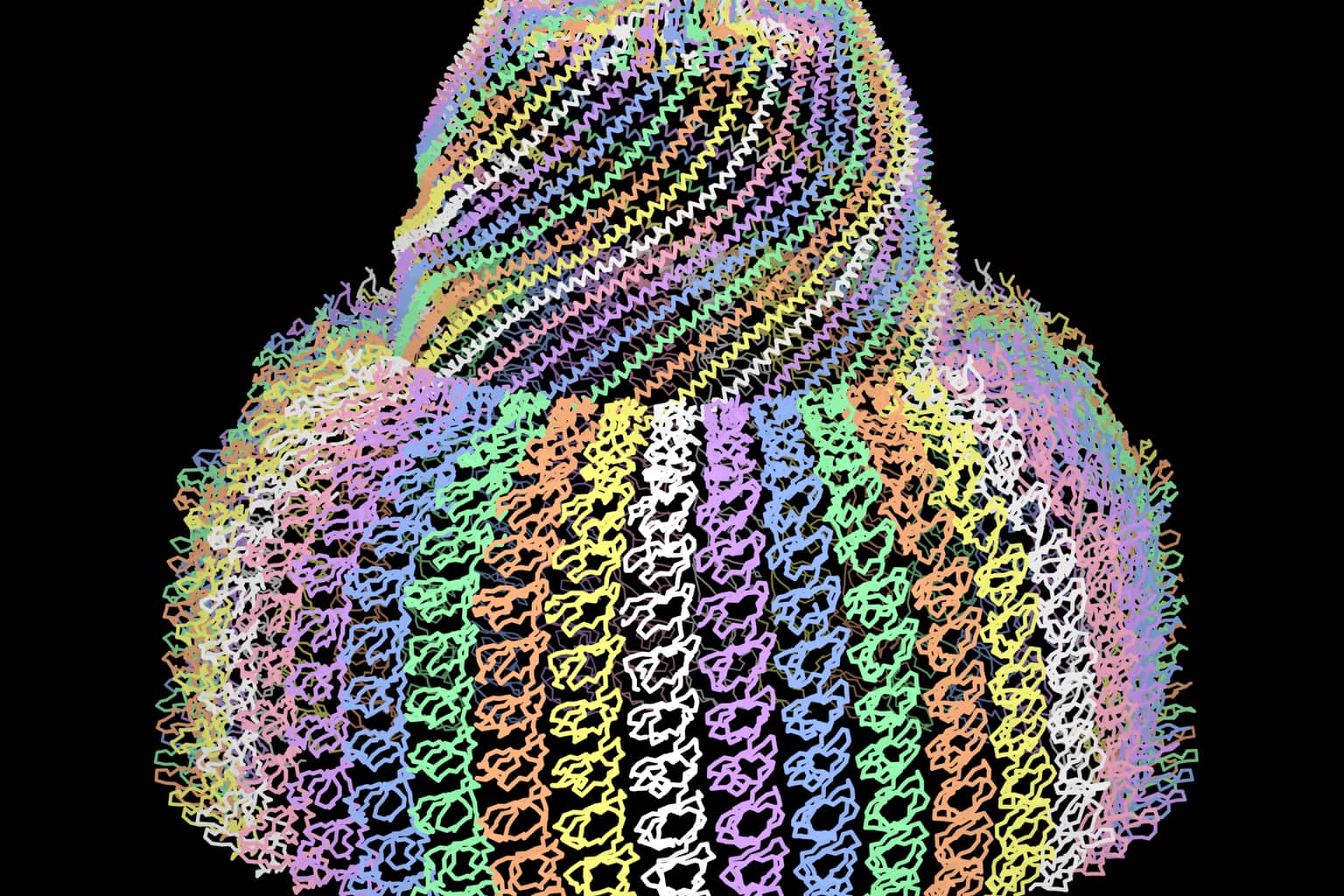
Ninety-six copies of one protein, locked together into a hollow barrel about 54 nanometers long: that is the structure Anthropic's biology research team has just mapped in three dimensions. According to the researchers, it is the first 3D structure of a vault particle linked to bacterial life, a branch of these assemblies that had not been explored. The team used Claude, Anthropic's AI model, at every stage, from picking out promising proteins to rebuilding their molecular architecture.
Vaults have puzzled biologists since Leonard Rome and Nancy Kedersha first identified them in 1986. They are among the largest protein complexes found in human cells, and they appear across organisms as different as slime molds and humans. Their purpose is still unknown: researchers have proposed roles in transport, drug resistance and immune defense, but no experiment has confirmed any of them. Common lab organisms have no vaults at all, which made them very hard to study.
The search began with roughly 15 billion predicted protein sequences, looking for distant relatives of vault proteins. It flagged candidates across 29 major bacterial groups and four groups of archaea, and the team selected 44 for lab testing. Of the 15 proteins that were successfully produced, seven assembled into vault-like particles. Cryogenic electron microscopy, or cryo-EM, then confirmed the structures of four candidates: two from bacteria and two from bacteriophages, the viruses that infect bacteria.
The team chose one phage-derived protein, L05, for detailed analysis. It assembled into a complete particle built from 96 copies of itself, measuring about 54 by 45 nanometers, with a mass of roughly 9.5 megadaltons. Despite being shorter than mammalian vaults, which contain 78 copies of their major protein, it encloses about 25 percent more volume. Adding two repeating segments made the particle larger still, with enclosed volume up by about 20 percent. These experiments suggest that protein duplication could have helped vaults evolve different sizes.
The method gains are the most concrete part. Traditional purification takes about three days; the team's chromatography-based approach cut it to roughly 90 minutes, with Claude helping choose equipment and optimize the procedure. Claude also processed the cryo-EM data and produced a first complete model within 34 hours, where the team estimates conventional analysis could take several weeks. The project had setbacks too: an additive in one protocol interfered with DNA delivery and cost two weeks, and Claude produced an inaccurate structural map after skipping a standard processing step. Closer supervision fixed these problems, and the lab shared its observations with Claude's development team.
For researchers studying vault-like structures in human cells, the bacterial version offers a simpler system to investigate, because it can be made and examined in the lab. Leonard Rome, one of the original discoverers, calls the central question enormously challenging. The new structures give researchers another route toward answering it, and much of the biology remains unexplored.
Sources — read the originals(Paris time)
Read next
Comments
Loading the thread…
Sign in to leave a comment. Sign in