Artemis I crystals read lunar radiation doses with a new method
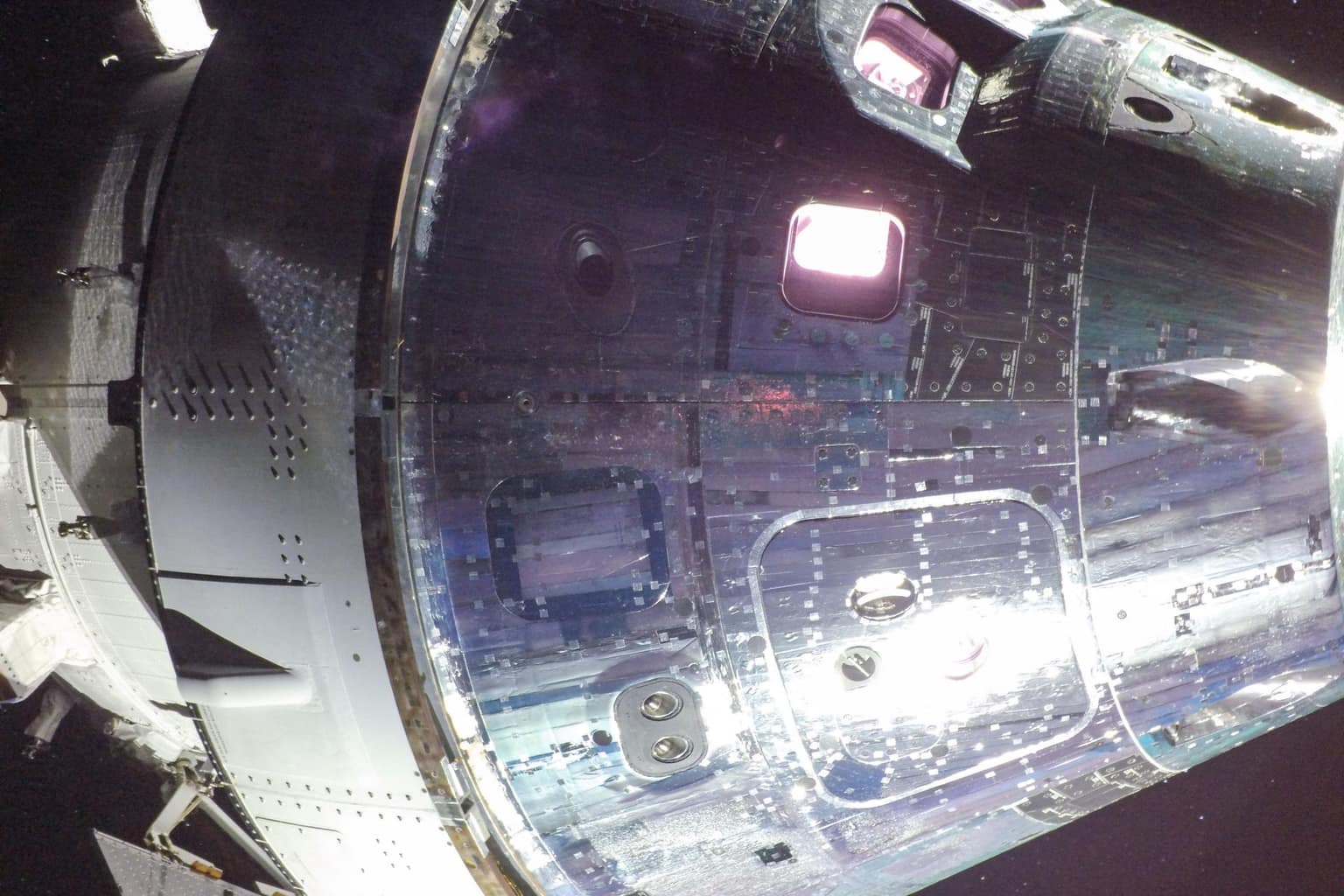
On the Artemis I flight in late 2022, the uncrewed Orion capsule circled the Moon with more than 10,000 small crystals inside two human phantoms, mannequins built to carry sensors. Several dozen of those crystals were experimental lithium fluoride detectors, developed at the Institute of Nuclear Physics of the Polish Academy of Sciences (IFJ PAN) in Kraków. Their data are now readable, and the method used to read them has been presented in the journal Radiation Measurements.
The principle is close to old photographic film. As ionizing particles cross the crystal, they create defects in its atomic lattice. Under blue light in the lab, those defects emit red fluorescence, and each particle track becomes visible under an ordinary fluorescence microscope. Plastic track detectors, the usual alternative, must be chemically etched before they can be read. The lithium fluoride crystals need no such step, which is why reading the tracks was quick. Turning them into numbers was harder.
Cosmic radiation comes from every direction and contains every natural type of particle and nucleus, across a very wide range of energies. The tracks therefore cross the crystal at many angles, and only a short segment falls within the microscope's focal plane. The rest adds a blurred glow that distorts the fluorescence intensity, the main measure of ionization density. Weakly ionizing particles leave only scattered dots rather than continuous lines, which distorts it further. The team applied a series of corrections and wrote software to strip out this background. After that work, the results differ by no more than 15% from those of conventional track detectors across the whole range where both methods apply. The new readout also records tracks from energy deposits below the threshold of the older detectors.
The mission also explains why the radiation picture changes. During the MATROSHKA experiment aboard the International Space Station, more than a decade earlier, low-energy protons trapped in the Van Allen belts, the bands of charged particles held by Earth's magnetic field, deposited much of the dose unevenly through the phantoms. Near the Moon those belts are absent, and galactic radiation dominates. Its particles are energetic enough to cross the whole body, leaving only part of their energy along the way. The dose recorded inside the phantoms during Artemis I was therefore essentially uniform. The team's measurements indicate that total doses near the Moon are higher than in Earth orbit, a preliminary finding that a fuller analysis will need to confirm.
What this changes is the way crews could be monitored on future lunar flights. A detector that needs no chemical etching and reads energy deposits the older generation missed gives mission planners more precise data on the same kind of hardware. The team has not announced a date for the next application of the method, but the readout already applies to the crystals that flew around the Moon.
Sources — read the originals(Paris time)
Read next
Comments
Loading the thread…
Sign in to leave a comment. Sign in