Atoms store 123 quantum bits in their positions, all linked
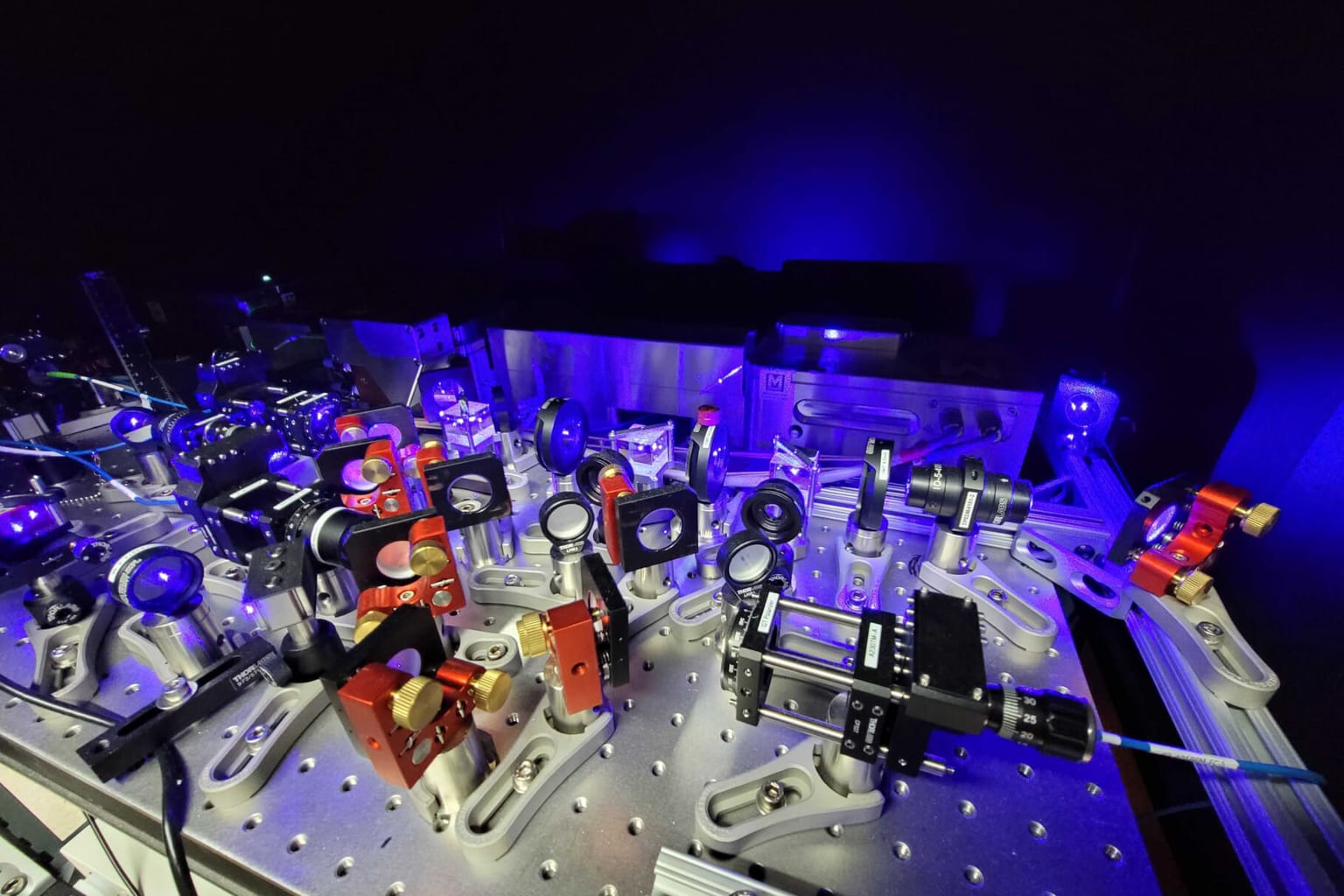
Picture a grid of laser light that holds one atom in each pair of neighboring traps, like a marble that can sit in either of two cups. In a study published in Physical Review Letters, a team of researchers has used that grid to link 123 quantum bits into one connected network.
A quantum bit, or qubit, is the basic unit of a quantum computer. A classical bit is either zero or one. A qubit can be prepared in a mix of both. When several qubits are entangled, they share a single state, so measuring one tells you something about the others. That shared state is what makes a network of qubits usable as a computing resource.
The difficulty is spacing. The atoms sit so close together that the laser light used to address one of them spills onto its neighbors. The authors write that, as the spacing approaches the limits of current quantum gas microscopes, this 'inevitably causes operational crosstalk' whenever someone tries to act on a single site. Earlier experiments on such grids had entangled several atoms, but turning those arrays into working computing resources had proven hard.
The team got around this by storing each qubit in the atom's position: whether it sits in the left or the right trap of a pair. The atom's internal direction, up or down, serves as the switch for operations. Controlled hops between traps generate entanglement between neighboring qubits. Extra internal states of the atoms let the researchers act on one atom at a time while still running operations in parallel. A single layer of entangling operations produced a line of linked qubits, and two layers produced a two-dimensional network. The team checked the result by imaging each site, and it verified that the entanglement covers a single connected region of 123 qubits.
The result proves the network is linked. It is not yet a computation. The team did not run a calculation using all 123 qubits. In separate experiments on small segments, it demonstrated single-qubit operations and a two-qubit entangling operation without disturbing neighboring atoms. Accuracy is the weak point. Uneven trapping limited the entangling operations, which reached an average accuracy of about 95% in the tested region.
The authors see a way forward. More uniform laser trapping, they say, could improve that accuracy, and they expect that above 99.9% could be reached in the future. They present the platform as 'a scalable architecture for quantum processing'. The study gives no date for either step.
For groups building quantum computers from atoms, the change is concrete: a connected network of 123 linked qubits now exists in the laboratory, and it can be tested as a whole. For everyone else, the timeline is still open. The precision of the operations is what will decide how far this approach goes, and the authors have named the target they are aiming for.
Sources — read the originals(Paris time)
Pages consulted while writing
Read next
Comments
Loading the thread…
Sign in to leave a comment. Sign in