ESA's Hera resolves Didymos and Dimorphos as two separate asteroids
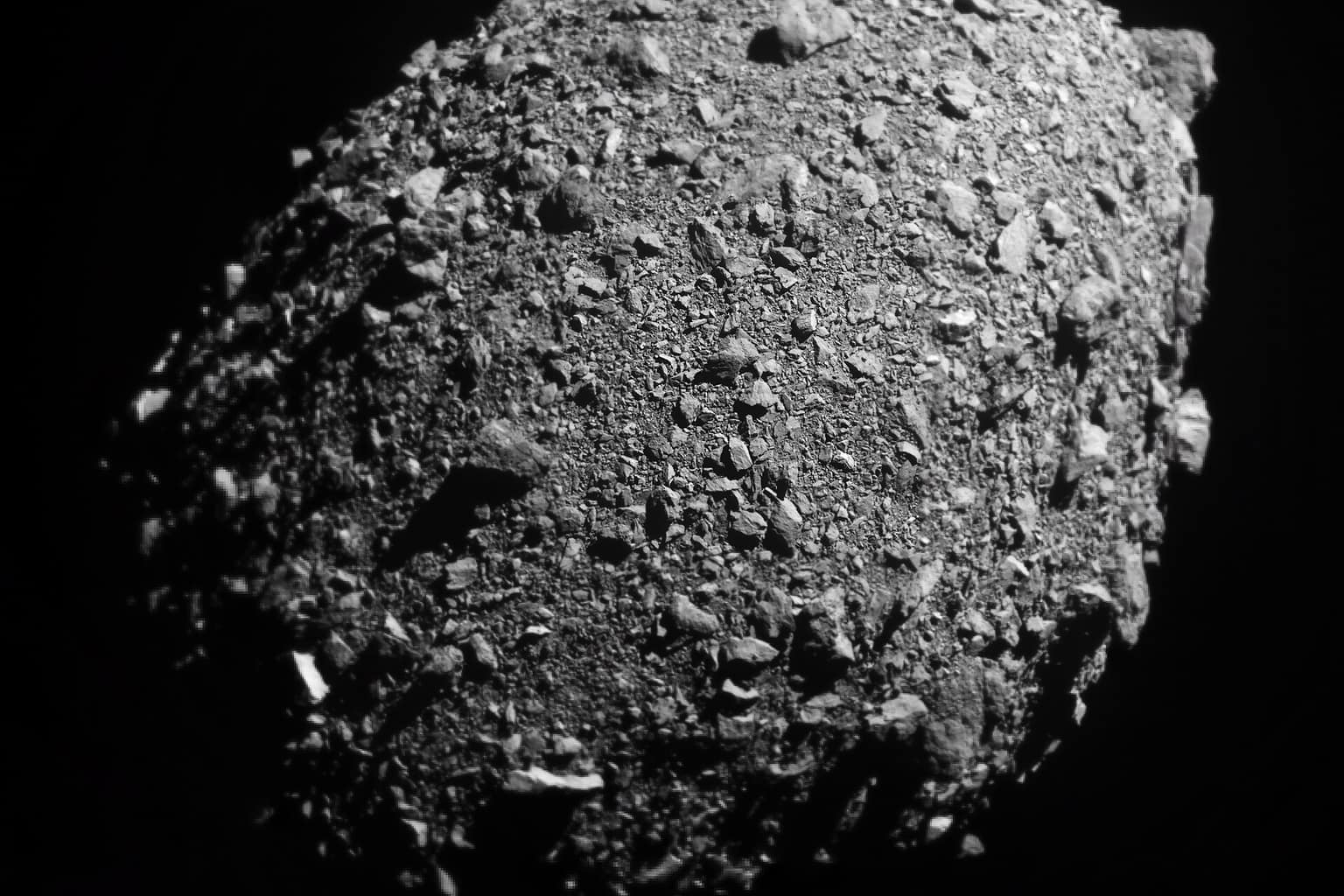
On the evening of Friday 18 October, ESA's Hera probe took an image in which Dimorphos stood apart from its parent asteroid for the first time. Until then, the two bodies had appeared as a single point of light. The pair sits about 197 million km from Earth, and Hera was 1,280 km away when its camera fired. In this first frame, Dimorphos covers only about one pixel, yet mission manager Michael Kueppers says it is "clearly well separated from its parent body."
The picture was the reward for a delicate approach. Hera fired its thrusters twice, a week apart, to slow to 20 m/s relative to the two asteroids, which let it draw closer step by step. The probe is the European follow-up to NASA's DART mission, which crashed into Dimorphos on 26 September 2022 at 6.1 km/s. That impact sent a plume of debris across 10,000 km of space and shortened the asteroid's orbit by around 33 minutes, a far larger shift than impact simulations had predicted. Dimorphos, about 151 m across, is roughly the size of the Great Pyramid of Giza. Its larger partner, Didymos, at 780 m in diameter, is a little smaller than Dubai's Burj Khalifa. The two orbit an average of 1.15 km apart, and Dimorphos moves around its parent at about 18 cm/s.
What changes is the ability to measure what DART actually did. Planetary defence, the effort to deflect dangerous asteroids, has so far rested on a single experiment. Hera is designed to answer the questions that experiment left open: whether the impact cratered Dimorphos or reshaped it, and what its precise mass, structure and composition are. Mission manager Ian Carnelli calls Dimorphos "the first object in the solar system to have had its orbit measurably shifted by human action," which makes it a unique reference point for the method.
The next step is set for 25 November, when Hera's detailed images of Dimorphos are due. Over the following months, the probe will carry out a close-up "crash site investigation" with several instruments and two shoebox-sized CubeSats, before moving toward a possible landing.
Sources — read the originals(Paris time)
Read next
Comments
Loading the thread…
Sign in to leave a comment. Sign in