Hera probe sends close-up views of the asteroid NASA hit
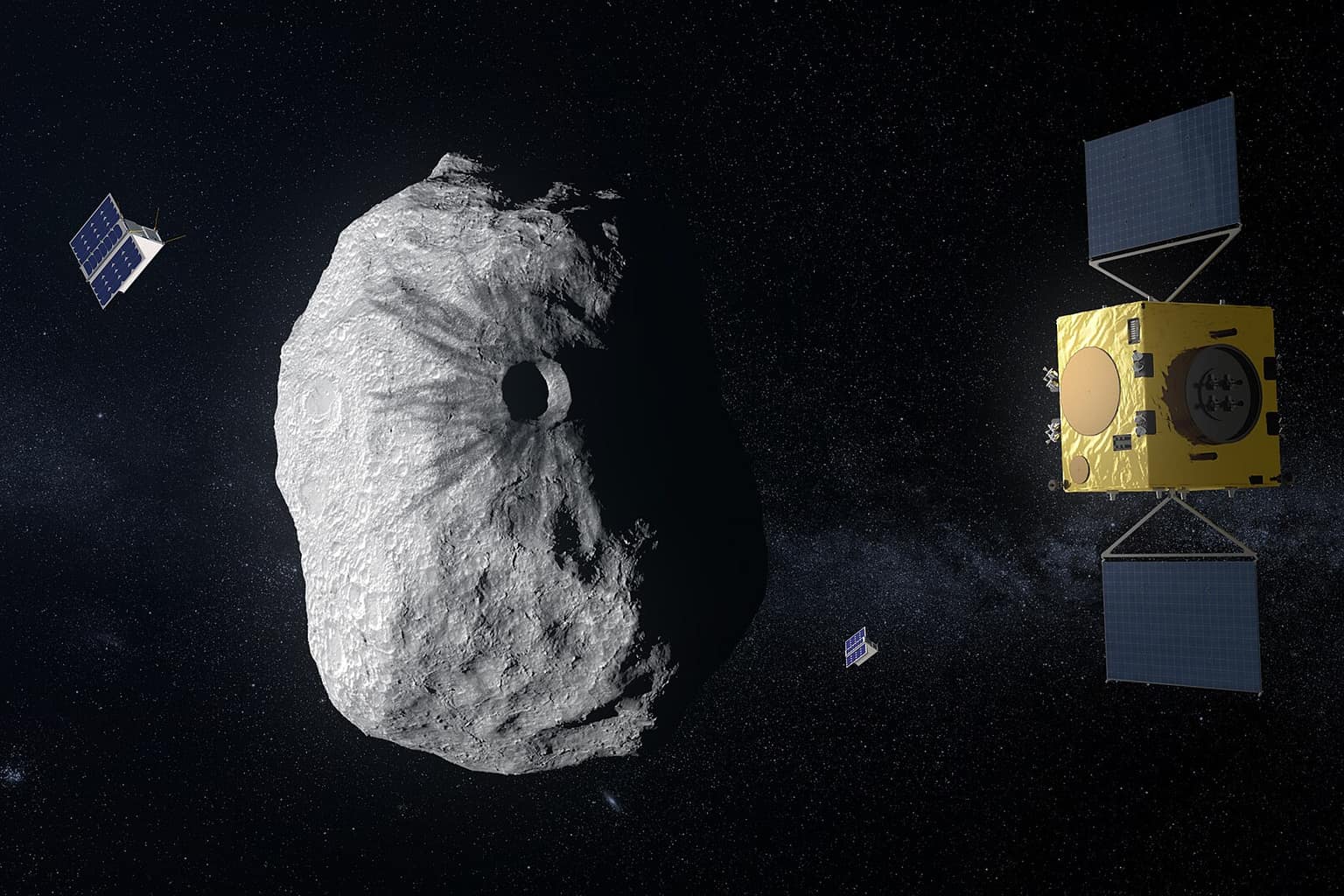
On 26 September 2022, NASA's DART spacecraft slammed into Dimorphos at more than 22,000 km/h. Dimorphos is a moonlet 151 m across that circles a larger asteroid, Didymos, which measures 780 m. The point of the test was to see whether a crash alone could push an asteroid onto a different path. Four years later, the European Space Agency's Hera probe, launched on 7 October 2024, has reached the pair and sent back some of the best pictures of it since the impact.
The hard part is that DART was a one-way trip, and no spacecraft was left behind to watch the impact up close. Ground observatories did follow the pair for four years, and they measured the result: Dimorphos had shortened its orbit around its partner by about 33 minutes. Some scientists were surprised by how large that change was, compared with the calculations made before the mission. Those calculations depend on how much of the push came from the spacecraft itself, and how much from the debris blasted off the surface and flying away, which acts like a recoil. Hera exists to separate the two.
Hera carries three imaging tools. The Asteroid Framing Cameras take black-and-white pictures and also help the probe navigate. The second, HyperScout H, records the pair in 25 colour bands. Each material reflects and absorbs light in its own way, a method called spectroscopy, so comparing those patterns with meteorites studied in laboratories on Earth should show what the rocks are made of. Seen in the Asteroid Framing Cameras, Didymos has the shape of a spinning top, fatter at its middle than at its poles, because it turns fast enough to pull loose gravel toward its equator.
The third tool is a thermal infrared camera, TIRI, supplied to ESA by Japan's space agency JAXA. It maps surface temperature, and solid rock gives up heat more slowly than loose, porous rubble, so the pattern hints at how solid Didymos really is. Dimorphos is the hardest of the two to see in visible light, tucked almost entirely into the shadow of its partner. In the infrared it stands out clearly: a violet spot below Didymos, apparently cooler than the main body.
For planetary defence, the gain is a measured answer to whether an impact can change an asteroid's path, and by how much. Today the answer rests on ground observations and on pre-mission calculations that did not fully match them. Hera is built to close that gap for this particular crash.
Hera also carries two small satellites, CubeSats, named Juventus and Milan. According to Space.com, they are to be released in January, and they will study the pair up close, using radar that looks beneath the surface and even touching down on Dimorphos.
The next release is set for 25 November, when ESA will unveil detailed images of both asteroids at a live event at the Berlin Museum of Natural History. Those will be the sharper views that follow this first round of pictures, and the work of establishing what really happened to Dimorphos is only beginning.
Sources — read the originals(Paris time)
Pages consulted while writing
Read next
Comments
Loading the thread…
Sign in to leave a comment. Sign in