First 3D map of the Sun's outer magnetic field, from existing data
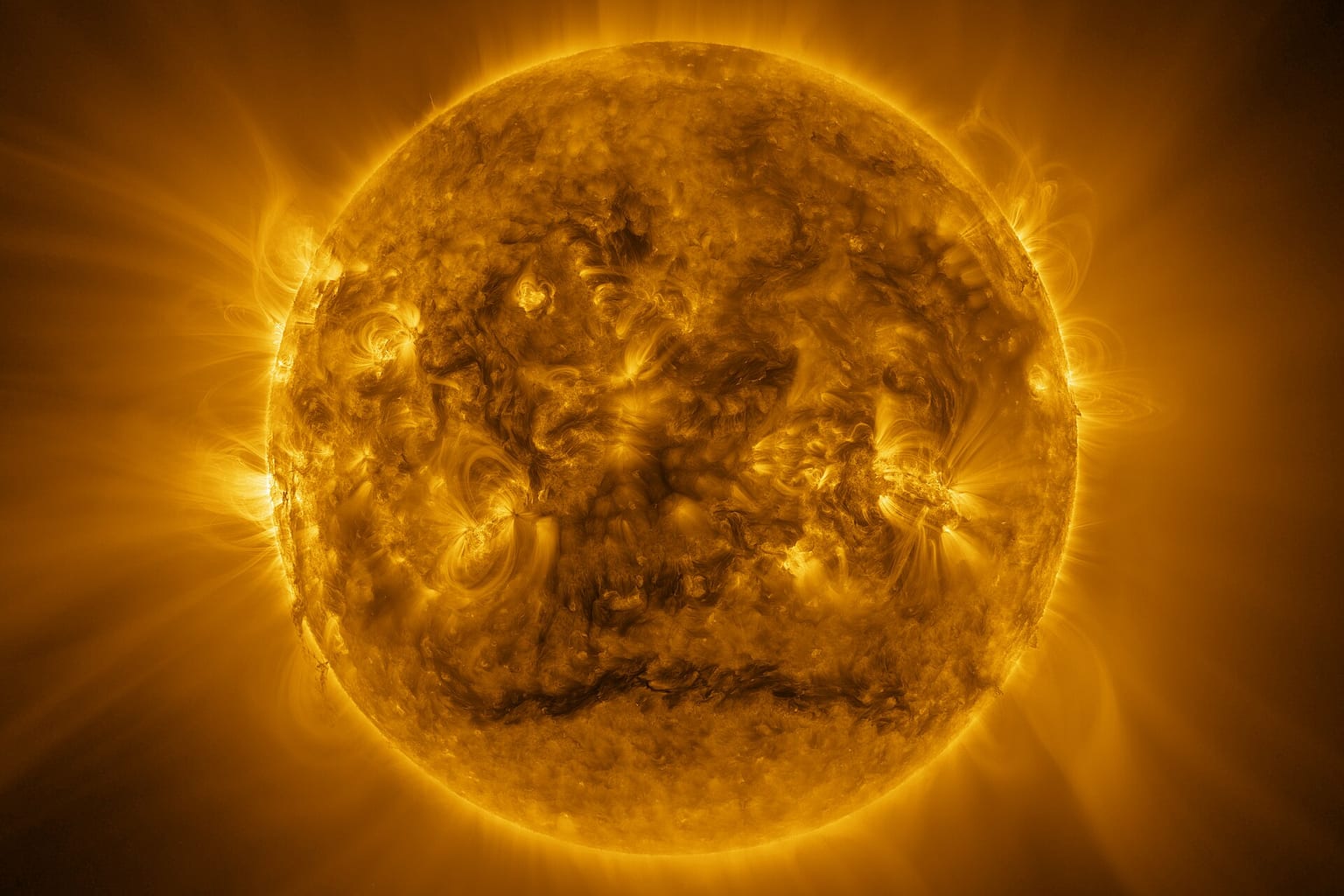
For decades, astronomers have been able to watch the corona, the Sun's upper atmosphere, in fine detail. What they could not do was measure the magnetic field shaping it. A team from the U.S. National Science Foundation National Center for Atmospheric Research (NSF NCAR), the National Solar Observatory (NSF NSO) and Southwest Research Institute now reports the first global, three-dimensional estimates of that field, including the area beyond the Sun's visible edge.
The team did not build a new telescope. It reused observations already held at the Mauna Loa Solar Observatory (MLSO), in Hawaii, and extracted information that had been out of reach. The work builds on an earlier study that produced the first 2D global maps of the coronal magnetic field, from the Upgraded Coronal Multi-channel Polarimeter (UCoMP) at MLSO. The new step relies on a technique called the IQUD inversion, which reads the waves travelling through the corona. Applied to data from the original Coronal Multi-channel Polarimeter (CoMP) of October 14, 2016, and from UCoMP of June 1, 2022, it reconstructs the field in three dimensions. Alin Paraschiv, an NSF NSO researcher and lead author, puts it simply: the team is "decoding the light and waves already coming from the sun's corona."
The maps give the strength and 3D direction of the coronal magnetic field across the regions covered by MLSO observations. Daniela Lacatus, an NSF NCAR researcher and co-author, says the results "look reasonable and comparable to what we'd expect" in validation tests. The team is careful about what this is: a demonstration that the method works on real observations, not a finished product. The maps have limitations, and additional development and validation are needed before the approach can become routine. The study is published in The Astrophysical Journal Letters, and the team has made its software and data sets openly available so other scientists can test and refine the method.
For forecasters, the gain lies in better models of solar activity. Solar magnetic eruptions are the root cause of extreme space weather, and the magnetic field is what drives them, so measuring more of that field is the first condition for predicting them better. Tom Berger, MLSO director, sees the work as a pathfinder for the advanced COSMO coronagraph network, the follow-on to the current MLSO facility, which is expected to make new observations of the magnetic field. The team hopes the IQUD method will one day be a standard data product in that network. No date has been given, and the method is not yet part of operational observatory pipelines. The next step is for other researchers to run it on their own days of data and show where it needs adjusting.
Sources — read the originals(Paris time)
Read next
Comments
Loading the thread…
Sign in to leave a comment. Sign in