Fish ponds under solar panels could nearly match US power use, a model shows
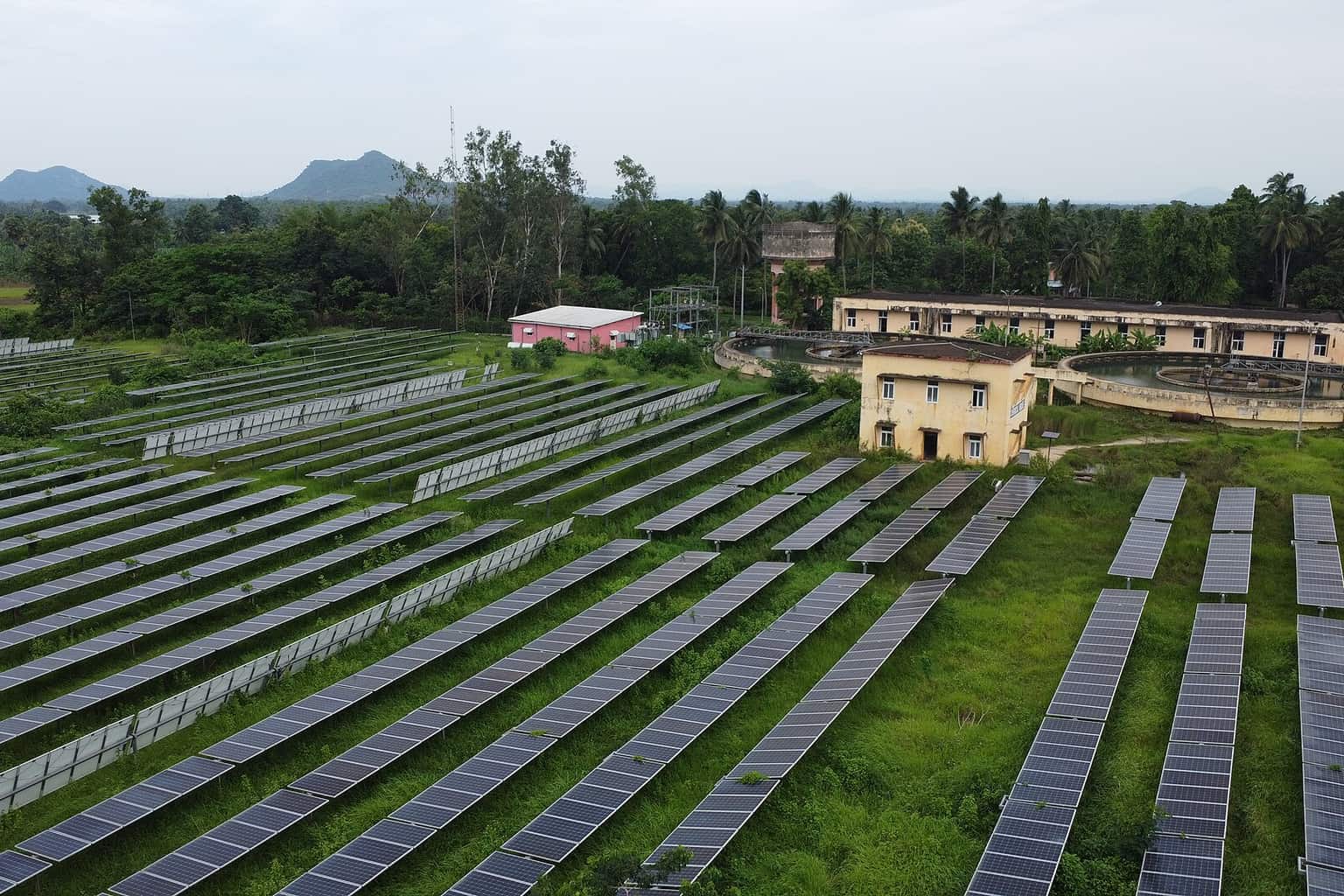
Solar panels above, fish below: that is the idea behind aquavoltaics, a sector that did not exist before 2010, which pairs photovoltaic panels, the devices that turn sunlight into electricity, with fish farming on the same water. A study published in Nature Food in 2026 puts a number on how far that idea could go. The authors estimated the total global area of aquaculture ponds from satellite imagery and other data, and found 50,000 square km of them worldwide.
Freshwater aquaculture already produces more than 160 million tons of fish, crabs and shrimp a year, and emits an estimated 438 million tons of CO2 equivalents, the standard unit that puts all greenhouse gases on the same scale. Solar power needs a lot of surface. It has been spread over farm fields and pastures, where it takes only a fraction of the sunlight without appreciably reducing crop yields, and set on lakes and reservoirs, where levels fluctuate too widely to make the work simple. Aquaculture ponds are generally small and shallow, with steady water levels.
Today only 423 square km of these ponds carry solar panels on the water, and 97 percent of that area is in China, with most of the rest in Vietnam, South Korea, Thailand and Israel. The authors then ran a scenario: if 40 percent of the 50,000 square km were covered, the electricity produced, 4,100 TWh a year (terawatt-hours, a unit of annual electricity), could replace fossil-fuel-derived power and avoid 2.5 billion tCO2eq a year, nearly six times the current emissions of aquaculture worldwide. That output is nearly as much electricity as the United States uses.
The benefit would fall mostly in regions that are not well connected to large power grids. The authors say this locally produced power could cover the current national electricity needs of Vietnam, Indonesia, Bangladesh, Myanmar, the Philippines, Cambodia, Ecuador, Honduras and Nicaragua, and could sustain more than 800 small and medium-sized cities. The highest potential sits along the coasts of South and East Asia, including Indonesia and the Philippines.
These figures rest on baselines that must be refined for each region and for each fish and crustacean species, and on the assumption that covering 40 percent of the water surface will not reduce yields. Those points remain assumptions in the model. For now, the study raises the possibility that aquavoltaics could help drive the transition to renewable energy, and the work that follows is to calibrate those baselines region by region and species by species.
Sources — read the originals(Paris time)
Read next
Comments
Loading the thread…
Sign in to leave a comment. Sign in