Flexible solar cells reach record 26.86% efficiency
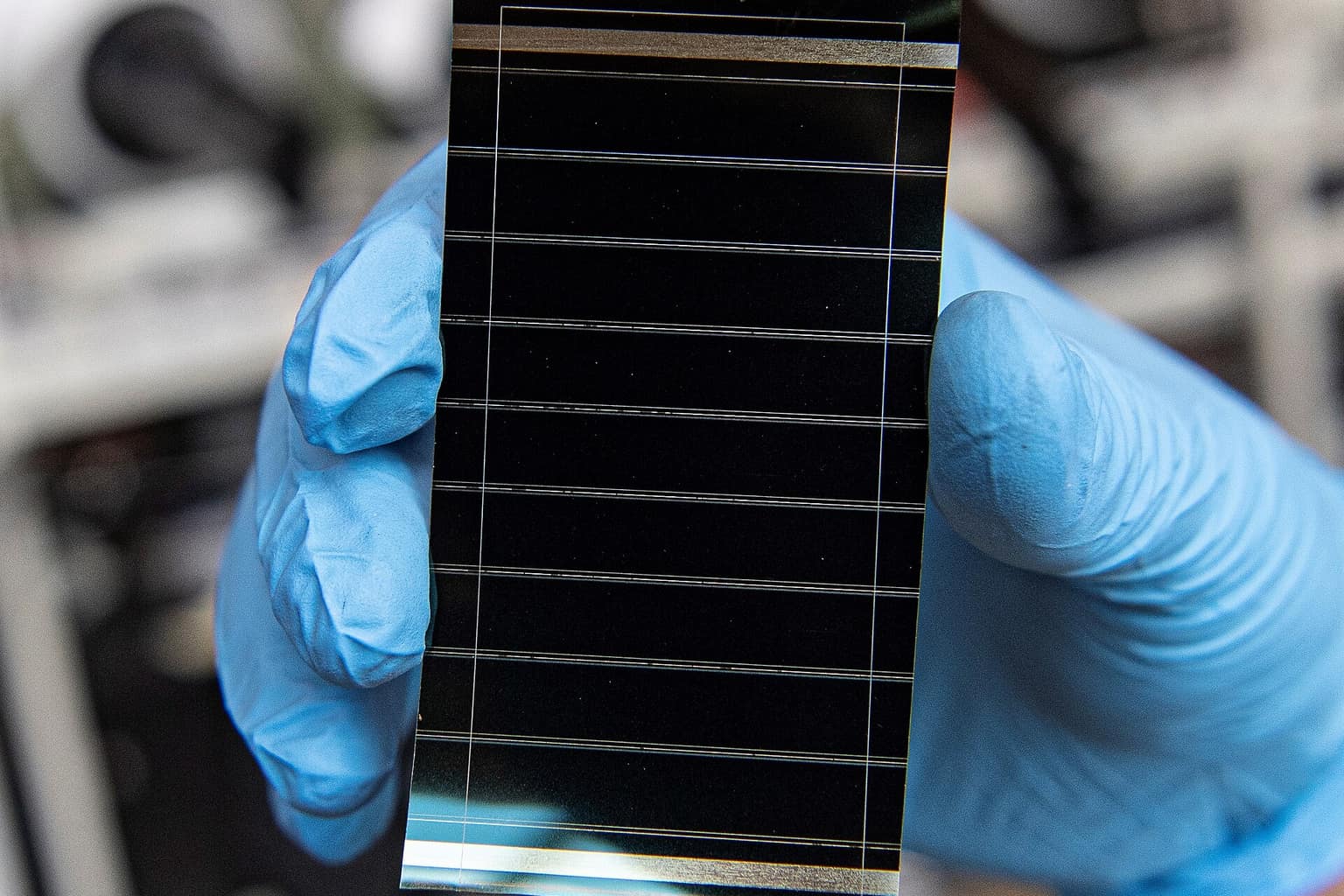
A flexible solar film that can roll over a backpack or curve across a car roof has just reached a new efficiency mark. A research team led by Southeast University and Soochow University reports 26.86% certified efficiency for small flexible perovskite cells, a record. The same approach, scaled up to 30×30 cm sheets, reaches 20.15%. The study was published in the journal Science.
The obstacle was in the printing. Flexible bases have uneven surfaces, and the two layers that make up the cell, the transport layer (a single-molecule film, or self-assembled monolayer, SAM) and the perovskite crystals, bound too strongly to each other when coated together. Instead of settling into their proper positions, they left uneven, defect-ridden layers that broke down under heat and humidity. The team's fix is a decoupling molecule, added to the precursor solution, carrying ammonium ions, iodide ions and two sulfonate groups. It forms strong chelating bonds with the perovskite, which blocks the harmful interaction, so the transport molecules can stick to the flexible base and the perovskite crystals grow with fewer flaws.
The stability figures are the most concrete. A 25 cm² flexible device kept 92.5% of its initial 22% efficiency after 1,044 hours of maximum power point tracking at 85°C (185°F) and 65% relative humidity. The flexible modules also survived thermal shock cycles, from frigid lows to extreme heat, and passed the IEC 63163 international stability standard. The team describes this certification as a foundation for industrial development of flexible perovskite photovoltaics.
For makers of flexible solar products, the change is practical: a printing method that holds efficiency as the panel gets larger, and that survives a standard stability certification. The team has not announced a timeline for commercial production, and the module figures and stability tests come from its own study, while only the small-cell efficiency is third-party certified. The next steps it names are refining the decoupling molecules, integrating tandem cell designs and scaling production for roll-to-roll manufacturing, where the film is printed continuously off a roll.
Sources — read the originals(Paris time)
Read next
Comments
Loading the thread…
Sign in to leave a comment. Sign in