Large perovskite solar module hits 22.70% efficiency
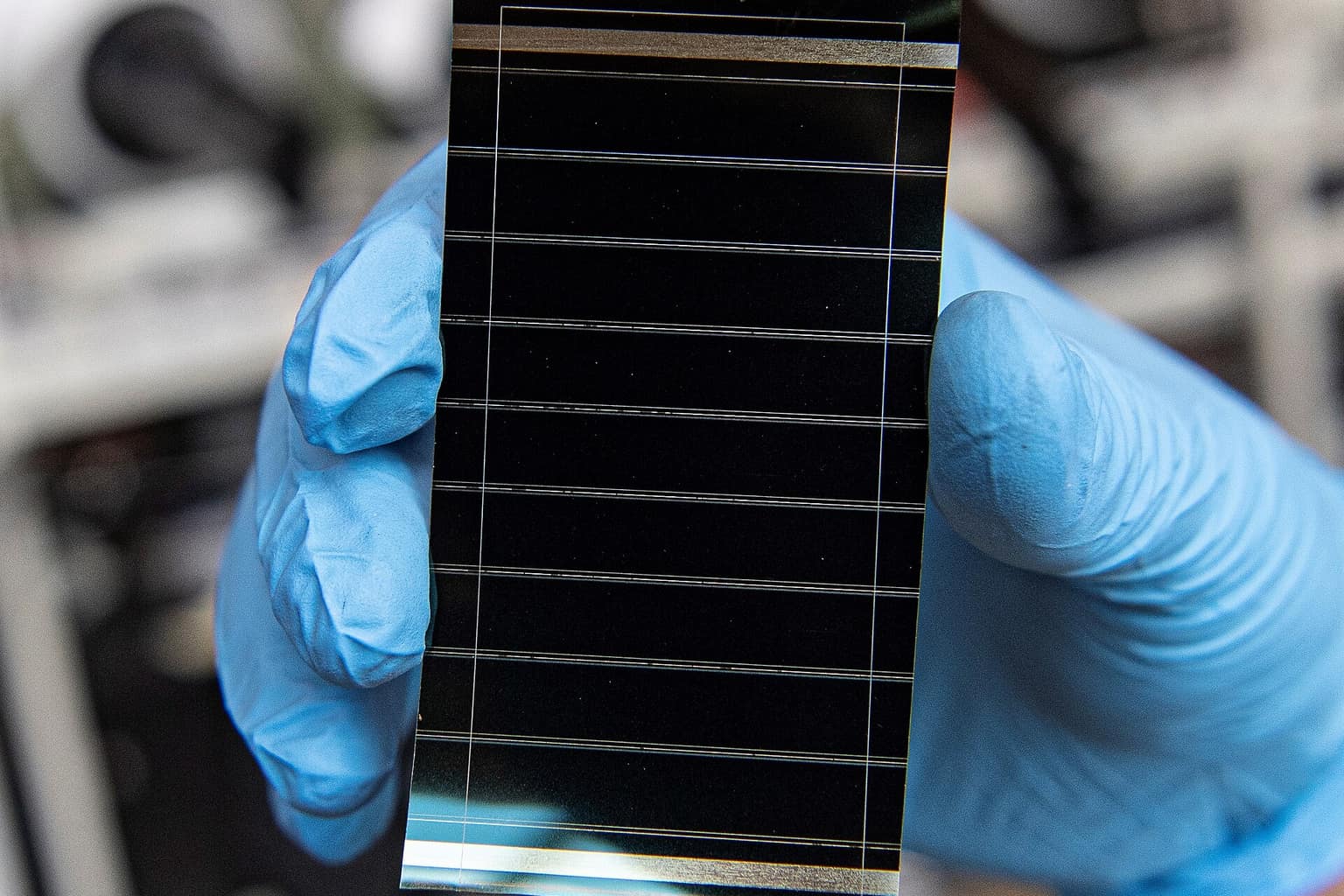
A 54.80 cm² perovskite solar module converted light into electricity at 22.70% efficiency in tests run by a research team, against 15.8% for its control module. The team, led by Professor Yang Dong at the Dalian Institute of Chemical Physics (DICP) of the Chinese Academy of Sciences, worked with Dalian Jiaotong University. The results are published in Advanced Materials.
The obstacle is the ink. The most stable version of this material, the MA-free FAₓCs₁₋ₓPbI₃ system, drops methylammonium, a volatile ingredient that compromises stability. But without it, the crystals form more slowly and tend to separate into phases, which makes a uniform film hard to achieve when coating in ambient air.
The team's answer was two additives with complementary roles. Formamidinium thiocyanate (FASCN) promotes nucleation, the first formation of crystals after a vacuum-flash treatment, and then their growth. Rubidium thiocyanate (RbSCN) works on the lattice itself: the rubidium ions sit on the A site of the crystal, relax its strain and lower the energy needed to form the photoactive α-FAPbI₃ phase, which suppresses the non-photoactive δ-FAPbI₃ phase. Together, the two additives extended the window for uniform crystallization to more than 100 seconds, and the films came out dense, with large grains and reduced residual stress.
The small-area cells reached 26.16%. The large module reached 22.70%, and the strategy also improved durability: unencapsulated devices kept 97.76% of their initial efficiency after 1,300 hours of continuous maximum-power-point tracking under AM 1.5G illumination at 65°C, while controls kept only 65.86%. These are laboratory measurements on unencapsulated devices, and the gap between the small cell and the module shows that scaling up still costs efficiency.
For manufacturers, the value is the window. Slot-die coating is compatible with continuous roll-to-roll processing and uses material efficiently, so a longer processing window is what lets a coating step tolerate the variations of a production line. The study does not say when this could reach a factory, nor at what cost. The next test is the one the paper points to: the same additives on larger modules, in conditions closer to production.
Sources — read the originals(Paris time)
Read next
Comments
Loading the thread…
Sign in to leave a comment. Sign in