Longi tandem solar cell reaches 35.31% efficiency
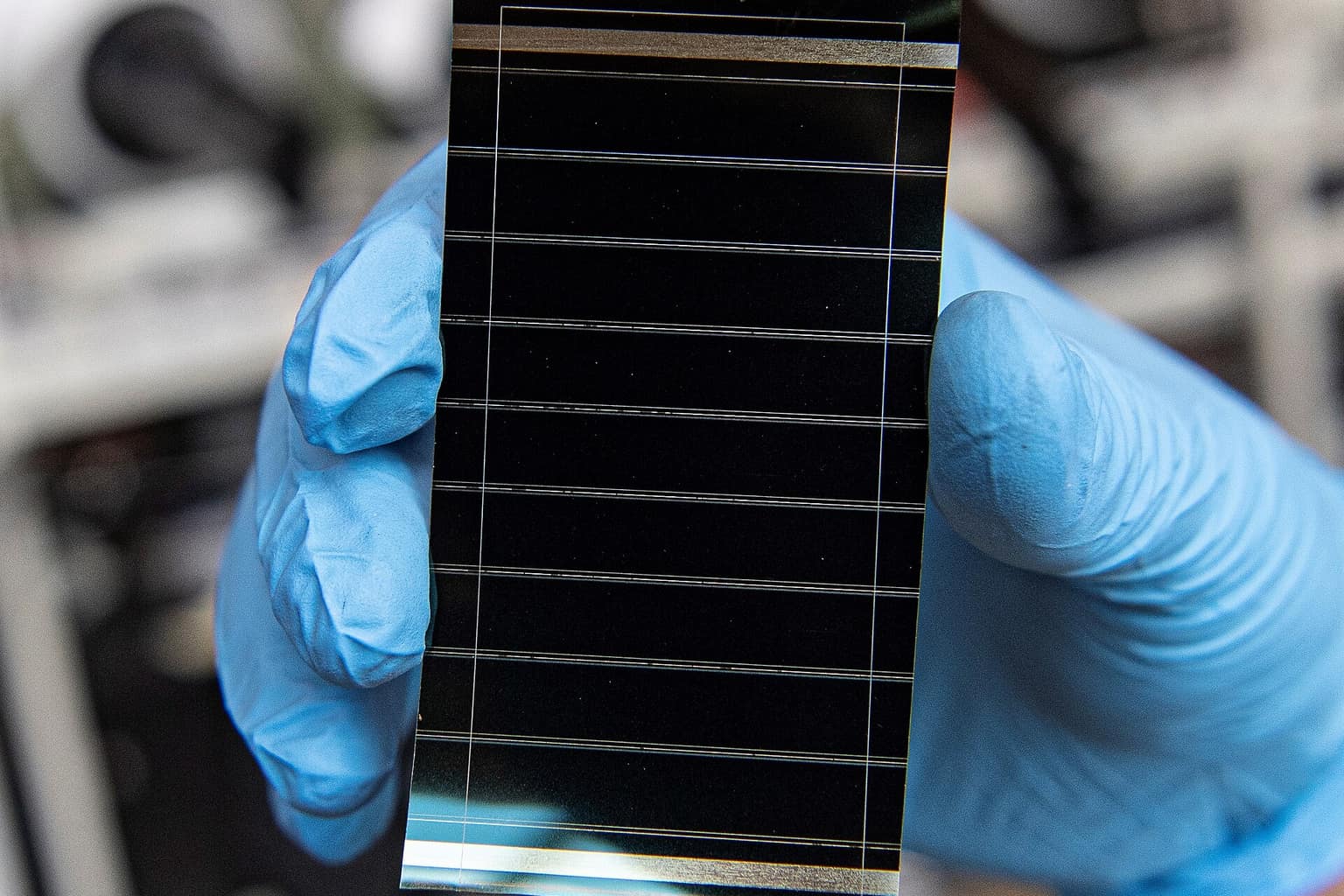
The silicon surface is covered in tiny pyramids, and the coating laid on top of it has to do two jobs at once: spread evenly across the bumps and let electrical charges pass through. Longi, the Chinese solar module maker, has now used a redesigned version of that coating to push a perovskite-silicon tandem cell to 35.31% efficiency, a laboratory result.
The problem sits in the coating itself. Conventional self-assembled monolayers, or SAMs, a layer of molecules that arranges itself on a surface, tend to clump together and leave uneven coverage on textured silicon. Longi's team, working with researchers from Soochow University, Northwestern Polytechnical University and Hong Kong Polytechnic University, designed four variants of the standard 4PACz molecule, called TC0 to TC3. TC2 offered the best balance, with a twisted side group that keeps the molecules from stacking too tightly. Simulations gave it 83.1% surface coverage, and experiments confirmed more than 80%.
A better-covered surface changes what grows on it. TC2 slowed and steadied the crystallization of the perovskite layer, producing larger, more uniform grains with fewer defects. The films reached a photoluminescence quantum yield of 1.46%, the highest among the SAMs tested, which the team reads as reduced nonradiative recombination, meaning energy lost without producing current. Bo He, a Longi researcher, said that the molecular design 'promotes the formation of a uniform, well-organized self-assembled monolayer.'
The device is a two-terminal tandem: a perovskite top cell on a heterojunction (HJT) silicon bottom cell, joined by an indium tin oxide (ITO) layer. The champion cell reached 35.31% efficiency, with a short-circuit current density of 20.82 mA/cm2, an open-circuit voltage of 2.007 V and a fill factor of 84.53%. Independent testing by the China National Center of Inspection on Solar Photovoltaic Products Quality (CPVT) certified 35.25% in a reverse scan and 35.13% stabilized.
The endurance numbers matter as much as the peak. Under the ISOS-L-1 protocol, a standard light-soaking aging test, the tandem cells kept 94% of their initial efficiency after 1,500 hours of continuous operation. Under ISOS-L-2, which runs at 65 °C, they kept 82% after 1,000 hours. Both tests are run in the laboratory, not in the field.
What changes now is the benchmark. The same team's approach builds on a run of recent results: a 34.0% tandem reported by Longi and Soochow University, and a certified 32.12% cell from a Soochow-led team around December 2025. For manufacturers weighing perovskite layers on silicon lines, the method is now published in Nature. Longi has given no timeline for taking the cell out of the laboratory, and the study reports no price.
Sources — read the originals(Paris time)
Read next
Comments
Loading the thread…
Sign in to leave a comment. Sign in