Organic solar module hits 18.8% efficiency
Silicon panels have covered rooftops for decades. Organic solar cells take a different route: they convert sunlight with carbon-based materials instead of silicon. A team at the Ningbo Institute of Materials Technology and Engineering (NIMTE), part of the Chinese Academy of Sciences, reports a fix for the weakest point of these devices, and the figures are the best yet for a module of this size.
The weak point sits at the electrode. A self-assembled monolayer, or SAM, is a single layer of molecules that lies on the transparent indium tin oxide electrode and helps carry charges out of the cell. Under continuous light and heat, these molecular contacts tend to desorb, meaning they detach from the surface. The team led by Ge Ziyi addressed this by depositing an indium-based interlayer in a vacuum. The layer triggers a ligand exchange, a chemical swap in which the molecules attach through a new network of indium-oxygen-phosphorus bonds. That network, which the researchers describe as multidentate, grips the SAM at several points and covers the surface densely and uniformly.
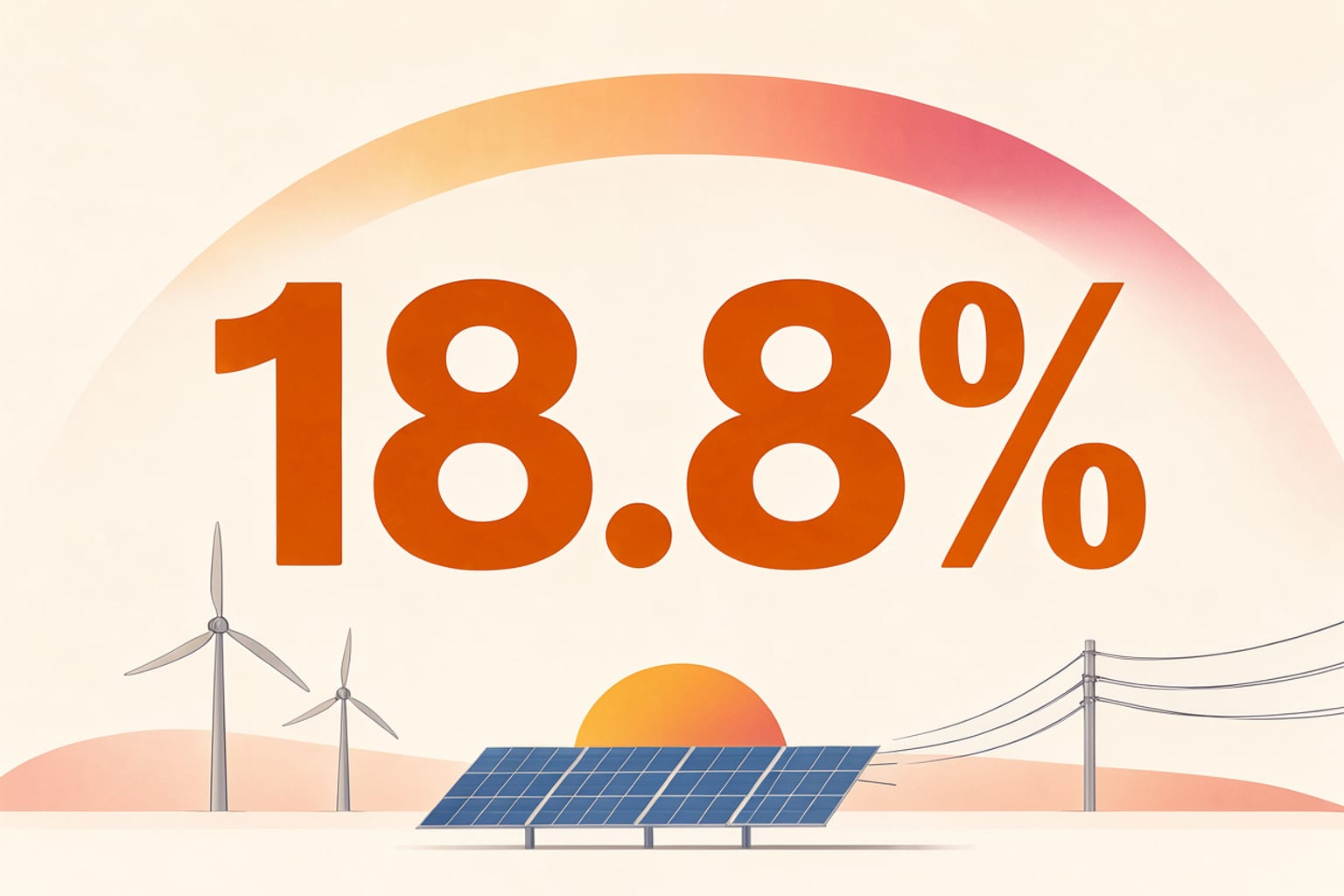
The numbers come in two sizes. Small-area cells built with this interface reached a power conversion efficiency of 20.4%. Scaled up to a module with an aperture area of 15.6 cm², the active-area efficiency reached 18.8%, which corresponding author Liu Quan presents as a record. After 2,000 hours of maximum power point tracking under continuous operation at 25 °C, the devices kept more than 85% of their initial efficiency. The paper, published in Joule on October 21, is titled as a chloride-mediated SAM locking study, and its authors say the approach offers a universal interface platform for modules of this kind.
The limits matter as much as the records. The 20.4% figure comes from small cells, not from the module. The stability test ran at a fixed temperature of 25 °C under controlled operation, not outdoors through seasons and heat waves, and the 18.8% figure is a laboratory measurement. The study does not give a production cost, a manufacturing partner or a date for commercial modules.
What changes, if the result holds, is the trade-off the authors name directly: efficiency, stability and scalability have rarely been reached together in organic photovoltaics. Makers of thin, flexible and large-area panels would be the first to gain from an interface that survives light and heat while being scaled up. For now, the gain belongs to the lab, and the next test is whether these modules keep their performance outside it.
Sources — read the originals(Paris time)
Read next
Comments
Loading the thread…
Sign in to leave a comment. Sign in