Four lasers print crack-free niobium nozzles, in prototype tests
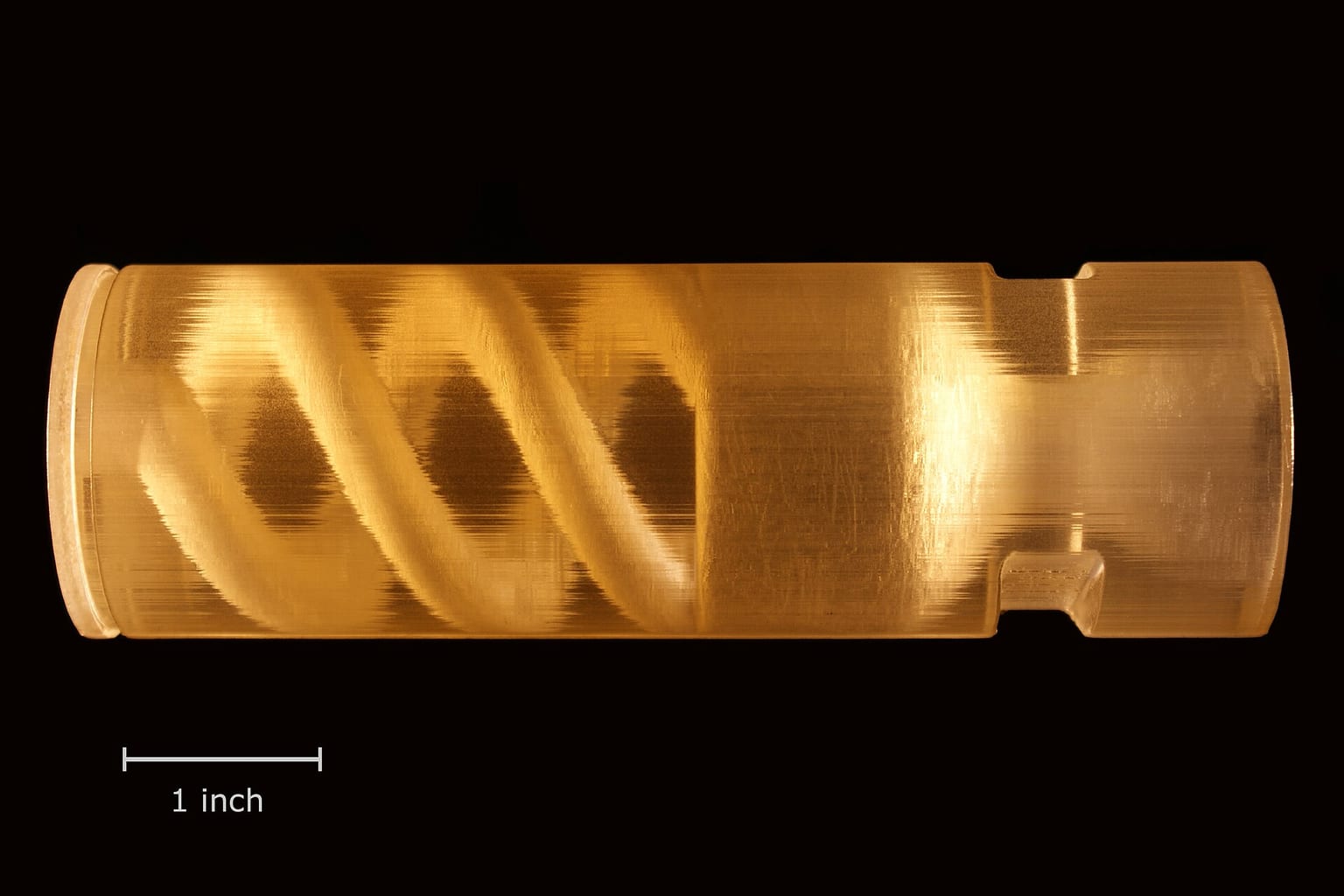
Rocket engines and hypersonic vehicles are pushing past roughly 1,050 °C, the point where nickel superalloys begin to soften. Niobium alloys are among the few materials that can take over there. At powder producer TANIOBIS, a team has now printed two of them, C-103 and FS-85, with laser powder bed fusion (PBF-LB), a process that builds a part layer by layer by melting metal powder with a laser. The team says it did so at industrial scale.
The parameters were first developed on a single-laser machine, the AM400, and moved to a four-laser AM500Q with only minor adjustments. To check consistency, the team printed 52 test cubes spread randomly across the plate, so that position could not bias the results: porosity stayed under 0.3% everywhere. Then came demonstrator nozzles, 53 mm across and 100 mm tall, which came off the build plate free of visible defects and without cracks. Running all four lasers at once raised throughput, closer to real production conditions.
The mechanical tests show a trade-off between the two alloys. FS-85 reaches about 750 MPa tensile strength at room temperature, against 565 MPa for C-103, which is a niobium alloy with about 10% hafnium. C-103, however, stretches 20–22% before breaking, while FS-85 manages only 6–7%. Heat treatment can lift elongation in both alloys to about 30% with little loss of strength. At 1,500 °C, where C-103 has almost no strength left, FS-85 still holds about 220 MPa. Printed C-103 beats rolled C-103 by a wide margin, with 557 MPa tensile strength against 420 MPa, and 462 MPa against 296 MPa at yield. That edge shrinks above roughly 800 °C, but it does not disappear before failure. Trade coverage of the work, from Metal-AM, reports the same ranking: FS-85 and Cb-752 outperformed C-103 on strength and creep at high temperature.
For a rocket designer, the gain is shape. Niobium is laborious to machine, which has confined it mostly to sheet and bar. Printing removes most of that burden and lets the alloys take complex, near-net-shape nozzles. The researchers conclude that no technical barriers remain to series production of components from either alloy. Those who would build flight hardware gain a material that can be made into a nozzle without the machining step; the timing of that gain depends on qualification, which the study has not yet reached.
The study itself targets that next step: showing the alloys behave consistently enough to qualify for flight hardware. TANIOBIS has also signed an agreement with Elmet Technologies to distribute its C-103 and FS-85 powders in North America, which widens access beyond the producer's own laboratories. The company gives no date for qualification.
Sources — read the originals(Paris time)
Pages consulted while writing
Read next
Comments
Loading the thread…
Sign in to leave a comment. Sign in