In lab, machine learning lifts ductility of 3D-printed aluminum
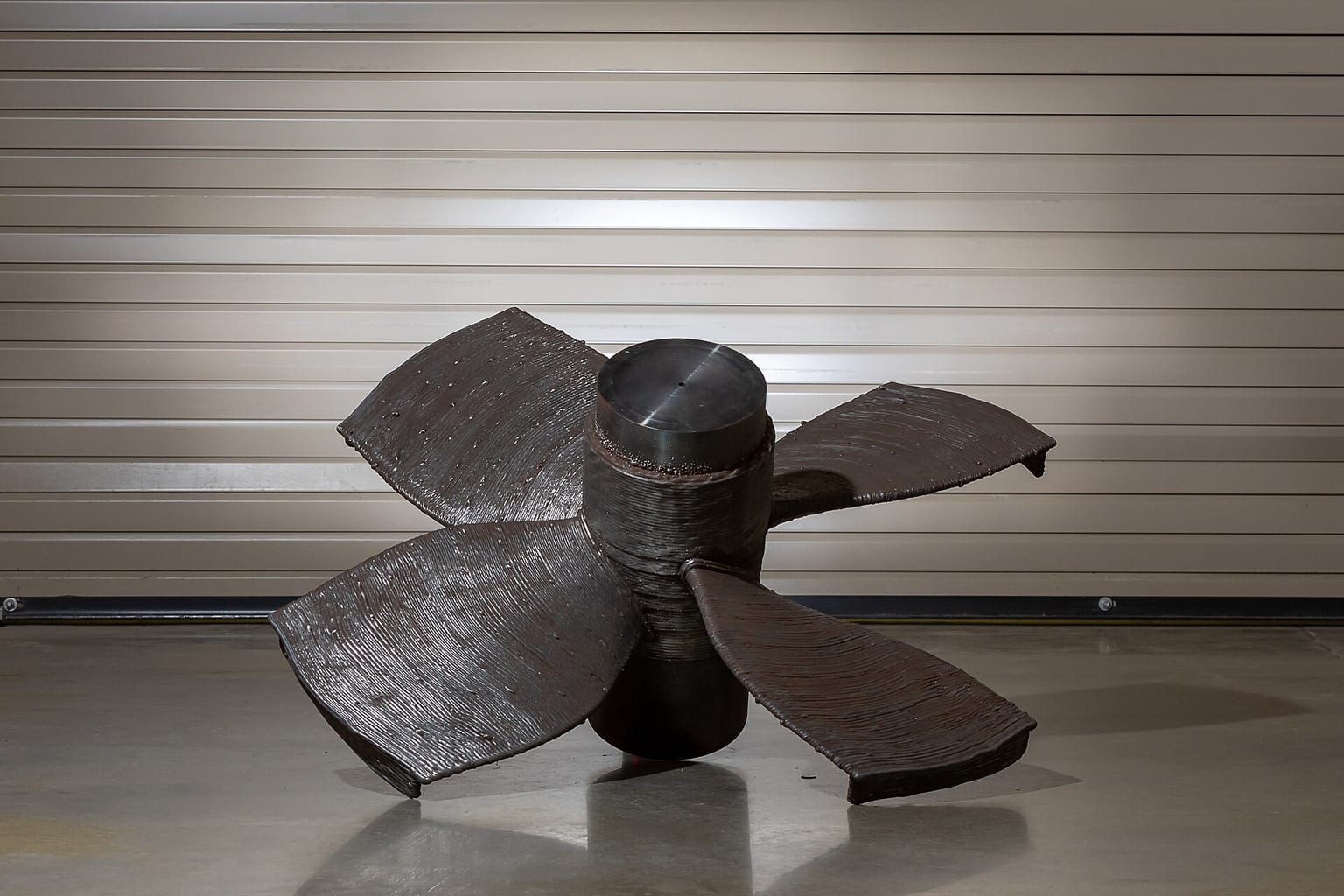
Inside a robotic cell, a welding arc melts aluminum wire and lays it down one bead at a time, building a wall along a fixed circular path. In a study published in Scientific Reports, researchers from King Faisal University in Saudi Arabia and two engineering institutions in India used that process to print aluminum walls and then trained a machine learning model to predict their properties from the printing settings. The best result in the new recommended settings was a stretch before breaking of 38.25%, measured on a single confirmation build.
Wire arc additive manufacturing, or WAAM, is a metal printing method suited to large structural parts because it deposits material quickly and makes efficient use of it. The walls in this study were printed on a Fronius welding unit mounted on an ABB robotic arm, in a mode called cold metal transfer (CMT), which reduces heat input and spatter. The team varied four settings: wire feed speed, travel speed, interpass temperature (the heat of the layer below when the next one is laid) and shielding gas flow. Across 30 builds, tensile strength ranged from 243.60 to 289.70 MPa, and elongation from 22.83 to 35.72%. The best run reached 289.70 MPa and 35.72% elongation, with 70.72 HV of Vickers hardness, a standard hardness scale.
The model, called PG-MOSR, combines several machine learning methods and translates the four settings into descriptors of heat buildup, cooling and gas shielding. Its predictive accuracy is measured by R², where 1 would be a perfect match. In cross-validation, the model scored 0.7799 for tensile strength, 0.8299 for elongation, 0.8142 for flexural strength and 0.8599 for hardness. A standard benchmark method matched it on tensile strength but fell to 0.573 on hardness. A simpler version trained on the four raw settings alone did better on all four properties, and the authors therefore present the physics-based descriptors mainly as a way to interpret the results. Wire feed speed weighed most in the tensile and flexural predictions, and interpass temperature in elongation, but the authors note that these rankings show statistical association, not physical cause.
With the model in hand, the optimizer screened 50,000 combinations and predicted 295.20 MPa in tensile strength and 40.10% in elongation. The confirmation build measured 288.90 MPa, 38.25%, 385.60 MPa in flexural strength and 70.95 HV, within 1.18% to 4.61% of the forecasts. The predicted gain in strength did not appear, and fracture surfaces showed ductile failure along with clustered pores, which the researchers suggest may explain the shortfall. For shops that print large aluminum parts, the value lies in the search itself: a model can test 50,000 settings on a computer, against the 30 physical builds the team had to make to train it.
The limits are clear and the authors state them. One confirmation build cannot establish reproducibility, and the model should not be used outside the tested parameter range without further validation. Fatigue, corrosion, residual stress and porosity were not part of the optimization. The next steps the team lists are CT-based porosity measurement, in-situ thermal monitoring during printing, and larger datasets.
Sources — read the originals(Paris time)
Read next
Comments
Loading the thread…
Sign in to leave a comment. Sign in