In lab tests, a chip sorts cells by electrical signature alone
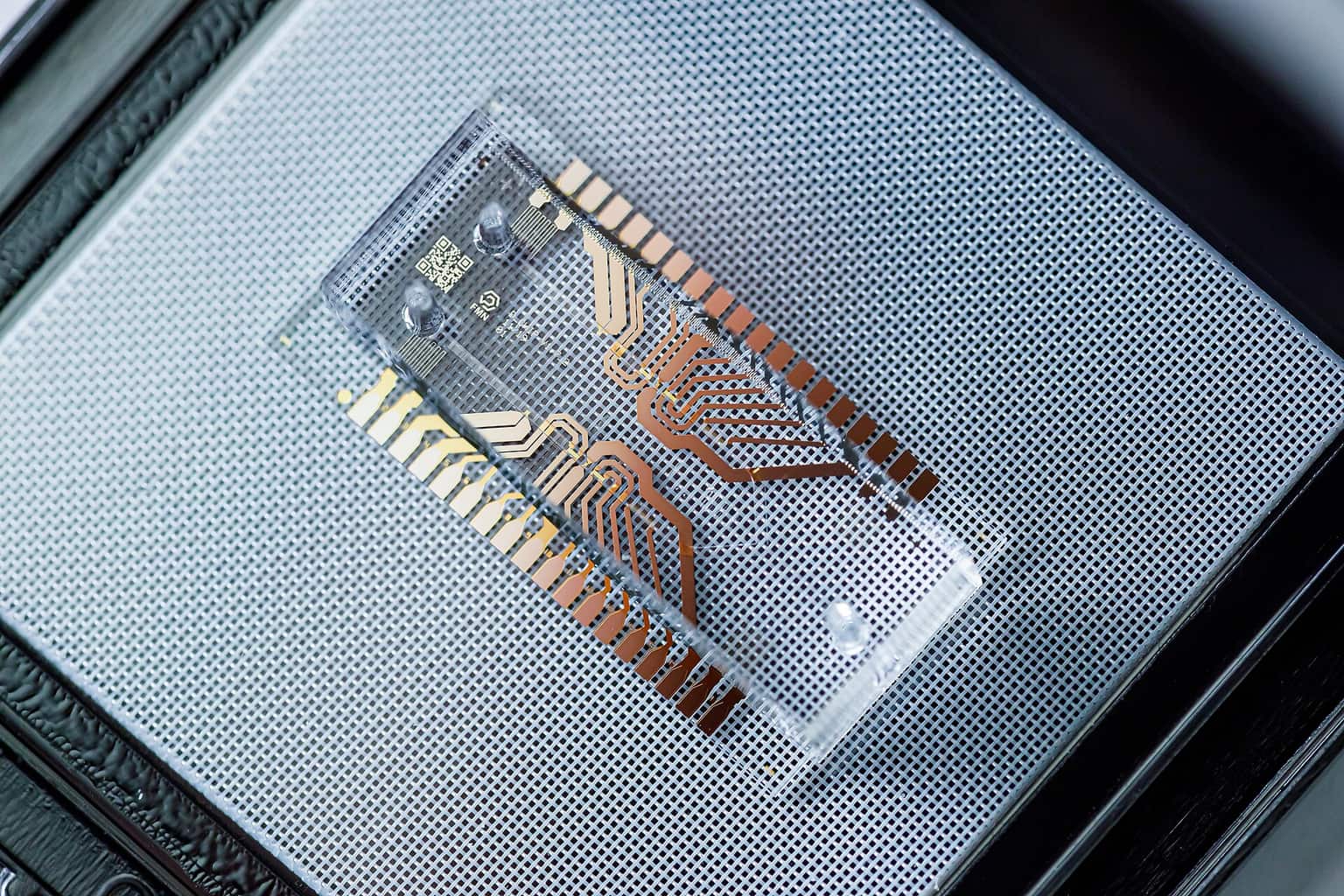
One by one, cells glide down a microchannel in single file, and each passes a pair of electrodes that read its electrical behavior. If it qualifies, a sound wave pushes it sideways into a collection outlet. This is the sorter described by a team from the Singapore University of Technology and Design (SUTD) and partners in China, published in the journal Small Methods. It works without dyes or tags: the cells are never labeled, and the sorting relies on what they already are.
Sorting living cells without damaging them has been a persistent problem in biomedicine. The standard method, fluorescence-activated cell sorting (FACS), tags cells with fluorescent markers, and those markers can stress cells, alter their behavior or interfere with the assay itself. The new platform combines three parts. A viscoelastic polymer solution, a thick, stretchy fluid, lines the cells up before they reach the electrodes. The electrodes apply weak alternating signals at 1 and 5 MHz and record how each cell changes them, which is a measure of impedance, or electrical resistance to alternating current. The system extracts features tied to the cell's effective size and electrical behavior, compares them with preset criteria, and predicts when that same cell will reach a junction downstream. If the cell qualifies, a focused sound wave switches on briefly and nudges it aside.
The team tested three problems. Sorting by size alone, separating HeLa cells from EA.hy926 cells by their effective electrical diameter, reached 98% purity. Red blood cells whose stiffness had been altered by chemical treatments mimicking disease-related changes to the membrane and cytoskeleton were also detected and sorted. The hardest test used HEK293T cells engineered with light-sensitive proteins: cells in an electrically 'activated' state were told apart from cells pharmacologically blocked from responding to blue light. These cells look structurally identical, and the platform reached 85.4% purity on them. Ai explains the gap: drug-treated cells may respond incompletely or at different rates, so their features partly overlap with those of activated cells.
Other groups are working on related principles. A paper in Lab on a Chip describes label-free, impedance-activated cell sorting with a latency of less than 0.3 ms, a throughput of 1,000 particles per second and an accuracy of almost 99%. Accuracy, throughput and purity are different measures, and the two platforms were tested on different cells, so their figures cannot be ranked against each other. The comparison shows a common route rather than a winner: electrical sensing is becoming a way to sort cells without labels.
For now, the nearest use is in research and drug screening. Researchers could enrich living cells that respond differently to a treatment affecting membrane function, in order to study them further, or look more closely at red blood cell deformability. Clinical uses, such as flagging disease-associated changes in blood cells, are a longer-term goal, and neither the study nor the team gives a date. The next steps are to extend the platform to primary, more fragile clinical samples, and to bring in machine learning to recognize patterns across signal amplitude, phase, waveform shape and frequency, rather than relying mainly on fixed thresholds. The challenge, Ai says, is making that identification reliable and fast enough to trigger the sound wave in real time.
Sources — read the originals(Paris time)
Pages consulted while writing
Read next
Comments
Loading the thread…
Sign in to leave a comment. Sign in