In the lab, a crystal's magnetism changes how heat and sound travel
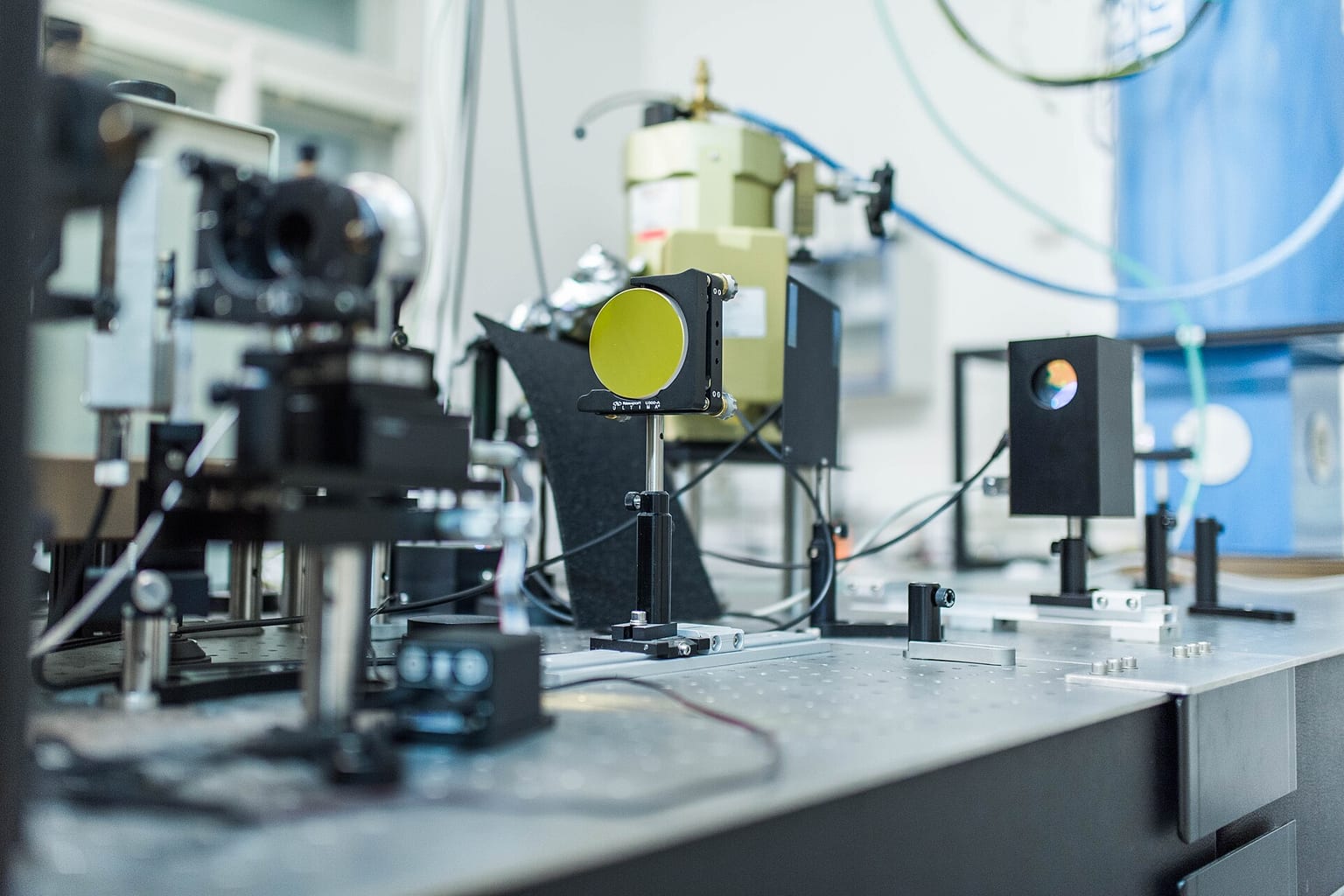
Cool a sheet of crystal only a few atoms thick to about 180 degrees below zero Fahrenheit, and the electrons inside stop pointing in random directions. Their spins, the built-in magnetism each particle carries, line up in a zigzag. Neighboring poles point in opposite directions, where in an ordinary magnet they all point the same way. Researchers at the UCLA Samueli School of Engineering and Auburn University have now measured how the vibrations of that crystal respond to this ordering, which the team calls a scientific first.
The vibrations in question are acoustic phonons, the quantized motions that travel through the crystal lattice and carry both heat and sound. To observe them, the team used Brillouin–Mandelstam light scattering spectroscopy, a technique that probes these vibrations with light, at the facility of the California NanoSystems Institute at UCLA. The instrument was custom-built by Alexander Balandin, holder of the Fang Lu Endowed Chair in Engineering at UCLA Samueli, and his colleagues. The team also confirmed the mechanisms it observed with computer simulations.
The result is that the link between spin and phonons is stronger below about 180 degrees below zero Fahrenheit, when the spins are ordered. Close to the temperature at which that order appears, acoustic phonons on the surface of the material slow down. Taken together, the findings indicate that the magnetic order of the material affects how vibrations travel through its crystal lattice.
The stakes are practical. Today's AI applications need large amounts of energy to power servers and water to cool them, and heat building up on computer chips may soon limit the number of features that can be added each year, the engine of computing progress since the 1950s. The study points toward systems that process data with spin, with phonons or with magnetic waves, rather than with the flow of electrons used in today's computers. Such platforms are expected to use energy more efficiently and to dissipate heat better. Magnetic hard drives already store data using spintronics, but processing data with spin is still out of reach.
What would change, if the approach works, is the energy and cooling bill of computing: lower energy use and less heat for AI servers. For quantum computers, which could offer unbreakable cryptography and model nature more accurately, the gain would be different. Their quantum states are fragile, and phonons easily disrupt them, so breaking the link between phonons and spin would be a major help. The limits are plain. The effect has been shown in one material, and the link is strongest when it is cold. The team gives no date for a device. Its authors describe measuring spin and phonons as a necessary step toward energy-efficient devices that resist overheating, and they note that the measurement technique itself may open routes to fundamental physics discoveries.
Sources — read the originals(Paris time)
Pages consulted while writing
Read next
Comments
Loading the thread…
Sign in to leave a comment. Sign in