In the lab, forbidden vibrations of single molecules are controlled
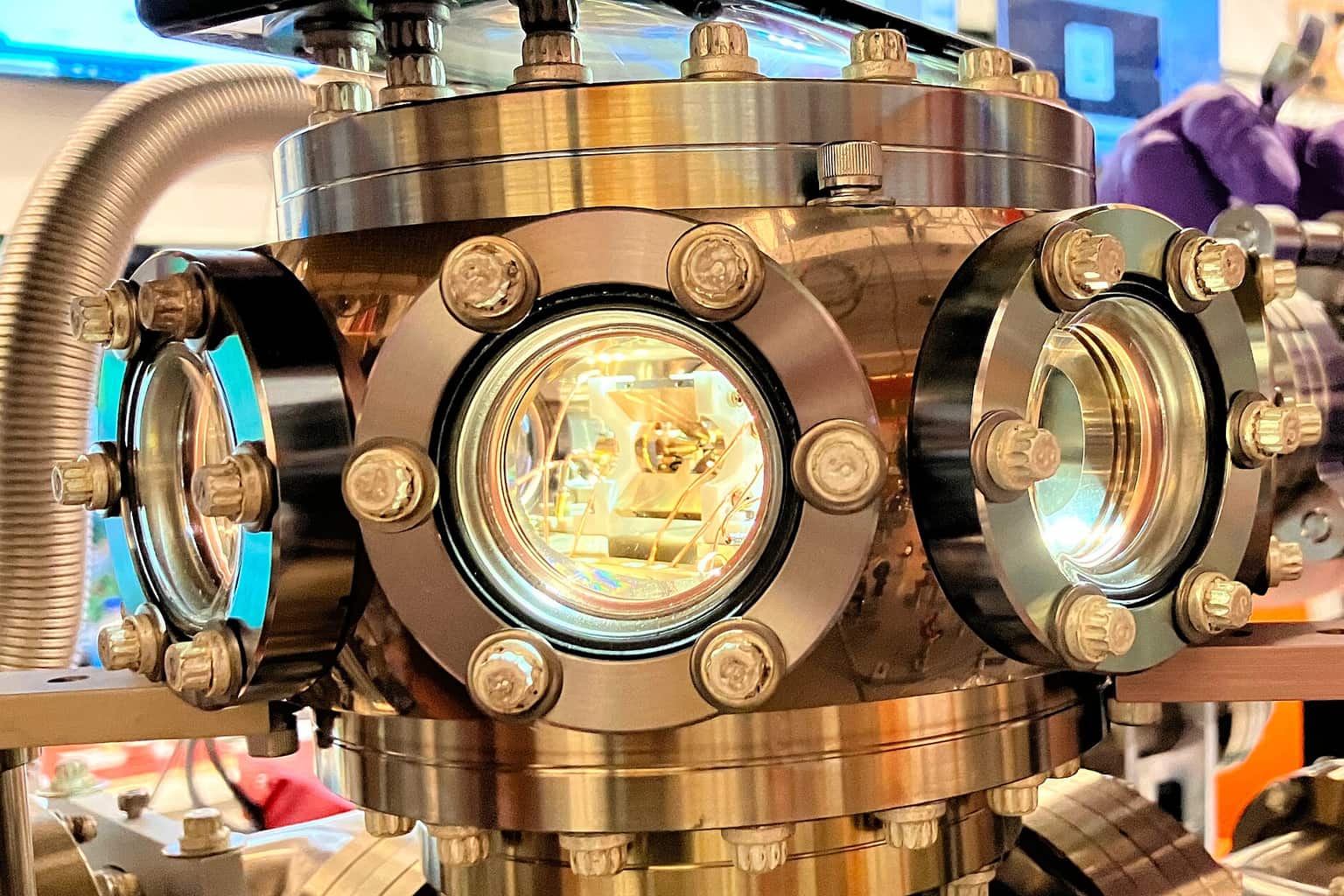
In a trap at the University of Basel, a single nitrogen molecular ion sits beside a calcium ion. A laser pulse pushes the molecule into a “forbidden” vibration, and a second pulse brings it back to its starting state. The same molecule can then go through the cycle again. The team, led by Professor Stefan Willitsch of the Department of Chemistry, reports the result in Nature Communications.
A “forbidden” transition is not impossible, only extremely unlikely. The green glow of the northern lights comes from one, and such jumps can be more than a billion times weaker than ordinary ones. That faintness is exactly what makes them valuable, because a forbidden transition can have an extraordinarily well-defined frequency. In atoms, such transitions already underpin the most precise clocks. In molecules, whose energy levels are far more complex, they had been very hard to find and control. In 2014, Willitsch's group was the first to observe forbidden vibrations in a molecular ion, but the chemical detection it used destroyed the sample in every measurement cycle.
The workaround is a method called quantum-logic spectroscopy. The nitrogen molecule emits no light that the researchers can readily detect, so a calcium ion serves as a messenger. The pair is set in motion by a carefully tuned laser only if the molecule is in its lowest vibrational and rotational state, and the calcium ion's response reveals that state without changing it. To find the light frequencies that excite the forbidden vibrations, the team scanned the frequency of a second laser. “Using the same molecule again and again was crucial,” says Dr. Aleksandr Shlykov, co-first author of the study. “It made the search for such faint lines feasible.” Combining measurements on several hundred individually prepared molecules, the team identified the components of the transition and determined the molecule's fundamental vibrational frequency 10 times more precisely than previous measurements.
The work has a visible history. The team posted a preprint on arXiv dated 12 March 2026, describing the search, observation and coherent manipulation of electric-quadrupole rotational-vibrational transitions in single trapped molecules. The journal version appeared at the end of October. The tenfold gain is repeated by outlets relaying the announcement.
For now, the payoff is a promise rather than a device. Several of the transitions studied are predicted to be remarkably insensitive to external disturbances, which would make them precise references for measuring time and candidates for future molecular clocks and qubits. The same measurements could also let physicists test whether the masses of protons and electrons stay constant over time. No calendar is given for either. What the Basel team has shown is narrower and already concrete: one molecule, measured again and again, without being lost.
Sources — read the originals(Paris time)
Pages consulted while writing
Read next
Comments
Loading the thread…
Sign in to leave a comment. Sign in