Invisible infrared makes green images that stay sharp, in lab tests
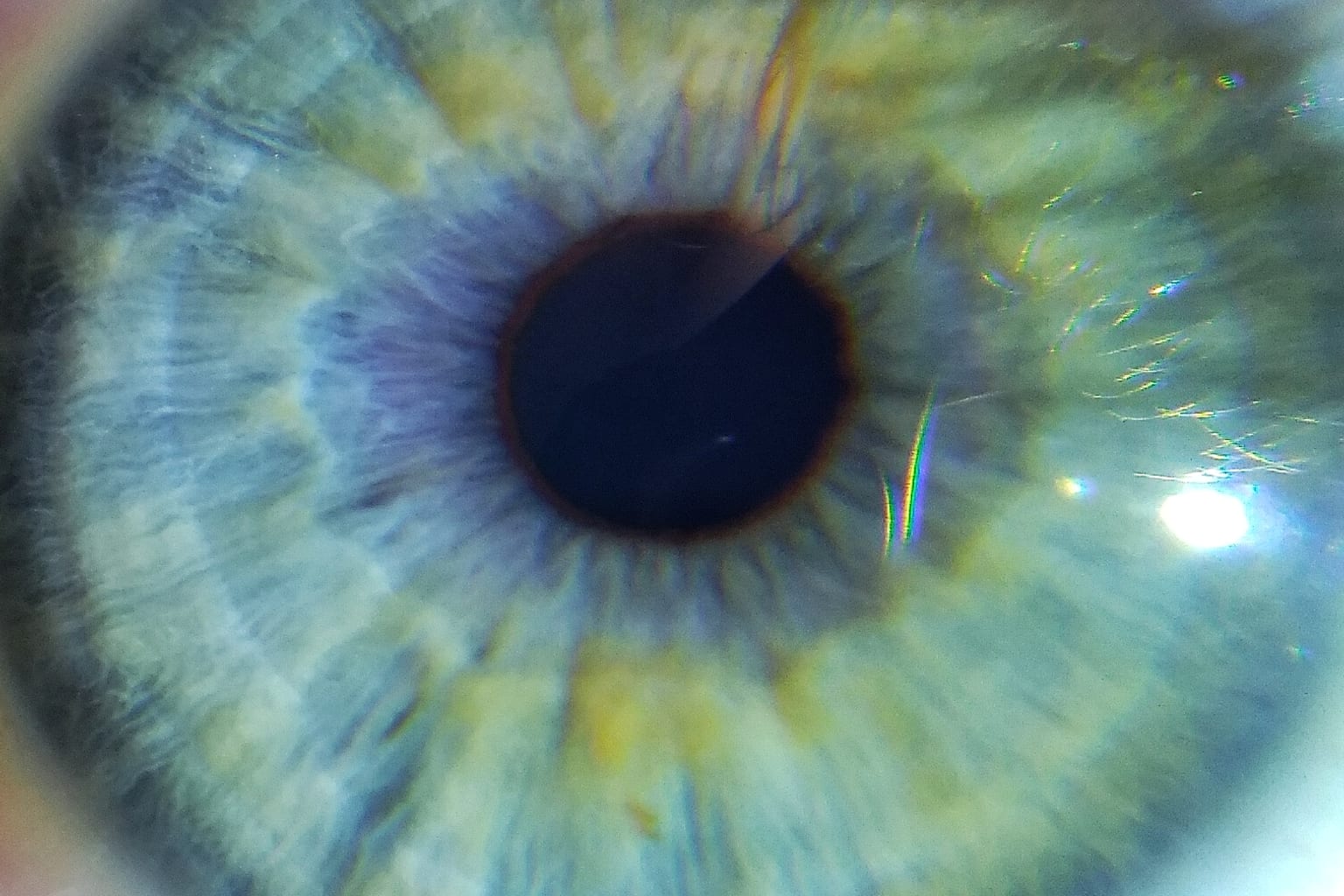
Look at a green letter E and the eye sees it sharp only as long as the lens does its job. In a study published in Optics Letters, researchers at the International Centre for Translational Eye Research (ICTER), based at the Institute of Physical Chemistry of the Polish Academy of Sciences, showed that a green E drawn with invisible infrared light keeps its edges far better when the eye is not perfectly focused on it.
A healthy eye changes the shape of its lens to match the distance of what it looks at, a process called accommodation. Head-mounted displays such as VR and AR headsets can break that link: a virtual object may appear at one distance while the optics require the eye to focus on another. The eye then has to work against the display, and the image blurs.
The ICTER team works on two-photon vision. Near-infrared pulses normally pass unseen, but when two photons are absorbed almost at the same moment, their combined energy corresponds roughly to that of a single photon at half the wavelength. Infrared light at about 1040 nm therefore produces a sensation close to 520 nm green. The stimulus was drawn by a scanning laser that moved across the retina fast enough to form a letter 12.5 arcminutes high, refreshed 50 times per second. The 12 participants, eight men and four women aged 25 to 47, all had good vision, and their dominant eye was tested alone. The researchers matched the perceived brightness of the two letters for each person, then added negative defocus in steps of 0.5 diopters, a unit of optical power, until a slight but persistent blur appeared.
For the non-presbyopic group, the infrared letter held its sharpness until 6.6 ± 0.7 diopters of defocus, against 4.3 ± 0.7 diopters for visible light. Thresholds were lower in participants with presbyopia, the age-related loss of near focus, at 2.7 ± 0.4 against 1.9 ± 0.3 diopters, but the advantage remained. In both groups, the range over which the infrared image stayed sharp was more than 1.4 times as wide. The effect was seen in all 12 participants, though its size varied.
For wearers of VR and AR headsets, the practical reading is a wider margin before the image looks soft when the eye and the display disagree. Nothing in the study, however, sets a date for such a display, and the team gives no timeline. The measurements come from a small group of healthy adults, in a laboratory, and describe perception rather than a product. What the work establishes is that an image built on two-photon vision tolerates focus errors that blur the conventional one.
Comments
Loading the thread…
Sign in to leave a comment. Sign in