KAIST maps barium titanate's light response from UV to far-infrared
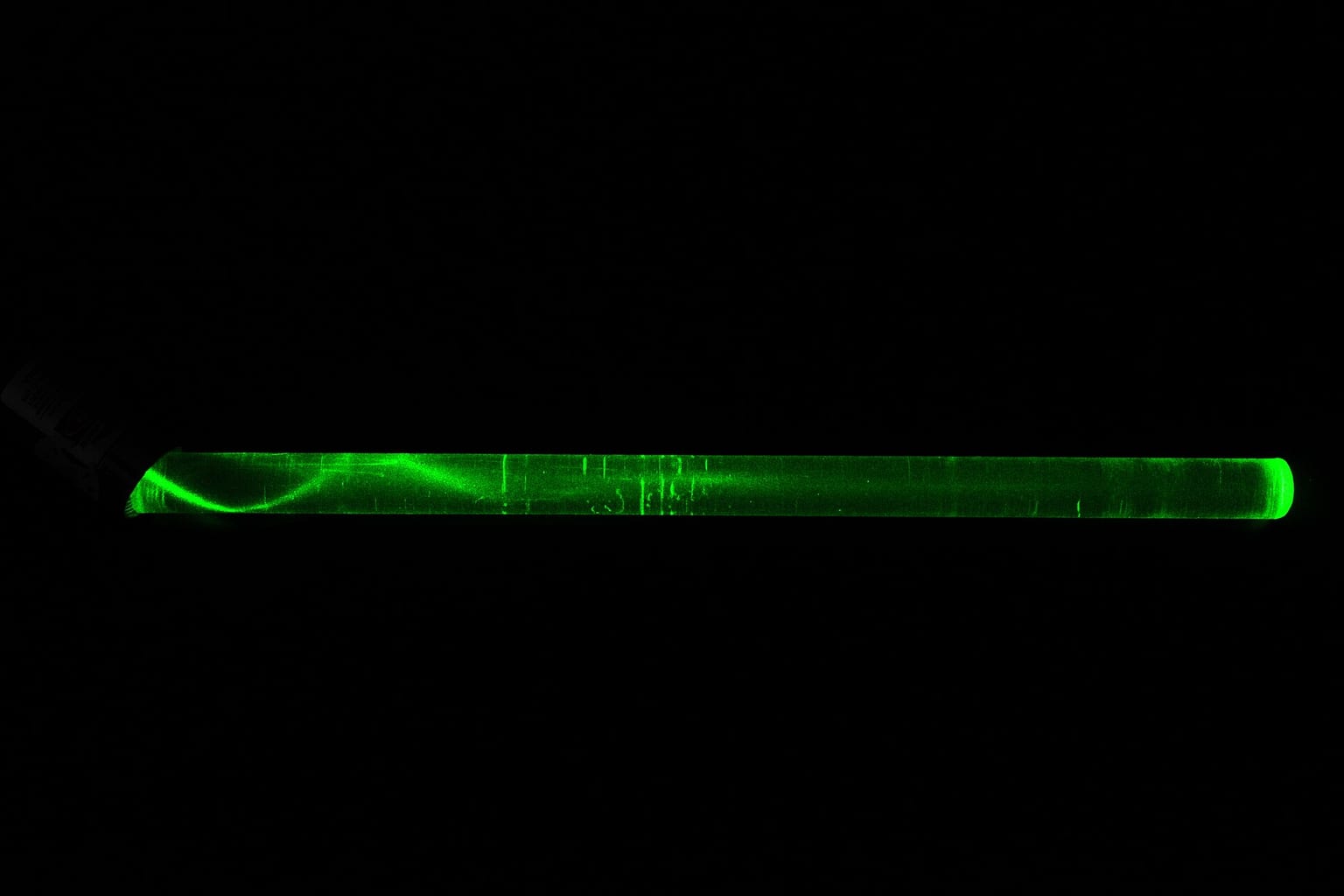
A KAIST-led team has pinned down how light travels through and is absorbed by barium titanate, from 190 nanometers in the ultraviolet to 40 micrometers in the far-infrared. Until now, the figures in circulation disagreed widely. A metrology company's page, for instance, gives a single refractive index, 2.41115, but only at one wavelength, 632.8 nm. The work, led by professor Min Seok Jang of the School of Electrical Engineering, appears in ACS Photonics, with colleagues at Caltech, the Korea Research Institute of Standards and Science and J.A. Woollam Co.
The obstacle is the crystal itself. BTO contains small regions called domains, each with its own crystal orientation, and these regions respond differently to light. Measured together, their responses blend, so the signal no longer shows the material alone. To separate them, the team used Mueller-matrix spectroscopic ellipsometry, a technique that measures how the polarization of light changes when it is reflected from or transmitted through a material. It applied this to two types of single-crystal samples whose domains are relatively uniformly oriented.
The researchers split the spectrum into three regions and used an analytical approach suited to each one, which gave how the refractive index and absorption vary with wavelength and crystal orientation. Where BTO is nearly transparent, between 2 and 10 μm, they combined ellipsometry with separate transmittance measurements, which measure how much light passes through, and reached extinction coefficients as low as approximately 10⁻⁵. The team also presents a method to calculate the overall optical response of a multidomain crystal from the orientation and relative proportion of its domains.
For a designer, the gain is practical. The data let them predict, before fabrication, how light will propagate and how much will be absorbed in devices of different sizes and shapes, which could cut the time and cost of repeated builds and redesigns. The team names three possible uses: optical modulators for communications, devices that generate light at new wavelengths, and circuits that process quantum information with light. The study gives no timetable for any of them.
The values come from the team's own measurements on two kinds of samples, and the applications it names are still potential ones. Jang presents the results as a reliable reference for how the material interacts with light. He expects them to support optical communication devices that reduce light loss and enable faster data transmission, and quantum photonic devices that need precise control of light.
Sources — read the originals(Paris time)
Pages consulted while writing
Read next
Comments
Loading the thread…
Sign in to leave a comment. Sign in