Lab test: hand outlines show VR roughness, sorting about 23% faster
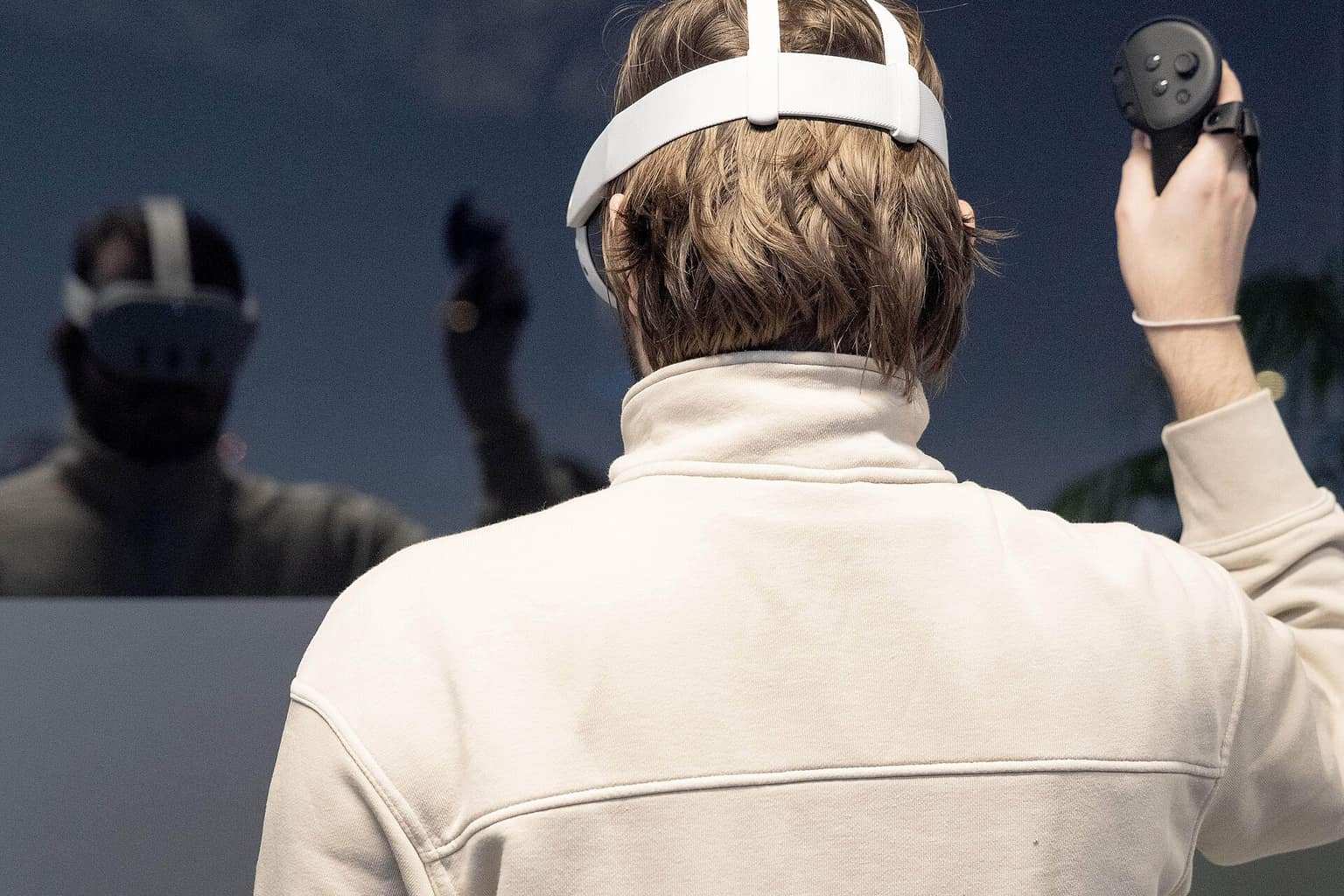
Put on a headset and pick up a virtual object, and your fingers feel nothing. Your partner, wearing a device that sends vibrations to the fingertips, feels the difference at once. For two people sorting objects together in virtual reality, that gap is a real obstacle. At KAIST, the Korea Advanced Institute of Science and Technology, a team has found a way to let the person without the device perceive roughness anyway: the outline of the virtual hand changes.
The method does not try to reproduce the sensation on the skin. The researchers modify the shape and movement of the hand's outline to represent three levels of roughness: low, medium and high. In two preliminary experiments, users could distinguish these visual cues, and the cues were consistent with the roughness felt through haptic feedback. The visual signal is thus a stand-in for touch, read by the eye instead of the fingertip.
The main test involved 48 participants, organized into 24 pairs, with one person using a haptic device and the other working without one. Each pair sorted virtual objects by roughness. When the cues were displayed on both participants' hands, the pairs finished the task about 23% faster than without any visual roughness cues, while keeping high sorting accuracy. Participants without a device also reported more confidence in their judgments, and a stronger sense of contribution when the cues appeared on their own hand. The team found that collaboration depended not only on how roughness was shown, but also on whose hand displayed it.
What changes, and for whom? Designers of VR education and training programs, and of remote collaboration tools where participants use different equipment, gain a way to share a tactile property without giving everyone the same hardware. The limits are clear. The tests were run in a lab, on a single sorting task, with three levels of roughness and 24 pairs. The work is published as a preprint on arXiv, and the team has not announced a timeline or a product for practical use.
The lab's record in XR research is growing. The team had already received the Best Paper Award at ISMAR in 2024, for work on mixed reality remote collaboration, and two Best Paper Awards in 2025. This year's award adds one more result showing that a visual cue can carry information that once required a specialized device.
Sources — read the originals(Paris time)
Read next
Comments
Loading the thread…
Sign in to leave a comment. Sign in