Laser method pulls over 95% of silver from old solar panels
Solar panels are built to survive decades outdoors, and that durability is what makes them hard to recycle. Their silver sits under a polymer called EVA that seals the cells for up to two decades and beyond. Breaking that seal has meant heating it to 450 to 600°C or soaking it in toxic chemicals. A team at the University of Glasgow has found a way to open it with a laser, and to recover almost all of the silver with a fraction of the energy.
The method uses a 1064 nm fibre laser, the kind already used on production lines to mark and cut metal. Its light passes almost straight through the transparent EVA and is absorbed by the silicon beneath, heating the interface between the two. Above a power threshold, the plastic comes away from the cell as one intact film. “By using a laser, we can quickly release the encapsulant in one piece rather than burning or dissolving it,” says Dr Joseph Cameron of the James Watt School of Engineering, who led much of the work.
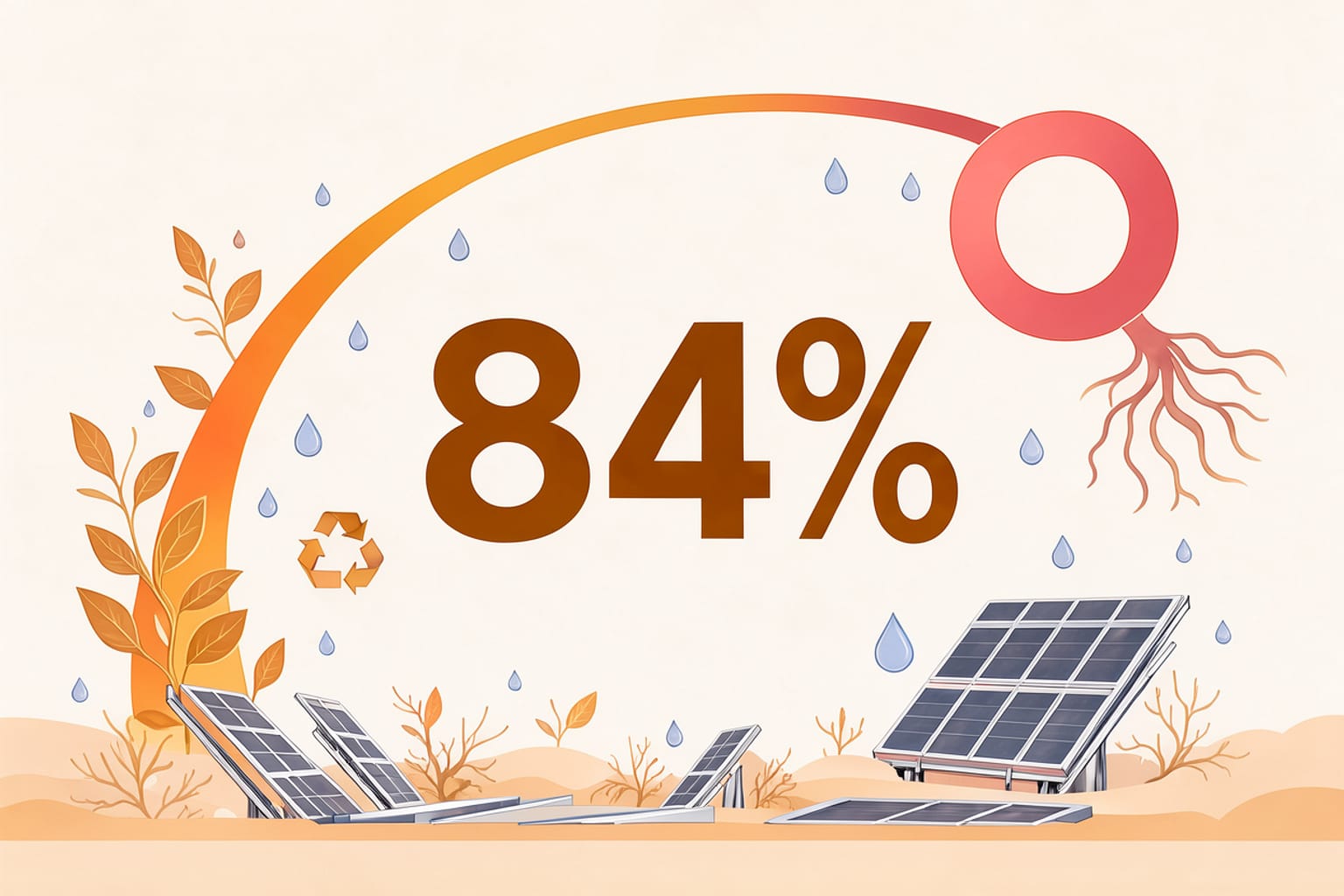
What remains is a powder of silicon, aluminium and silver, with the metal busbars separated off. Dilute sodium hydroxide removes the aluminium, then an iron chloride and choline chloride brine dissolves the silver, avoiding the hazardous nitric acid used in conventional silver leaching. On two types of modules aged about 10 to 13 years, the silver was recovered with over 95% selectivity, and with over 99% in one case. Silver made up 1.08% to 1.38% of the powder’s mass. Small metal residues stayed in the EVA, particularly near the busbar contacts. The researchers estimate the process cuts the power used in recycling by 84%.
The stakes rise with every panel installed. Global solar capacity has reached 3 terawatts, and more than a million metric tons of panel waste are expected by 2030, rising above 200 million by 2050. The metals inside make up only 0.05% of a panel’s weight, yet they represent two-thirds of its scrap value. The silver figures come from the team’s own paper, published in Communications Materials, and trade press such as pv magazine relays them. The authors say the extraction is, to the best of their knowledge, the most selective reported for aged panels. A separate laboratory study by the Netherlands Organisation for Applied Scientific Research reported 97% silver yields at 99.7% purity on retired modules from China, a different measure that cannot be compared directly.
For recycling centres, the gain is cleaner material: the plastic comes off in one piece, the silver is pulled out with mild chemistry, and the silicon is left ready for recovery. For laser makers, it could open a market. Declan Brannagan of Watt Laser says the technique could form the basis of new laser equipment for the recycling sector, built on industrial fibre lasers already used on factory floors. He expects scale-up from a single laser head to multi-head systems that can handle full panels at commercial rates to take less than a year, but says it needs an industrial end player to firm up throughput. No price or launch date has been announced. The next step is to refine the technique with Watt Laser, within the EU APOLLO project and with REACT, the Responsible Electronics and Circular Technologies Center led by the University of Glasgow, toward commercial equipment.
Sources — read the originals(Paris time)
Pages consulted while writing
Read next
Comments
Loading the thread…
Sign in to leave a comment. Sign in