Mantis shrimp pigments can switch on red light, in the lab
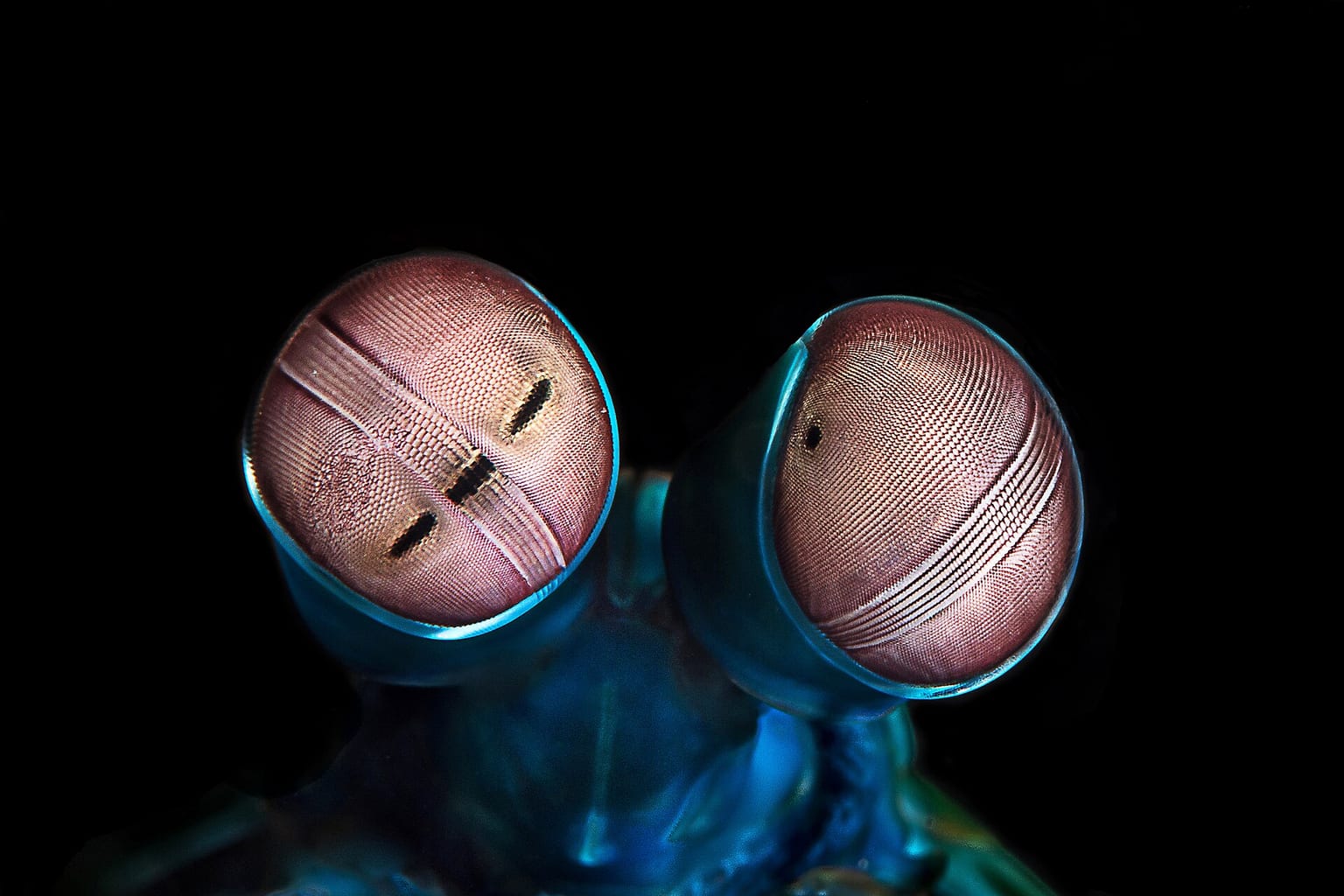
Inside the eye of a mantis shrimp, about 30 visual pigments work together, against three in humans. For decades, ecologists and biologists have asked why this crustacean needs so many. A team from the University of Liège (ULiège) and Humboldt University in Berlin has now taken them apart one by one, and found that some respond to red light, a part of the spectrum very few animals can perceive. The results are published in Science Advances.
Vision starts with opsins, proteins that capture light. Combined with retinal, a small molecule derived from vitamin A, they form the visual pigments of the retina. In humans, a pigment that absorbs a photon loses its retinal and must regenerate before it works again, which is why a bright lamp leaves spots in our field of vision for a while. Four of the mantis shrimp pigments are different. They are bistable: a second photon restores the retinal, so the pigment can switch between two stable states with light alone. Two are activated by red light and deactivated by blue light. The other two work the other way around, activated by blue and deactivated by orange.
Measuring them was the hard part. Marjorie Liénard, a researcher at GIGA–ULiège, developed an in vitro expression platform that produces these proteins outside the animal. The team combined it with the electrophysiology expertise of Peter Hegemann's laboratory at Humboldt University. Of the 17 opsins in the median band, 12 are standard green pigments, similar to ours, three are infrared, and two are blue-orange bistable. "This is the first time such pigments have been described in an animal while using the same chromophore as humans," Liénard explains. Combined with the coloured filters in the eye, sensitivity reaches 687 nanometres.
The team suggests the shrimp changes its pigment mix with the light around it. Liénard compares it to sunglasses by day and a torch at dusk: in bright light, the ultraviolet, blue and green pigments saturate, and the red opsins keep working, while at dawn and dusk the animal relies on its green opsins and its blue bistable ones. How it uses this to find prey, avoid predators or defend its territory is not yet confirmed, and would need behavioural experiments, which are hard to run with these robust predators.
The most concrete prospect is optogenetics, a technique that controls cell activity with light. Unlike the channelrhodopsins of the alga Chlamydomonas reinhardtii, these opsins belong to the G-protein-coupled receptors, which trigger signalling cascades inside cells. That family is involved in cardiovascular, neurological and inflammatory diseases. Red light penetrates tissue more deeply and harms cells less than blue or ultraviolet light, so a switch that red turns on and blue turns off could, in principle, modulate those pathways precisely and reversibly. None of this has been developed yet. The team now wants to make the signalling more selective, look for similar proteins in closely related species, and understand what makes some of them bistable. It gives no date. "Nature still harbours many innovations," Liénard says, "which can only be uncovered through" this kind of approach.
Comments
Loading the thread…
Sign in to leave a comment. Sign in