Prototype optical transmitter runs without isolator at 180 Gbit/s
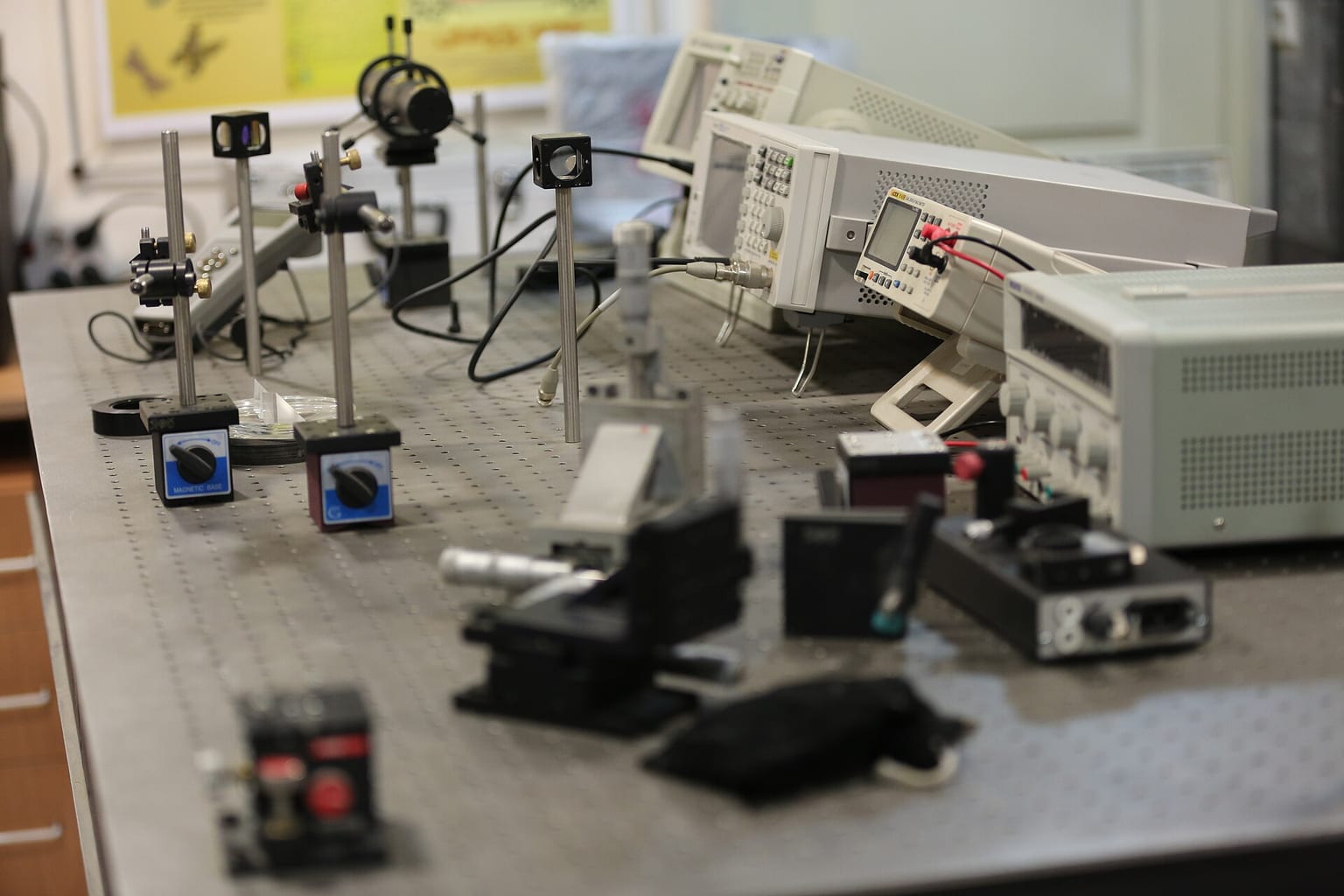
Every high-speed link between two data centers starts with a laser beam, and that beam has to stay steady while it carries data. A team at Waseda University in Japan, led by professor Tomohiro Kita, has built an optical transmitter that keeps its laser stable without an optical isolator, the component usually used to block light travelling backward, and it carries data at 180 Gbit/s.
The obstacle comes from integration. The laser and the modulator, which encodes data onto the light at high speed, are built on different platforms, and reflections from the modulator can travel back into the laser, destabilizing it and disrupting the data. Conventional systems solve this with an isolator. The Waseda design instead works on the feedback itself. Two silicon nitride ring resonators form a Vernier filter that selects the laser's wavelength, while a thin-film lithium niobate modulator carrying an asymmetric Mach-Zehnder interferometer has a wavelength-dependent response. The team designed these two responses together, so that the light returning to the laser is shaped and its destabilizing effects are mitigated, which the authors call cross-platform spectral co-design.
The transmitter operates across a range of about 67 nm and keeps a stable single-mode laser output even without active temperature control. The 180 Gbit/s test is the highest data rate investigated in the experiment, and the optical signals remained distinguishable at that speed. These are results from the team's own experiments, published on October 7, 2026 in the Journal of Lightwave Technology.
For network operators, the gain is a simpler transmitter that could be smaller, making it easier to combine different photonic technologies in a compact device. The authors point to high-capacity links between data centers, including AI data centers, and to wavelength-division multiplexing, which sends several data channels at different wavelengths through a single optical fiber. The researchers do not give a timeline for commercial use.
Sources — read the originals(Paris time)
Read next
Comments
Loading the thread…
Sign in to leave a comment. Sign in