Robot world models predict arm motion well, but not objects
A robot reaches for a piece of fruit and closes its gripper, but the grasp misses. The world model, an AI that generates a video of what the robot will do from a starting image and a sequence of actions, shows the fruit lifted and carried away. The success it depicts never happened. That gap is what WorldOracle, a new benchmark from Princeton University, the University of Texas at Austin, the University of Toronto, NVIDIA and AgiBot, is built to measure. It compares each predicted video with the real recording of the same actions, starting from the same first image.
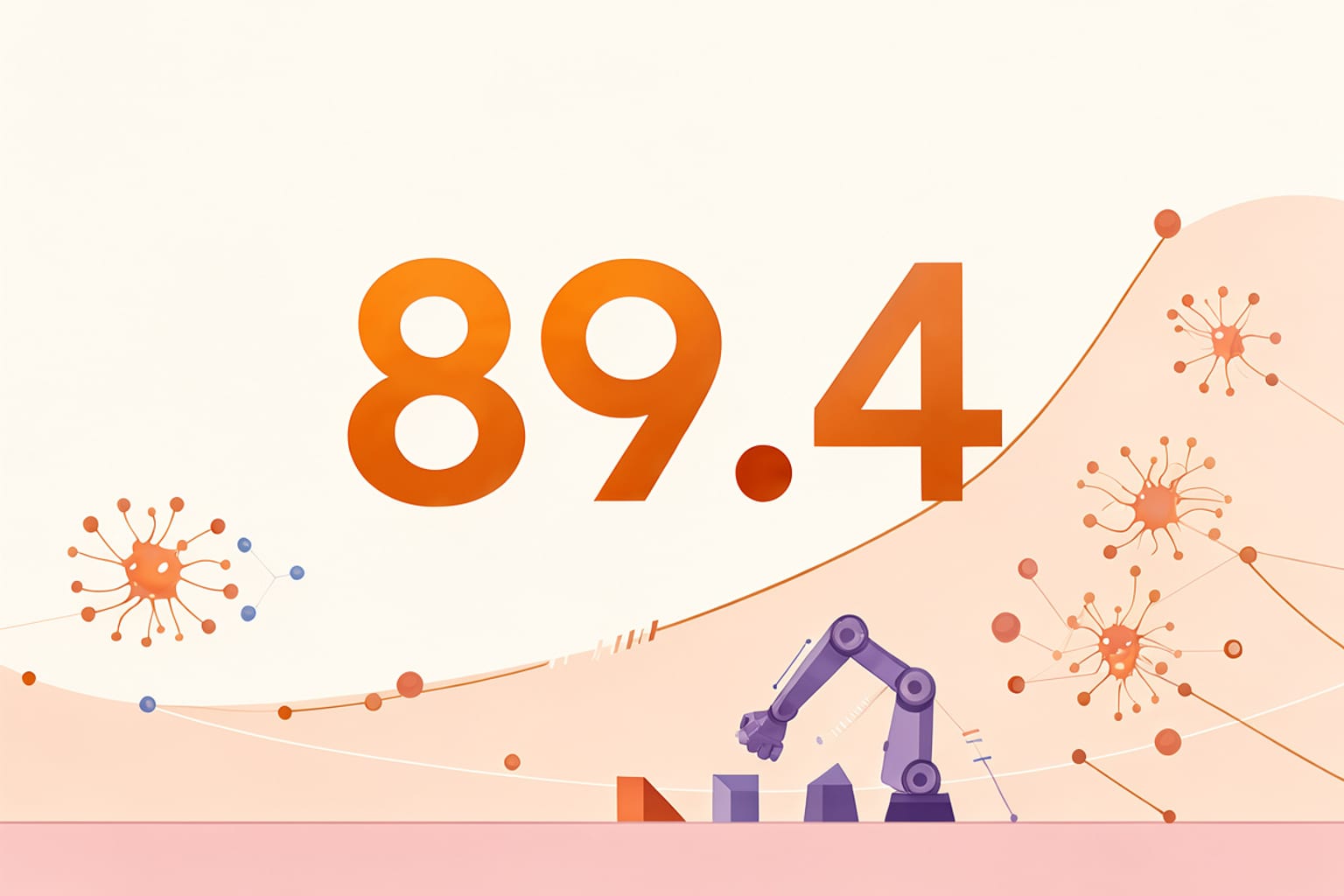
The team evaluated seven representative models and found that arm motion is predicted relatively well. IRASim scored 78.8 on the arm but only 29.1 on the object, and Cosmos 3 reached 89.4 on the arm against 45.4 on the object. The arm follows the commands; the fruit does not always follow the arm. For all five models tested on the human-operated AgiBot G2 data, the object scored lower than the arm.
Time is the second weakness. Real tasks chain grasps, placements and adjustments, so each error becomes the starting point of the next step. On the same AgiBot G2 teleoperation data, scores fell across all five models over the full sequence. DreamDojo dropped from 50.56 to 27.08, and Cosmos 3 from 53.99 to 26.60. GE-Sim 2.0 held up best, falling from 73.86 to 63.33 and posting the highest score at both horizons.
Failures count too. WorldOracle covers two robot bodies, AgiBot G2 and YAM, along with first-person videos of human hands, and four tasks: fruit picking, towel hanging, water pouring and drawer pulling. These involve rigid, deformable, fluid and articulated objects. When an operation fails in reality, a model that predicts the failure earns a high score, so the benchmark penalizes models that simply default to success.
For developers building robot models, the change is practical. The platform has been open since October 16: they download the initial frames and action sequences from the evaluation set, submit their generated videos, and receive a score for each one. The team presents this as a way to pinpoint weaknesses and check whether a change really helped. Object tracking over long sequences is now a measured target rather than an impression.
Sources — read the originals(Paris time)
Read next
Comments
Loading the thread…
Sign in to leave a comment. Sign in