Self-taught AI picks particle sprays out of noise
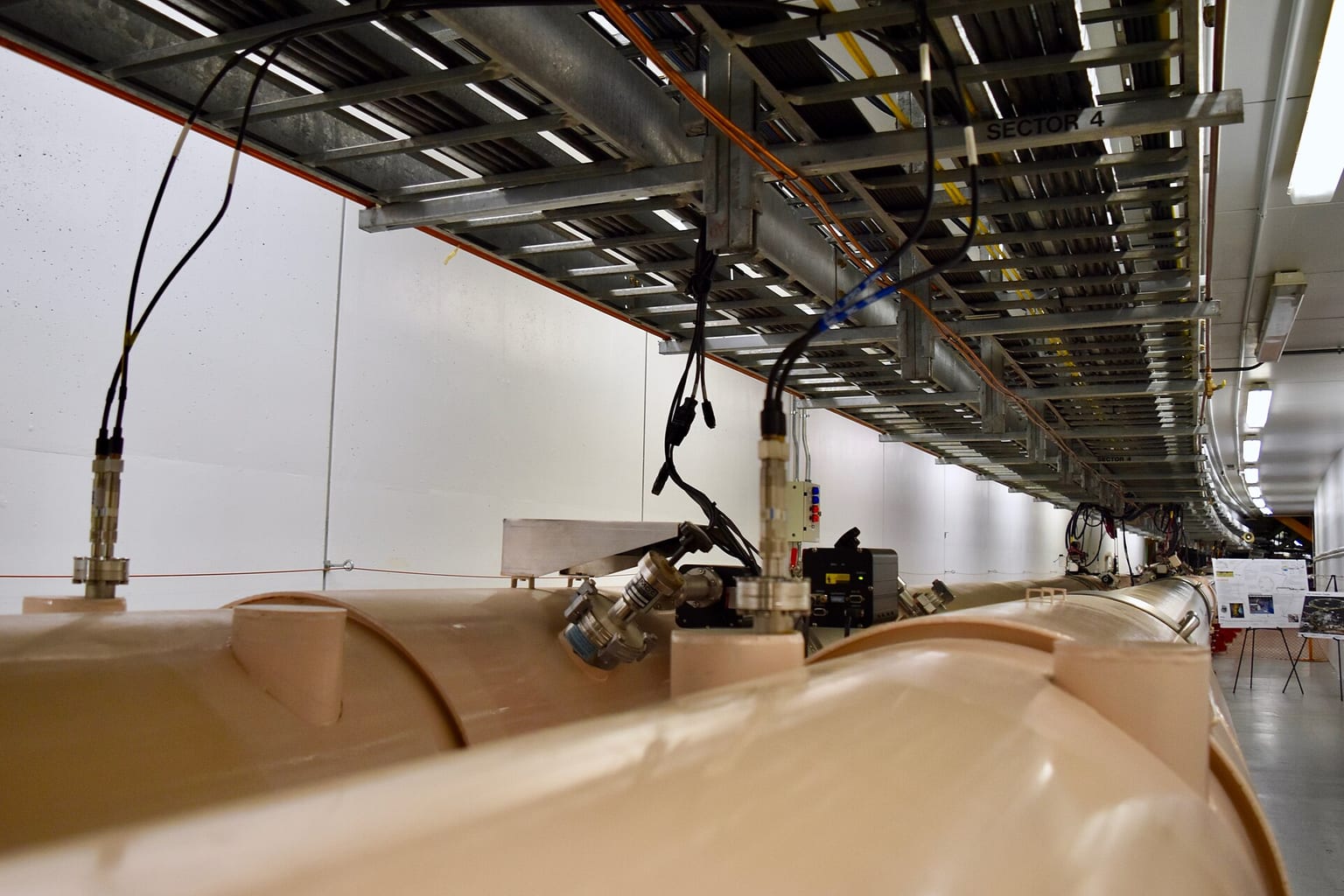
Two beams of heavy ions, travelling close to the speed of light, slam into each other, and the detector records a crowded picture. The signal physicists want is a jet: a narrow spray of high-energy particles, buried inside a dense haze of other particles from the same collision. A team led by researchers at the U.S. Department of Energy's Brookhaven National Laboratory has built a generative AI that learns to pull the two apart on its own. In simulated data from the sPHENIX detector, it rebuilt jets' positions, energies and internal structure more accurately than conventional background-subtraction methods.
Jets matter because they are among the best tools for studying the quark-gluon plasma, or QGP: a hot, dense soup of free quarks and gluons that existed a microsecond after the Big Bang. The Relativistic Heavy Ion Collider (RHIC) at Brookhaven recreates those conditions. As a jet streams through the plasma, its particles lose energy and change internal structure, and those changes reveal the plasma's properties. Reading them requires separating the jet from the background, which, as the team puts it, has long limited the precision of jet measurements. The usual way to train a model for this is laborious: people label examples one by one, the way one would sort thousands of photos into cats and dogs.
The new model is unsupervised and unpaired. It is fed two separate sets, simulated background from the plasma and ideal jet simulations without background, with no matching pairs linking them. "What our algorithm does is look at a collection of pure background data and at our ideal jet simulations, and then automatically figure out how to extract the underlying jet signal," said computer scientist Dmitrii Torbunov. The test used simulated data captured by the calorimeters of sPHENIX, a detector that ran during RHIC's final three runs. The team, which includes researchers from Columbia University and the University of Colorado Boulder, describes the work as the first use of an "unpaired, unsupervised" model trained on physics data rather than on labels supplied by scientists. Earlier approaches to this problem, according to a 2025 conference talk by the team, mainly relied on supervised regression techniques.
For physicists, the payoff is precision. Better background subtraction, says Yeonju Go, a Brookhaven physicist and Stony Brook University assistant professor working on RHIC data, could enable more precise measurements of how quarks and gluons interact under extreme conditions. The benefit matters most where labels are impossible to produce: real experiments have no answer key saying which part of each signal comes from the jet. The team has not announced a timeline for applying the method to real sPHENIX data.
For now, the proof is in simulated collisions. Torbunov notes that, in data this crowded, working out by hand how much of each data point comes from background and how much from the jet may be "difficult, or even impossible." In simulation, the model learns that split without being told what either side looks like.
Sources — read the originals(Paris time)
Pages consulted while writing
Read next
Comments
Loading the thread…
Sign in to leave a comment. Sign in